Full Body Harness Inspection Form - Ardent Shared - ardentshared 2026

Get Form
harness inspection form Preview on Page 1

Here's how it works

01. Edit your harness inspection form online
Type text, add images, blackout confidential details, add comments, highlights and more.

02. Sign it in a few clicks
Draw your signature, type it, upload its image, or use your mobile device as a signature pad.

03. Share your form with others
Send safety harness inspection via email, link, or fax. You can also download it, export it or print it out.

How to use or fill out Full Body Harness Inspection Form - Ardent Shared - ardentshared with our platform

Form edit decoration
9.5
Ease of Setup
DocHub User Ratings on G2
9.0
Ease of Use
DocHub User Ratings on G2
  1. Click ‘Get Form’ to open the Full Body Harness Inspection Form in the editor.
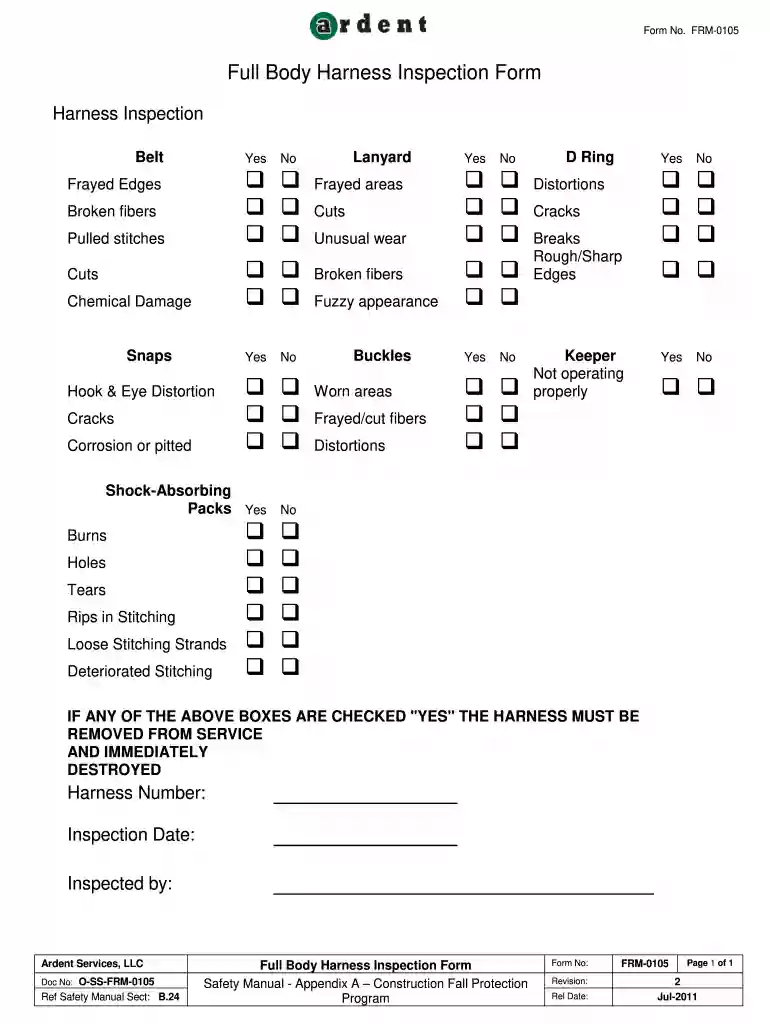
  2. Begin by entering the 'Harness Number' and 'Inspection Date' at the top of the form. This information is crucial for tracking inspections.
  3. In the 'Harness Inspection' section, carefully evaluate each component of the harness. Check 'Yes' or 'No' for items such as frayed edges, broken fibers, and chemical damage.
  4. Continue through sections for Snaps, Lanyard, Buckles, D Ring, and Shock-Absorbing Packs. Ensure you check all relevant boxes based on your inspection findings.
  5. If any boxes are checked 'Yes', note that the harness must be removed from service and destroyed immediately. This is critical for safety compliance.
  6. Finally, sign off on the form by entering your name under 'Inspected by'.

Start using our platform today to streamline your document editing and ensure safety compliance effortlessly!

See more Full Body Harness Inspection Form - Ardent Shared - ardentshared versions

We've got more versions of the Full Body Harness Inspection Form - Ardent Shared - ardentshared form. Select the right Full Body Harness Inspection Form - Ardent Shared - ardentshared version from the list and start editing it straight away!
Versions Form popularity Fillable & printable
2016 4.8 Satisfied (116 Votes)
2011 4 Satisfied (27 Votes)
be ready to get more

Complete this form in 5 minutes or less

Get form

Got questions?

We have answers to the most popular questions from our customers. If you can't find an answer to your question, please contact us.
Contact us
Formally, HSE guidelines recommend that your safety harnesses should be inspected by a professional every 6 months.
Who should inspect a safety harness? A safety harness should be inspected by the user before and after each use and by a competent person at regular intervals. A competent person is someone who has the necessary training, knowledge, and experience to properly inspect the harness for defects and signs of wear.
Here are some examples of the types of individuals who are qualified to inspect safety harnesses: Certified Inspectors. Many companies choose to employ certified professionals to conduct their safety harness and equipment inspections. In-House Safety Officers. Competent Trained Employees. Third Party Safety Consultants.
Visual Harness Inspection Examine the hardware components, such as buckles, D-rings and connectors, ensuring they are intact and functioning correctly. Inspect the stitching for any signs of loose threads or compromised integrity. Lastly, verify the presence and legibility of any safety labels or identification tags.
The wearer should inspect their equipment before each use. Keep a written record of the inspection. Replace defective equipment. If there is any doubt about the safety of the equipment, do not use it and ask your supervisor for help.

People also ask

Who should inspect a safety harness? A safety harness should be inspected by the user before and after each use and by a competent person at regular intervals. A competent person is someone who has the necessary training, knowledge, and experience to properly inspect the harness for defects and signs of wear. 3.
NFPA 70E One who has demonstrated skills and knowledge related to the construction and operation of electrical equipment and installations, and has received safety training to identify and avoid the hazards involved.

Related links