




01. Edit your 1099 a form 2016 online
Type text, add images, blackout confidential details, add comments, highlights and more.

Type text, add images, blackout confidential details, add comments, highlights and more.

Draw your signature, type it, upload its image, or use your mobile device as a signature pad.

Send 1099a form to buy a car via email, link, or fax. You can also download it, export it or print it out.
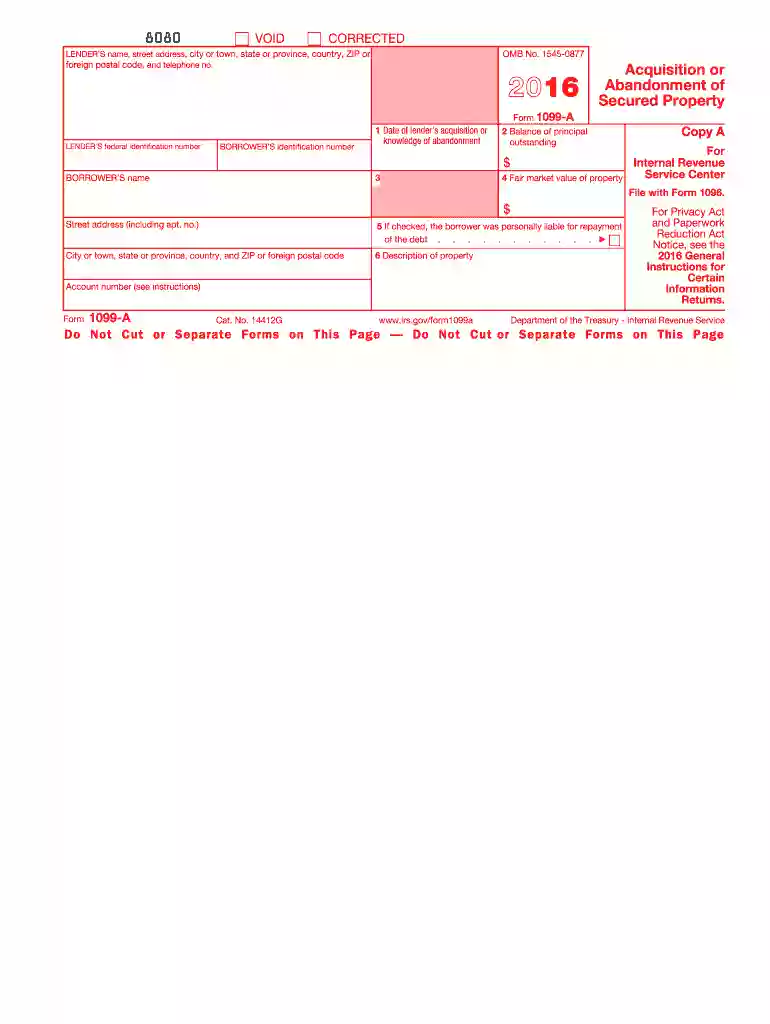
Form 1099-A, titled "Acquisition or Abandonment of Secured Property," is used by lenders to report borrowers who have had their property acquired by the lender or have abandoned the property securing a loan. This form is crucial in detailing the transaction details related to the foreclosure or abandonment of property. It helps both lenders and borrowers understand the tax implications resulting from these events. The form is a necessity in cases where a loan is secured by property that the borrower no longer possesses.
Filling out a 1099-A form involves entering specific information about the lender, borrower, and the property in question. Lenders must complete the form when acquiring property through foreclosure or when a borrower abandons secured property. In Box 1, lenders provide the date of the acquisition or the date the borrower abandoned the property. Box 2 requires the balance of the principal outstanding. Box 3 specifies the property's fair market value on the acquisition date or upon abandonment. Box 5 establishes whether the borrower was personally liable for repaying the debt. This information is essential for borrower records and IRS filings.
Both lenders and borrowers have interests in the 1099-A form. Lenders use it to report the foreclosure or abandonment of property. Borrowers refer to this form to determine their financial responsibilities and tax obligations following the loss of property. Real estate professionals and financial advisors might also involve themselves in the process to assist clients with tax planning and compliance tied to these events. Additionally, the IRS utilizes this data to monitor the transactions and verify tax liabilities.
The use of Form 1099-A is defined by IRS regulations. Lenders are legally required to use it to report property acquisitions or abandonments to both the borrower and the IRS. For borrowers, understanding this form is essential to accurately report income and any potential capital gains resulting from a foreclosure or an abandoned property. Legal compliance ensures transparency and accountability in financial transactions involving secured properties.
The form consists of several key elements necessary for compliance:
These elements are crucial in ensuring all parties have the necessary information to fulfill their tax obligations and document the transaction appropriately.
The IRS provides comprehensive guidelines to ensure that Form 1099-A is used appropriately. The form must be filed by lenders by February 28 if submitted by mail, or March 31 if filed electronically following the tax year in which the property was acquired or abandoned. Failure to comply with these deadlines or submit accurate information can result in penalties. Lenders must issue this form to borrowers by January 31. This ensures borrowers have vital information in time for tax planning and filings.
We've got more versions of the 1099 a form 2016 form. Select the right 1099 a form 2016 version from the list and start editing it straight away!
| Versions | Form popularity | Fillable & printable |
|---|---|---|
| 2022 | 4.5 Satisfied (31 Votes) | |
| 2021 | 4.7 Satisfied (87 Votes) | |
| 2020 | 4.1 Satisfied (64 Votes) | |
| 2019 | 4.4 Satisfied (101 Votes) | |
| 2018 | 4.2 Satisfied (98 Votes) | |
| 2017 | 4.4 Satisfied (745 Votes) | |
| 2016 | 4.4 Satisfied (574 Votes) | |
| 2015 | 4.4 Satisfied (46 Votes) | |
| 2014 | 4 Satisfied (33 Votes) | |
| 2013 | 4.2 Satisfied (36 Votes) | |
| 2012 | 4.2 Satisfied (69 Votes) | |
| 2011 | 4 Satisfied (50 Votes) | |
| 2010 | 4 Satisfied (54 Votes) | |
| 2008 | 4 Satisfied (35 Votes) | |
| 2007 | 3.9 Satisfied (52 Votes) |
At DocHub, your data security is our priority. We follow HIPAA, SOC2, GDPR, and other standards, so you can work on your documents with confidence.
Candidates will be required to bring and wear a mask during the entirety of their time at the test center. Either a medical mask or cloth face covering is
Internal Revenue Service. Reproducible copies of federal tax forms and instructions.Read more
To complete Form 1099-A, use: the 2016 General Instructions for Certain Information. Returns, and. the 2016 Instructions for Forms 1099-A and 1099-C. ToRead more


