




01. Edit your form online
Type text, add images, blackout confidential details, add comments, highlights and more.

Type text, add images, blackout confidential details, add comments, highlights and more.

Draw your signature, type it, upload its image, or use your mobile device as a signature pad.

Send it via email, link, or fax. You can also download it, export it or print it out.
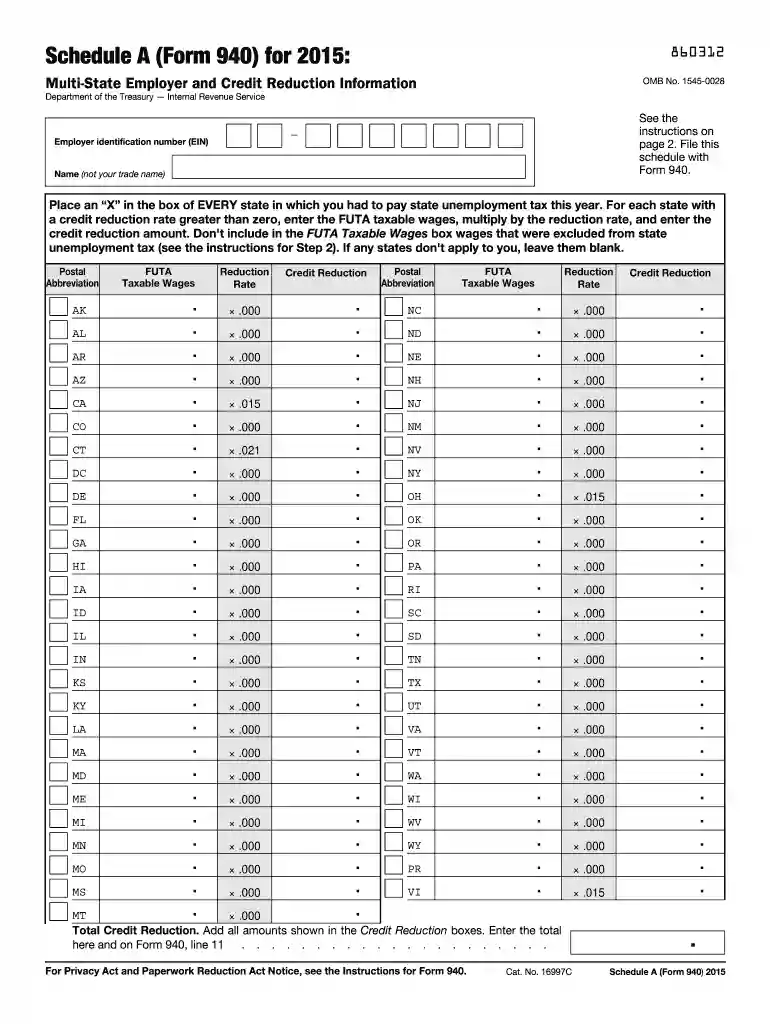
The 2015 Form 940 Schedule A is an integral part of the Employer's Annual Federal Unemployment (FUTA) Tax Return. It is specifically designed to assist employers in calculating and reporting unemployment taxes paid across multiple states. While Form 940 itself is used to report federal unemployment taxes, Schedule A provides critical details for multi-state employers who must account for varied state unemployment tax obligations, including any credit reductions that may apply.
Completing the 2015 Form 940 Schedule A involves several critical steps that must be followed meticulously to ensure accuracy and compliance.
Utilizing the 2015 Form 940 Schedule A is crucial for any business with multi-state operations, ensuring compliance with both state and federal tax laws.
Understanding and accurately filling out the key sections of Schedule A ensures its effectiveness and regulatory compliance.
The IRS provides established guidelines for completing Schedule A alongside Form 940, emphasizing accuracy and compliance.
Understanding the timelines for submitting the 2015 Form 940 Schedule A is crucial to maintaining compliance and avoiding late fees.
Not all employers are required to submit the 2015 Form 940 Schedule A. Understanding eligibility criteria can clarify who needs to report.


Each state has unique guidelines that affect how unemployment taxes are reported and calculated on Schedule A.
Creating a detailed, accurate, and compliant 2015 Form 940 Schedule A is essential for multi-state employers to fulfill their unemployment tax obligations efficiently. With this guide, businesses are better equipped to meet the IRS and state-specific requirements smoothly.
We've got more versions of the 2015 form 940 schedule a form. Select the right 2015 form 940 schedule a version from the list and start editing it straight away!
| Versions | Form popularity | Fillable & printable |
|---|---|---|
| 2025 | 4.4 Satisfied (56 Votes) | |
| 2024 | 4.4 Satisfied (49 Votes) | |
| 2023 | 2.9 Satisfied (88 Votes) | |
| 2022 | 4.4 Satisfied (43 Votes) | |
| 2021 | 4.8 Satisfied (160 Votes) | |
| 2020 | 3.9 Satisfied (49 Votes) | |
| 2019 | 4.3 Satisfied (134 Votes) | |
| 2018 | 4 Satisfied (65 Votes) | |
| 2017 | 4.4 Satisfied (137 Votes) | |
| 2016 | 4.4 Satisfied (90 Votes) | |
| 2015 | 4 Satisfied (22 Votes) | |
| 2014 | 4 Satisfied (35 Votes) | |
| 2014 | 4.9 Satisfied (44 Votes) | |
| 2013 | 4 Satisfied (28 Votes) | |
| 2011 | 4.4 Satisfied (45 Votes) |
At DocHub, your data security is our priority. We follow HIPAA, SOC2, GDPR, and other standards, so you can work on your documents with confidence.
Agents must complete. Schedule R (Form 940), Allocation Schedule for Aggre- gate Form 940 Alers, when filing an aggregate Form 940,. Employers Annual FederalRead more
May 2, 2017 Be sure that the payers name and EIN on Forms W-2 and. W-3 are the same as those used on the Form 941,. Employers QUARTERLY Federal Tax ReturnRead more
Because you paid wages in a state that is subject to credit reduction, you must complete Schedule A and file it with Form. 940. Total payments to all employeesRead more


