




Personal financial statement template 2026

Get Form
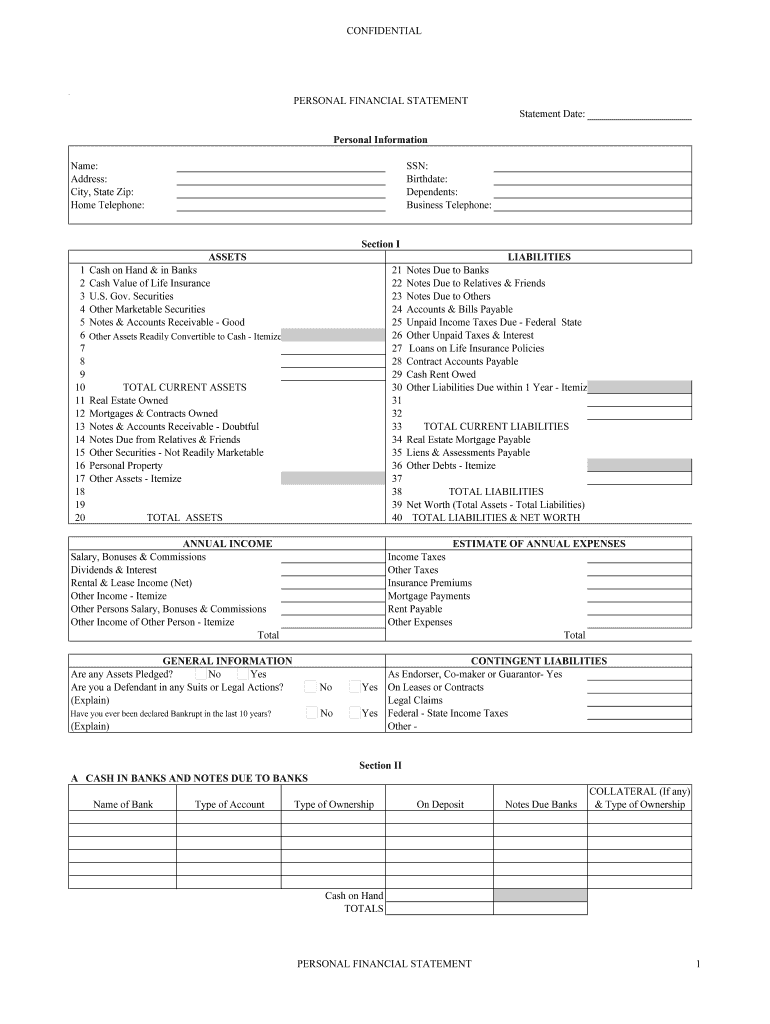
financial statement Preview on Page 1

Here's how it works

01. Edit your financial statement online
Type text, add images, blackout confidential details, add comments, highlights and more.
02. Sign it in a few clicks
Draw your signature, type it, upload its image, or use your mobile device as a signature pad.
03. Share your form with others
Send personal financial statement via email, link, or fax. You can also download it, export it or print it out.

Understanding the Personal Financial Statement Template

A personal financial statement template serves as a structured document that individuals can use to outline their financial situation in detail. This summary includes critical data regarding assets, liabilities, income, and expenses, making it a valuable tool for personal finance management and applications for credit.

Key Components of a Personal Financial Statement

The essential elements of a personal financial statement template typically encompass the following sections:

  • Assets: This section lists all assets owned by the individual, including cash in bank accounts, real estate properties, securities, and other investments. Each asset's current value should be documented to provide an accurate picture of overall wealth.

  • Liabilities: Here, all debts are recorded, including mortgages, credit card debts, loans, and any other obligations. This information helps calculate net worth by subtracting total liabilities from total assets.

  • Income: This area outlines all sources of income, such as salaries, rental income, dividends, and other earnings. It is vital to indicate both gross and net income to provide a comprehensive overview.

  • Expenses: Documenting regular monthly expenses, such as housing costs, utilities, transportation, groceries, insurance, and discretionary spending, is crucial for evaluating budgeting needs and financial health.

Utilizing a Personal Financial Statement Template Effectively

To maximize the benefits of a personal financial statement template, consider the following practical tips:

  1. Regular Updates: Review and update the statement at least annually or whenever you experience significant financial changes, such as a new job, promotion, or any major purchase. Regular updates ensure that the document reflects current financial conditions.

  2. Documentation: Compile supporting documents that verify the information provided in the financial statement. This may include bank statements, tax returns, mortgage documents, and investment statements.

  3. Use of Digital Tools: Many users prefer to utilize templates available in spreadsheet applications like Excel or Google Sheets, as they allow for easy calculations and updates. Several free options are available online, ensuring accessibility.

Advantages of a Personal Financial Statement Template

Utilizing a personal financial statement template offers several key benefits:

  • Enhanced Clarity: By organizing financial information into a clear and coherent format, individuals can better understand their financial situation and make informed decisions.

  • Facilitation of Credit Applications: Lenders often require a personal financial statement during the application process for loans or credit. Having a well-prepared statement on hand can expedite this process.

  • Financial Planning: A personal financial statement is an essential tool for budgeting and long-term financial planning, enabling individuals to identify areas for improvement or investment opportunities.

Legal Considerations for Personal Financial Statements

When submitting a personal financial statement, especially for loan purposes, it is essential to consider the following legal factors:

  • Accuracy: All information must be truthful and accurate, as any misrepresentation could lead to legal consequences or denial of credit applications.

  • Confidentiality: Individuals should take precautions when sharing personal financial statements, ensuring that sensitive information, such as Social Security numbers or bank account details, is protected.

Conclusion: The Importance of Personal Financial Statements

The personal financial statement template is invaluable in outlining and managing one's financial well-being. By diligently maintaining an accurate and comprehensive statement, individuals are better equipped to navigate their financial futures effectively. From enhancing personal finance insights to assisting in credit applications, this document serves multiple purposes across different financial scenarios.

be ready to get more

Complete this form in 5 minutes or less

Get form

Got questions?

We have answers to the most popular questions from our customers. If you can't find an answer to your question, please contact us.
Contact us
Financial statements are documents that summarize a businesss financial performance and position over a specific period. These statements provide crucial information about your businesss revenue, expenses, assets, liabilities, and cash flow, helping lenders assess your ability to repay the loan.Apr 24, 2025
How to prepare an income statement Choose your reporting period. First, choose the length of your reporting period. Determine your trial balance. Determine revenue. Calculate the cost of goods sold. Determine gross profit. Determine expenses. Calculate total income. Determine taxes and interest.
In your paperwork, you should include a current (dated within 90 days) financial overview statement, as well as financial statements for the past three years. These financial statements are separate from the personal financial statement, which is outlined in SBA Form 413.
List your assets: Identify and value all your assets using current market values for investments and real estate. List your liabilities: Include all your debts, noting the remaining balances and interest rates. Calculate your net worth: Subtract your total liabilities from your assets to determine your net worth.
The five core components of financial statements are Assets, Liabilities, Equity, Revenue (or Income), and Expenses, representing everything a company owns, owes, the owners stake, money earned, and costs incurred, respectively, forming the basis for understanding financial health. These elements are crucial for the Balance Sheet (Assets, Liabilities, Equity) and the Income Statement (Revenue, Expenses). Heres a breakdown of each component: Assets: Resources owned by the business expected to provide future economic benefits (e.g., cash, inventory, equipment). Liabilities: Obligations the company owes to outside parties (e.g., loans, accounts payable). Equity: The owners residual claim on assets after liabilities are paid (e.g., owners capital, retained earnings). Revenue: Inflows from selling goods or services, increasing equity (e.g., sales, service fees). Expenses: Outflows of costs incurred to generate revenue, decreasing equity (e.g., salaries, rent, utilities). These elements are linked by the fundamental accounting equation: Assets = Liabilities + Equity. For financial advice, consult a professional. Elements of Financial StatementsSep 15, 2023 hi everyone today we are going to see five elements of financial statements asset liability equity or capital income oYouTube Saheb AcademyThe five elements of financial statements - FacebookMar 12, 2022 1. #Assets Resources owned by a business that provide future economic benefits. Examples: Cash, Inventory, Equipment, Facebook

Security and compliance

At DocHub, your data security is our priority. We follow HIPAA, SOC2, GDPR, and other standards, so you can work on your documents with confidence.

Learn more
ccpa2
pci-dss
gdpr-compliance
hipaa
soc-compliance

People also ask

The four basic financial statements are the Income Statement, showing revenues and expenses over time; the Balance Sheet, a snapshot of assets, liabilities, and equity at a point in time; the Cash Flow Statement, detailing cash movements; and the Statement of Changes in Equity (or Shareholders Equity), explaining equity changes. These statements work together to provide a complete financial picture of a companys health, performance, and cash position. Heres what each statement covers: Income Statement (or Profit Loss Statement): Reports a companys financial performance over a specific period, detailing revenues, costs, and expenses to arrive at net income or loss. Balance Sheet: A snapshot at a single point in time showing what a company owns (assets) versus what it owes (liabilities) and the owners stake (equity). Cash Flow Statement: Tracks cash inflows and outflows from operating, investing, and financing activities over a period, showing where cash comes from and goes. Statement of Changes in Equity (or Shareholders Equity): Details the changes in equity accounts (like retained earnings and paid-in capital) from the beginning to the end of a period. These statements are interconnected; for example, net income from the Income Statement flows into the Statement of Equity, and the ending equity balance appears on the Balance Sheet. For financial advice, consult a professional. The Four Core Financial Statements - principlesofaccounting.comFinally, it is important to note that the income statement, statement of retained earnings, and balance sheet articulate. This meaprinciplesofaccounting.comBeginners Guide to Financial Statements - SEC.govJan 12, 2014 Show me the money! We all remember Cuba Gooding Jr.s immortal line from the movie Jerry Maguire, Show me the moneySEC.gov
An Excel Personal Financial Statement Template is a powerful tool that allows you to track your financial health and provides a comprehensive overview of your financial situation.

financial statement template