Type text, add images, blackout confidential details, add comments, highlights and more.
02. Sign it in a few clicks
Draw your signature, type it, upload its image, or use your mobile device as a signature pad.
03. Share your form with others
Send fidelis eft enrollment via email, link, or fax. You can also download it, export it or print it out.
How to use or fill out healthfirst eft enrollment with our platform
Ease of Setup
DocHub User Ratings on G2
Ease of Use
DocHub User Ratings on G2
Click ‘Get Form’ to open the healthfirst EFT Enrollment form in the editor.
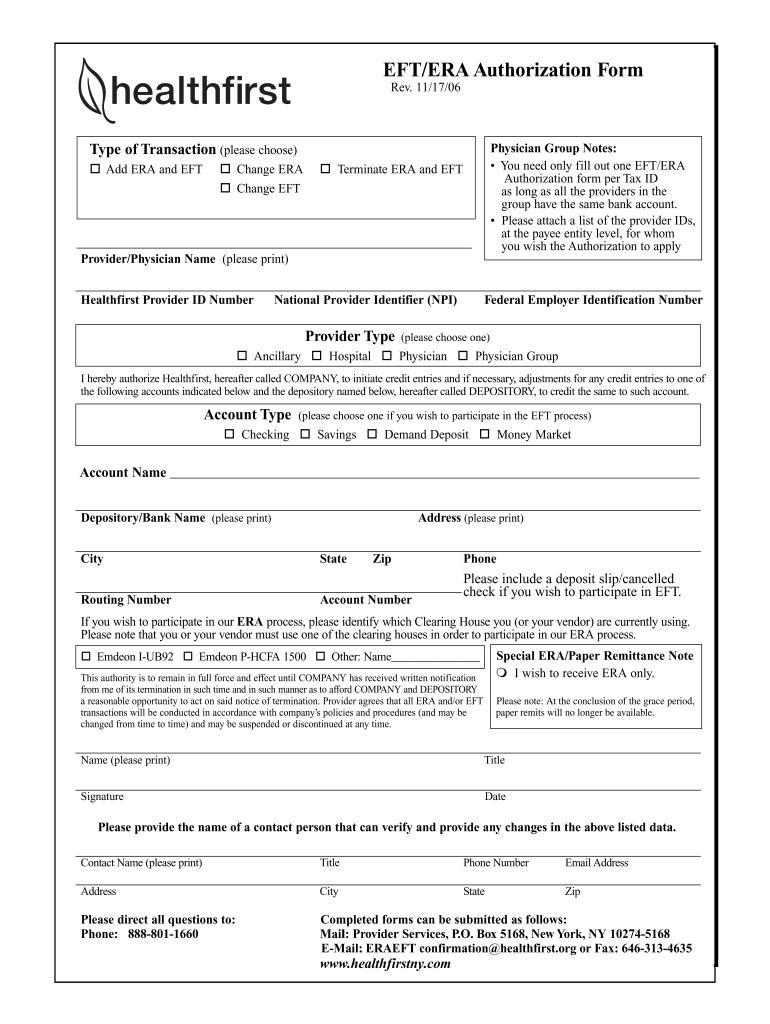
Begin by selecting the type of transaction you wish to initiate: Add ERA and EFT, Change ERA, Terminate ERA and EFT, or Change EFT. This selection is crucial for processing your request correctly.
Fill in your Provider/Physician Name, Healthfirst Provider ID Number, National Provider Identifier (NPI), and select your Provider Type from the options provided: Ancillary, Hospital, Physician, or Physician Group.
Indicate your Federal Employer Identification Number (FEIN) and choose the Account Type for EFT participation: Checking, Savings, Demand Deposit, or Money Market. Provide the Account Name and Depository/Bank Name along with the necessary address details.
If participating in the ERA process, specify which Clearing House you are using. Ensure that all required information is accurate to avoid delays.
Complete the authorization section by printing your name, title, signing the form, and dating it. Also provide a contact person’s details for verification purposes.
Start filling out your healthfirst EFT Enrollment form online for free today!
Fill out healthfirst eft enrollment online It's free
What Is an EFT? An electronic funds transfer, or EFT, is the electronic message used by health plans to order a financial institution to electronically transfer funds to a providers account to pay for health care services. An EFT includes information such as: Amount being paid.
What is an EFT enrollment form?
Completing the Medicare Enrollment Application - Electronic Funds Transfer (EFT) Authorization Agreement (CMS-588) application. The Electronic Funds Transfer (EFT) Authorization Agreement (CMS-588) application is used to have your Medicare payments deposited directly into your bank account.
What is an EFT insurance?
Electronic funds transfer (EFT) system coverage is a financial institution crime coverage that relates to the erroneous transferring of funds to or from the checking or savings account of a customer based upon instructions fraudulently transmitted by a nonemployee.
How to get EFT details?
The EFT trace number is typically found on the transaction details or confirmation receipt provided by the bank or payment processor. It can also be located in your bank statement under the specific EFT transaction, helping to identify and track the transfer within the banking system.
What is EFT and how does it work?
An electronic funds transfer (EFT), also known as a direct deposit, is the digital transfer of money between bank accounts. As digital transfers, they reduce the need for manual input and paper documents.
Enroll in automatic payments Authorizing Electronic Funds Transfer (or EFT) as your payment method will speed payment delivery by depositing payments directly to your bank account, allowing quicker access to funds paid to you.
Is EFT just a bank transfer?
The term EFT applies to any kind of transfer that is processed electronically instead of manually, whereas ACH and wire transfers are types of EFTs, each with its own unique features and processes.
What is an EFT payment?
Essentially, EFT (electronic fund transfer) is used to move money from one account to another. The transaction is completed electronically, and the two accounts can be at the same financial institution or different financial institutions. However, the term EFT doesnt refer to a specific type of payment.
Related links
A Guide for Medicare Providers, Physicians, Suppliers, and
Any provider not currently on EFT that submits any change to its existing enrollment data must also submit a CMS-588 form to convert to EFT. Eventually, allRead more
Service provider NPI required in servicing provider loop. No longer require 6 digit provider identifier. Provider must complete enrollment form on payers.Read more
Cookie consent notice
This site uses cookies to enhance site navigation and personalize your experience.
By using this site you agree to our use of cookies as described in our Privacy Notice.
You can modify your selections by visiting our Cookie and Advertising Notice.