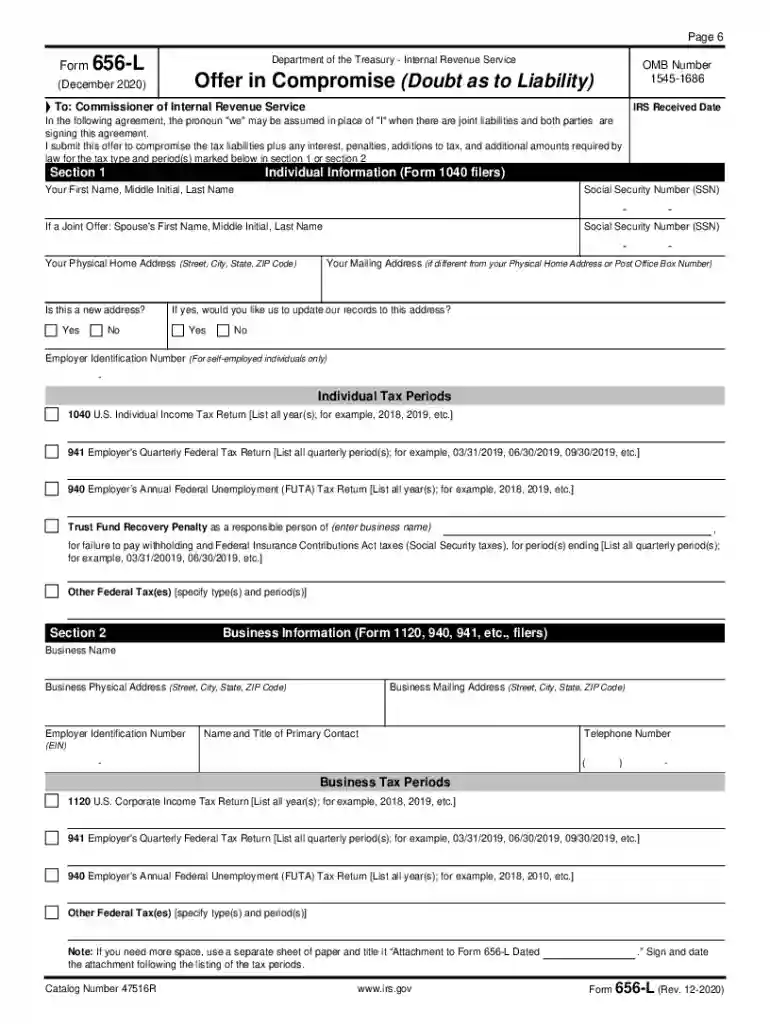
Irs oic forms 2026

Get Form
form 656 offer in compromise Preview on Page 1

Here's how it works

01. Edit your form 656 offer in compromise online
Type text, add images, blackout confidential details, add comments, highlights and more.

02. Sign it in a few clicks
Draw your signature, type it, upload its image, or use your mobile device as a signature pad.

03. Share your form with others
Send irs form 656 offer in compromise via email, link, or fax. You can also download it, export it or print it out.

Definition & Meaning of IRS OIC Forms

The IRS OIC forms, specifically Form 656 and Form 656-L, are utilized for submitting an Offer in Compromise (OIC). An Offer in Compromise allows taxpayers to negotiate their tax debt with the Internal Revenue Service (IRS) when they are unable to pay the full amount owed. The primary intent is to settle tax debts for a lesser amount that the taxpayer can afford. Form 656 is typically used for general offers, whereas Form 656-L is designated for cases where there is doubt as to liability, meaning the taxpayer disputes the legitimacy of the owed amount.

These forms are vital for individuals struggling with tax liabilities, as they provide a legitimate avenue to potentially reduce their outstanding debts. They require detailed financial disclosures and supporting documentation to demonstrate the taxpayer's financial circumstance and inability to pay the full debt.

Key Terms Related to IRS OIC Forms

Understanding the terminology surrounding OIC forms is crucial:

  • Offer in Compromise (OIC): A settlement arrangement with the IRS allowing taxpayers to pay less than the total tax debt.
  • Form 656: The application form for submitting an Offer in Compromise for most taxpayers.
  • Form 656-L: Used when there is doubt regarding the existence or amount of tax liability.
  • Doubt as to Collectibility: A claim made by the taxpayer asserting that they cannot afford to pay the outstanding tax according to the IRS payment guidelines.

How to Use the IRS OIC Forms

Utilizing the IRS OIC forms involves several steps to ensure compliance and accuracy during the submission process. After determining eligibility, the following procedure is recommended:

  1. Evaluate Financial Situation: Gather necessary financial documents, such as income statements, expenses, and assets.
  2. Select the Appropriate Form: Depending on your situation, choose either Form 656 or Form 656-L.
  3. Fill Out the Form Accurately: Ensure all information is complete and accurate, as errors can lead to delays or rejection.
  4. Include Supporting Documentation: Attach required documentation, which may include income verification, estimates of expenses, and asset valuations.
  5. Submit the Form: Send the completed forms to the IRS via mail or electronically if applicable.

Being thorough and precise in filling these forms is critical; the IRS requires extensive details to process Offers in Compromise.

Steps to Complete the IRS OIC Forms

Completing the IRS OIC forms involves meticulous attention to detail. Adhering to the following steps can facilitate a smoother submission:

  1. Personal Information: Start by providing your name, address, Social Security number, and other identifying information.
  2. Select the Offer Type: Indicate whether you are submitting an OIC based on doubt as to liability or collectibility.
  3. Financial Information: Fill in detailed financial disclosures, including monthly income and expenses, total assets, and liabilities.
  4. Payment Terms: Specify the offer amount you propose for settlement. Ensure this amount reflects what you can realistically pay based on your financial condition.
  5. Sign and Date the Form: Ensure that the form is signed and dated accurately, as it constitutes an official submission.

It is recommended to retain a copy of the submitted forms and all associated documents for record-keeping.

Eligibility Criteria for IRS OIC Forms

To qualify for submitting the IRS OIC forms, taxpayers must meet specific eligibility criteria defined by the IRS. The requirements generally include:

  • Tax Compliance: All tax returns must be filed, and all tax payments must be current to be eligible for an OIC.
  • Inability to Pay: You must demonstrate an inability to pay the total amount owed, which is assessed through a comprehensive examination of your financial situation.
  • Asset Limitations: The IRS evaluates your assets to determine if they can be liquidated to settle the debt. If you have significant assets that could cover the tax liabilities, you may not qualify.
  • Reason to Compromise: Either doubt as to collectibility or liability must be established, clarifying that the taxpayer’s financial situation substantiates a reduced payment offer.

Understanding these criteria is essential for determining whether the OIC is a feasible option.

decoration image ratings of Dochub

Important Documents Required for IRS OIC Forms

Submitting the IRS OIC forms entails providing comprehensive documentation that substantiates your claims and case. The critical documents include:

  • Proof of Income: Recent pay stubs, tax returns, or profit and loss statements for self-employed individuals.
  • List of Monthly Expenses: Detailed account of all living expenses, including housing, utilities, and necessary costs associated with your daily life.
  • Asset Documentation: Information about your assets such as bank statements, real estate documents, or investment accounts.
  • Form 433-A or 433-B: These forms provide additional financial detail and may be required for individual and business OIC submissions respectively.

Proper documentation is foundational for completing the IRS OIC process and will significantly affect the likelihood of approval.

Filing Methods for IRS OIC Forms

There are two primary methods to submit IRS OIC forms, each with distinct processes:

  1. By Mail: Send completed forms and documents to the IRS address specified in the instructions accompanying the OIC forms. Ensure that all copies are properly organized and included to prevent unnecessary delays.
  2. Online Submission: For certain taxpayers, online submission may be available through IRS-approved e-filing methods. Always check current IRS guidelines for electronic submissions to ensure compliance.

Regardless of the method chosen, maintaining copies of all submissions is advisable for personal records and future reference.

See more irs oic forms versions

We've got more versions of the irs oic forms form. Select the right irs oic forms version from the list and start editing it straight away!
Versions Form popularity Fillable & printable
2020 4.8 Satisfied (173 Votes)
2018 4.2 Satisfied (161 Votes)
2017 4.4 Satisfied (56 Votes)
2016 4.2 Satisfied (67 Votes)
2012 4.3 Satisfied (174 Votes)
be ready to get more

Complete this form in 5 minutes or less

Get form

Got questions?

We have answers to the most popular questions from our customers. If you can't find an answer to your question, please contact us.
Contact us
Youre eligible to apply for an offer in compromise if you: Filed all required tax returns and made all required estimated payments. Arent in an open bankruptcy proceeding. Have a valid extension for a current year return (if applying for the current year).
Form 433-A (OIC) is a special version of the standard 433-A form, and its specifically used for people who are applying for an office in compromise (OIC).
The IRS typically takes between 6 to 12 months to process an Offer in Compromise, though complex cases can take longer.
Use Form 656 when applying for an offer in compromise (OIC), which is an agreement between you and the IRS that settles your tax liabilities for less than the full amount that you owe.
An Offer in Compromise (OIC) provides an alternative for individuals who are unable to pay their outstanding California income tax liabilities, and who wont be able to in the foreseeable future .
be ready to get more

Complete this form in 5 minutes or less

Get form

People also ask

Form 433-A is a collection information statement for wage earners and self-employed individuals. 433 A Form (OIC) is a specific version used when applying for an Offer in Compromise, which is an agreement with the IRS to settle your tax liabilities for less than the full amount owed.
IRS Definition Form 433-A provides information necessary for determining how a wage earner or self-employed individual can satisfy an outstanding tax liability.
The hidden downsides include required tax compliance, loss of tax refunds, and intense financial scrutiny. As you consider your tax payment options, dont forget to consider the downsides of an offer in compromise. For more guidance regarding your unique tax situation, call Seattle Legal Services at 206-536-3152.

counter offer form