




01. Edit your ct w4 online
Type text, add images, blackout confidential details, add comments, highlights and more.

Type text, add images, blackout confidential details, add comments, highlights and more.

Draw your signature, type it, upload its image, or use your mobile device as a signature pad.

Send ct w 4 via email, link, or fax. You can also download it, export it or print it out.
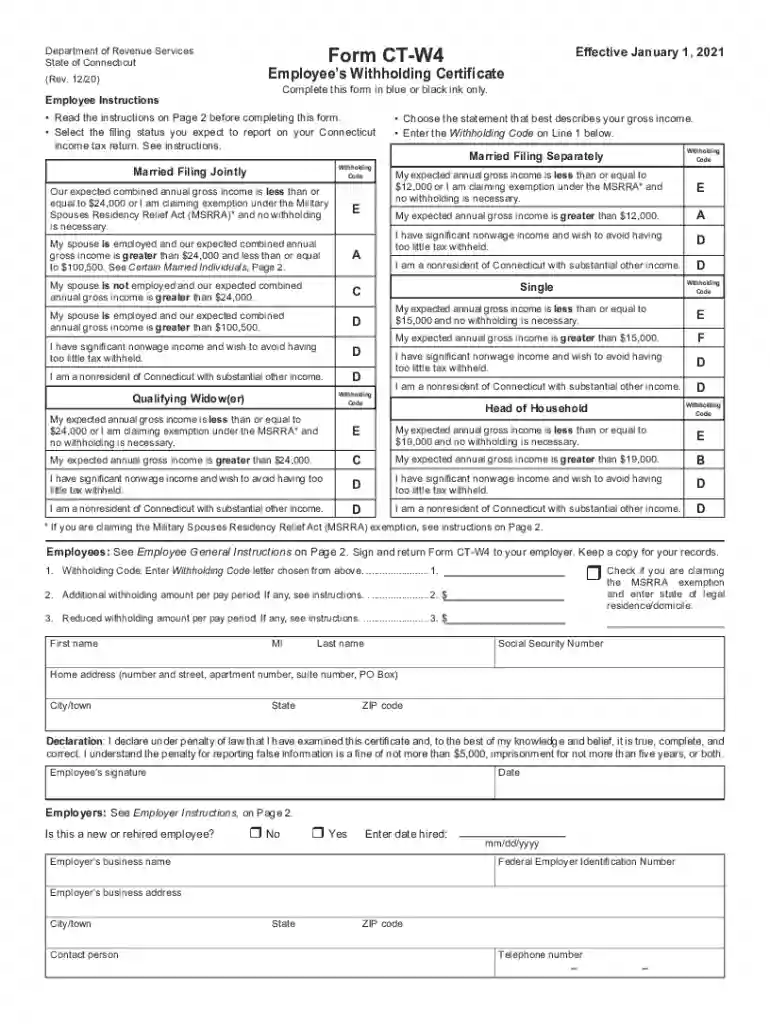
The CT W4 form, formally known as the Employee's Withholding Certificate for Connecticut, is a crucial document that employees must complete to ensure appropriate state income tax withholding from their paychecks. This form allows individuals to declare their expected filing status, exemptions, and additional withholding amounts, which are essential for accurate tax calculations. The CT W4 is vital not only for employees to manage their tax liabilities but also for employers to fulfill their withholding obligations.
The CT W4 form is structured to capture specific information critical for determining the withholding amount. Key elements include:
Understanding these elements ensures employees can correctly complete the form, reducing the risk of improper tax withholding throughout the year.
It is important for employees to review and, if necessary, update their CT W4 form whenever there are changes in their personal or financial situation. This could include:
Employers should encourage their employees to review and adjust their withholding periodically to optimize their tax withholding strategy.
Timely submission of the CT W4 is crucial in managing state tax obligations effectively. Relevant deadlines include:
These deadlines help maintain clarity in tax obligations and ensure that employees do not face unexpected tax liabilities.
Employers are legally obligated to withhold income tax based on the information provided on the CT W4 form. Key legal aspects include:
Understanding the legal implications surrounding the CT W4 reinforces the importance of accurate and timely completion by employees.
To aid in the understanding of the CT W4 form, consider the following scenarios that illustrate how an employee might fill it out based on their personal circumstances:
These examples provide clarity on how varied personal circumstances can influence the completion of the CT W4 form and ultimately affect tax withholding.
The CT W4 form includes specific withholding codes that are essential for determining the correct amount of state tax to withhold. Understanding these codes is critical for employees:
Each code has implications for the amount withheld, making it imperative for employees to select the most accurate code based on their specific financial situations.
While the CT W4 form is a relatively straightforward document, its implications for both employees and employers are significant. Understanding the details, including legal obligations, filing procedures, and examples of use, ensures optimal compliance with state tax laws. Proper management of the CT W4 is essential for effective income tax withholding within Connecticut.
We've got more versions of the ct w4 form. Select the right ct w4 version from the list and start editing it straight away!
| Versions | Form popularity | Fillable & printable |
|---|---|---|
| 2023 | 4.7 Satisfied (22 Votes) | |
| 2022 | 4.1 Satisfied (57 Votes) | |
| 2021 | 4.9 Satisfied (35 Votes) | |
| 2020 | 4.4 Satisfied (101 Votes) | |
| 2019 | 4.4 Satisfied (55 Votes) | |
| 2018 | 4.3 Satisfied (75 Votes) | |
| 2017 | 4.2 Satisfied (95 Votes) | |
| 2016 | 4.4 Satisfied (55 Votes) | |
| 2015 | 4.4 Satisfied (513 Votes) | |
| 2015 | 4 Satisfied (21 Votes) | |
| 2013 | 4 Satisfied (43 Votes) | |
| 2012 | 3.7 Satisfied (31 Votes) | |
| 2012 | 4 Satisfied (50 Votes) | |
| 2012 | 4 Satisfied (49 Votes) | |
| 2011 | 4 Satisfied (26 Votes) |
At DocHub, your data security is our priority. We follow HIPAA, SOC2, GDPR, and other standards, so you can work on your documents with confidence.


