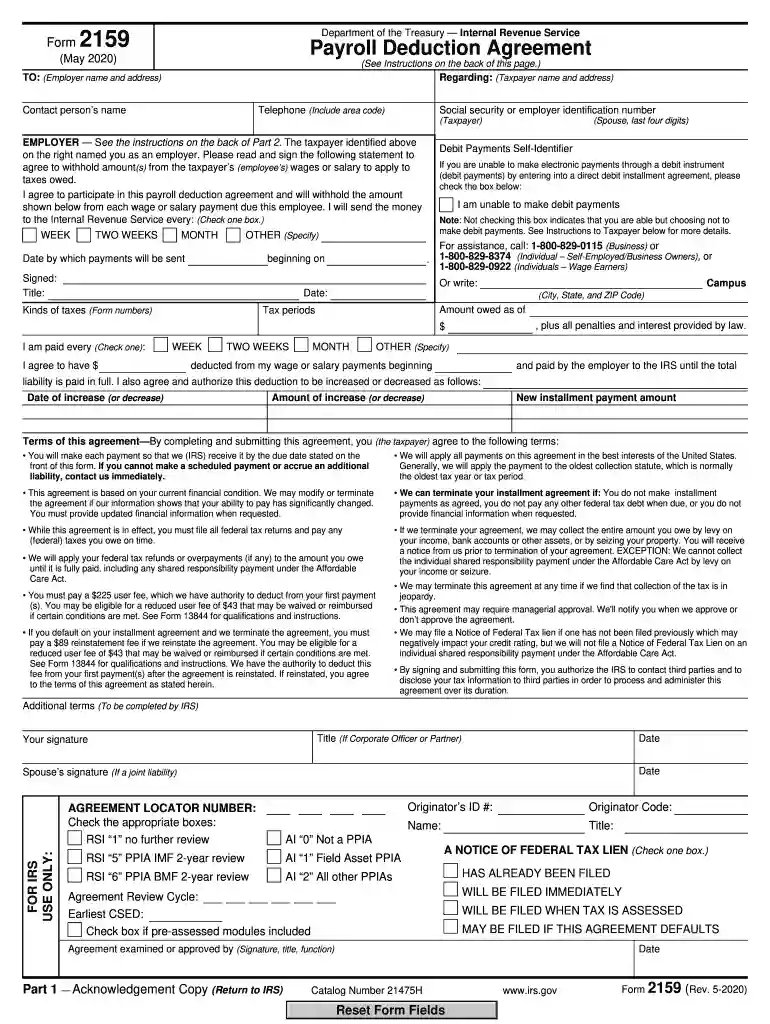
Definition and Purpose of Form 2159
Form 2159, also known as the Payroll Deduction Agreement, is issued by the IRS and allows an employer to withhold a specified amount from an employee's wages to settle tax liabilities. This agreement details the obligations of both the employer and the employee, including payment schedules, terms of agreement, potential fees, and the conditions under which the agreement may be modified or terminated.
Employers utilize this form when employees request to pay federal tax liabilities through payroll deductions. This method not only aids in compliance with tax obligations but also simplifies the payment process for employees who might prefer gradual tax settlement over a lump sum. The form provides clarity on how payroll deductions will be applied to tax liabilities and ensures that both parties are aware of their responsibilities.
How to Use Form 2159 Effectively
Utilizing Form 2159 requires an understanding of its components and the necessary steps for implementation.
-
Complete the Form: Fill in your information accurately, including your employee identification details, the specific tax liabilities to be deducted, and the amount to be withheld from each paycheck.
-
Employer Review: Once submitted, the employer must review the agreement for accuracy and compliance before it can be enacted. This includes ensuring that the deduction does not exceed limits defined by IRS guidelines.
-
Set Up Payroll Integration: Employers should integrate the deductions into their payroll system to ensure that the specified amounts are consistently withheld from the employee’s wages according to the agreed schedule.
-
Monitor Compliance: Regularly review payroll reports to ensure the deductions align with what was agreed upon in Form 2159. This step is crucial for maintaining accurate records and ensuring that employees meet their tax obligations.
-
Provide Documentation: Employers should maintain a copy of Form 2159 for internal records and provide a copy to the employee as a reference for their own financial tracking.
This multi-step process ensures that the use of Form 2159 is effective, compliant, and clear for both parties involved.
Steps to Complete Form 2159
Completing Form 2159 involves several structured steps to ensure accuracy and compliance with IRS guidelines.
-
Employee Information: Provide your full name, address, Social Security number, and any other personal identification required to establish your identity.
-
Tax Liability Details: Specify the tax liabilities that you wish to address through payroll deductions. Include details such as the type of taxes and the amounts owed.
-
Deduction Amounts: Clearly state the amount to be deducted from each paycheck. Ensure this value reflects both your financial capabilities and IRS regulations regarding maximum allowable deductions.
-
Employer Acknowledgment: After completing the form, submit it to your employer for acknowledgment. The employer will need to verify the information and ensure that the deductions align with their payroll practices.
-
Sign and Date: Both the employee and the employer must sign and date the form. This step is essential for legal compliance, as it signifies that both parties agree to the terms outlined in the form.
By following these detailed steps, employees can efficiently complete Form 2159, ensuring all necessary information is accurately provided for both payroll processing and tax compliance.
Important Terms Related to Form 2159
Understanding the key terms associated with Form 2159 can enhance your comprehension of its use and implications in a payroll context.
-
Payroll Deduction: This refers to the process where an agreed amount is subtracted from an employee's wages to settle debts, such as tax liabilities.
-
Tax Liability: The total amount of tax owed by an individual, which can include federal, state, and local taxes.
-
Withholding: The portion of an employee's wages withheld by the employer to cover tax obligations.
-
Agreement Terms: The specific clauses within Form 2159 that outline the conditions and stipulations of the payroll deduction arrangement.
-
Modification/Termination Conditions: These sections detail how and when alterations to the agreement can occur, as well as the process for ending the payroll deduction.
Grasping these terms can simplify the complexities of payroll deductions and their associated agreements.
Legal Use of Form 2159
Form 2159, as an authorized payroll deduction agreement, is legally binding under the provisions set by the IRS. Utilizing this form correctly can prevent legal issues related to tax compliance.
-
Legally Binding Contract: The signatures of both the employee and employer make the form a contract. Each party agrees to uphold their side of the agreement: the employee agrees to allow deductions, while the employer commits to adhering to the specified terms.
-
IRS Compliance: By using Form 2159, employers and employees ensure they are compliant with IRS guidelines regarding payroll deductions for tax liabilities. This minimizes the risk of penalties associated with non-compliance.
-
Documentation Retention: It’s essential for both parties to retain signed copies of the form. This documentation can be crucial in the event of any disputes regarding payment obligations or tax liabilities.
Understanding the legal implications of Form 2159 can enhance its efficacy in resolving tax obligations while maintaining compliance with IRS regulations.
Examples of Using Form 2159 in Different Scenarios
Form 2159 can be applied in various contexts, significantly aiding employees in managing their tax liabilities.
-
New Employees: A new employee who is aware of outstanding tax liabilities may request to have a specific amount deducted from each paycheck using Form 2159. This enables them to efficiently manage their tax payments while starting their new position.
-
Tax Underpayment: An employee who discovers they have underpaid taxes in previous years can utilize Form 2159 to set up a repayment plan. The form allows them to spread out repayments over several pay periods, easing financial pressure.
-
Changes in Employment Status: If an employee transitions to a new job but still has federal tax liabilities requiring payment, they can present Form 2159 to the new employer, ensuring that deductions continue uninterrupted.
These scenarios illustrate the importance of Form 2159 in facilitating tax compliance and providing financial relief to employees facing tax obligations.