




01. Edit your form 8582 example online
Type text, add images, blackout confidential details, add comments, highlights and more.

Type text, add images, blackout confidential details, add comments, highlights and more.

Draw your signature, type it, upload its image, or use your mobile device as a signature pad.

Send 2020 form 8582 via email, link, or fax. You can also download it, export it or print it out.
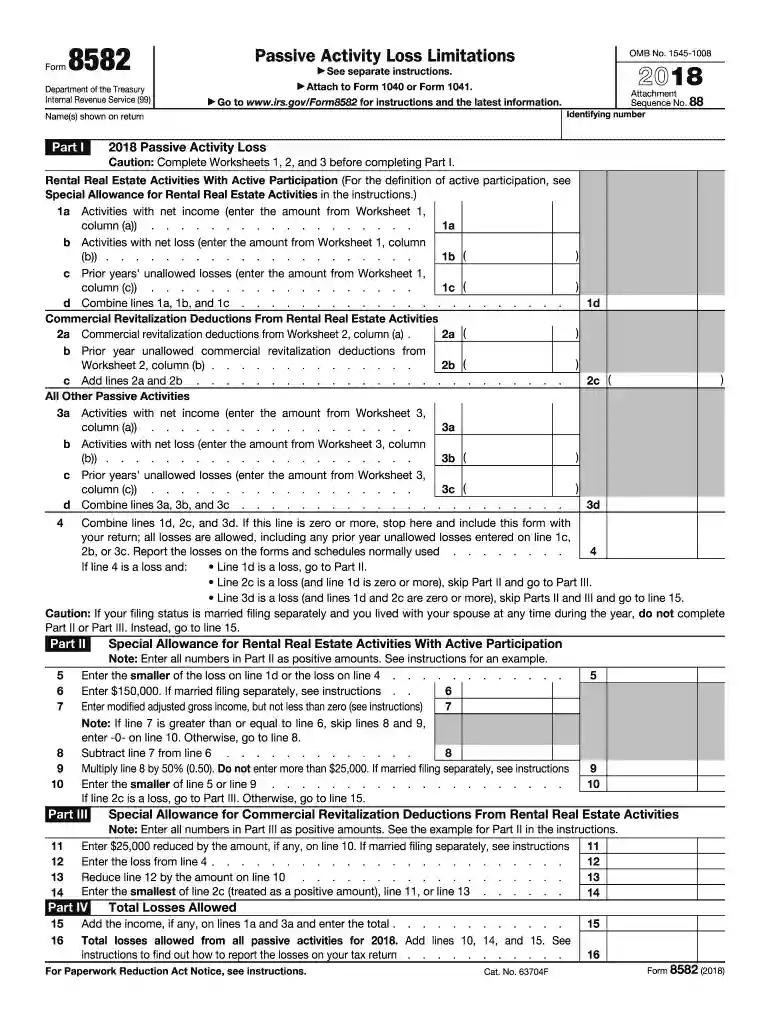
Tax Form 8582, commonly referred to as the PAL form, is utilized by the Internal Revenue Service (IRS) to monitor Passive Activity Loss Limitations. It is designed for taxpayers who need to report financial losses from passive activities such as rental properties and other business activities in which they do not materially participate. The form sets guidelines for calculating and reporting allowable losses, ensuring these do not exceed passive income.
The IRS guidelines for the 2017 tax year emphasize clarity and compliance. They outline the procedures for filing Form 8582 and detail the limitations on passive income losses. The IRS uses these rules to prevent excessive loss deductions, ensuring taxpayers only claim losses from allowable activities.
Taxpayers must submit Form 8582 along with their federal tax return, generally due by April 15th. If the deadline falls on a weekend or holiday, the filing date shifts to the next business day. Staying aware of these deadlines is crucial to avoid late penalties.
To accurately complete Form 8582, you need:
Form 8582 can be seamlessly integrated with most tax preparation software like TurboTax and QuickBooks. These platforms offer automated calculations for allowable losses and can import data directly from related financial records, ensuring accurate and efficient tax filing.
Form 8582 is required if you are reporting losses from passive activities. To claim these losses, taxpayers must meet criteria set by the IRS, such as owning rental properties or running a business with limited participation. It is imperative to ensure that all activities comply with the IRS's definition of passive activities to avoid filing errors.


We've got more versions of the form 8582 example form. Select the right form 8582 example version from the list and start editing it straight away!
| Versions | Form popularity | Fillable & printable |
|---|---|---|
| 2025 | 4.3 Satisfied (23 Votes) | |
| 2024 | 4.4 Satisfied (55 Votes) | |
| 2023 | 3.8 Satisfied (31 Votes) | |
| 2022 | 4.9 Satisfied (27 Votes) | |
| 2021 | 4.8 Satisfied (135 Votes) | |
| 2020 | 4.4 Satisfied (190 Votes) | |
| 2019 | 4.3 Satisfied (203 Votes) | |
| 2018 | 4.2 Satisfied (72 Votes) | |
| 2017 | 4.2 Satisfied (115 Votes) | |
| 2016 | 4.4 Satisfied (185 Votes) | |
| 2015 | 4.3 Satisfied (53 Votes) | |
| 2014 | 4 Satisfied (32 Votes) | |
| 2013 | 4.2 Satisfied (52 Votes) | |
| 2012 | 4.3 Satisfied (49 Votes) | |
| 2011 | 4.2 Satisfied (35 Votes) |
At DocHub, your data security is our priority. We follow HIPAA, SOC2, GDPR, and other standards, so you can work on your documents with confidence.
Form 8582 is used by noncorporate taxpayers to figure their passive activity loss for the current tax year. Learn who uses it, wher Web while filing taxes for
Dec 17, 2020 On December 22, 2017, the U.S. government enacted tax reform. The primary provisions of tax reform affecting the company in. 2018 were aRead more
Nov 29, 2017 Form 8582 is used by noncorporate taxpayers to figure the amount of any passive activity loss (PAL) for the current tax year and to report the.Read more


