Type text, add images, blackout confidential details, add comments, highlights and more.

02. Sign it in a few clicks
Draw your signature, type it, upload its image, or use your mobile device as a signature pad.

03. Share your form with others
Send idaho st 101 via email, link, or fax. You can also download it, export it or print it out.

How to use or fill out Idaho ST-101 with our platform
Ease of Setup
DocHub User Ratings on G2
Ease of Use
DocHub User Ratings on G2
Click ‘Get Form’ to open the Idaho ST-101 in the editor.
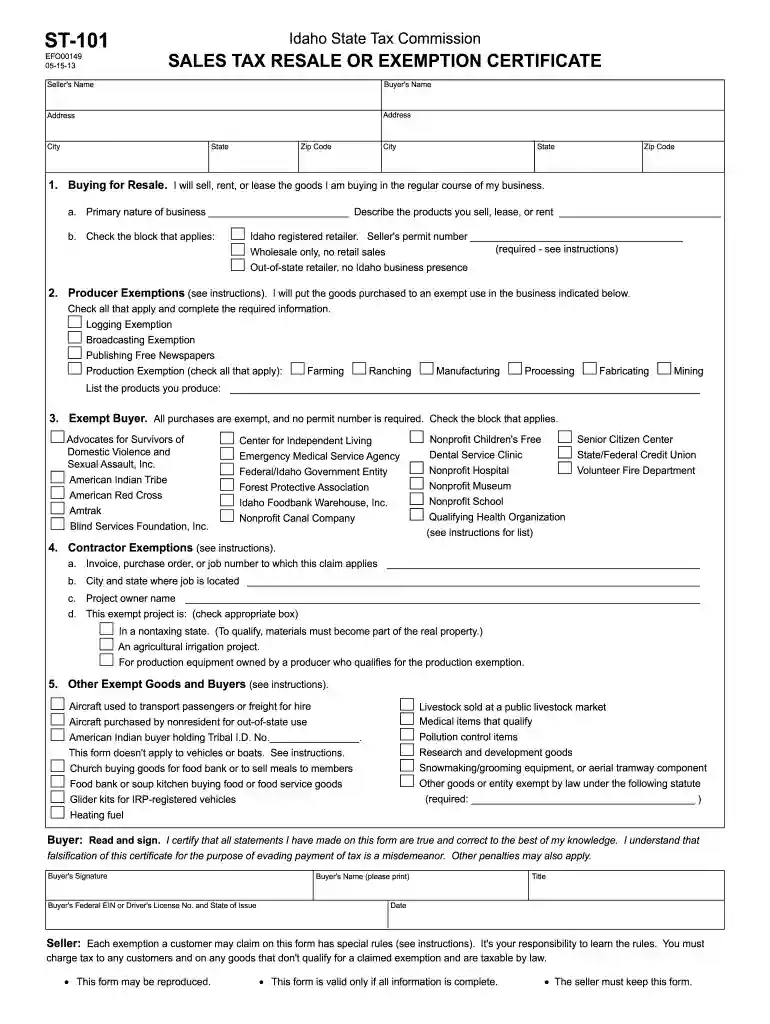
Begin by entering the Seller's Name and Buyer's Name in the designated fields. Ensure that both names are accurate to avoid any issues.
Fill in the addresses for both the seller and buyer, including city, state, and zip code. This information is crucial for proper identification.
In Section 1, indicate if you are buying for resale by checking the appropriate box. Provide your Idaho seller's permit number if applicable.
For Section 2, check all applicable producer exemptions and list the products you produce. This section helps clarify your business activities.
Complete Section 3 if you qualify as an exempt buyer by checking the relevant boxes for organizations like nonprofits or government entities.
In Section 4, provide details about contractor exemptions, including job location and project owner name. Make sure to check the appropriate exemption box.
Finally, read through all sections carefully before signing at the bottom of the form. Your signature certifies that all information is true and correct.
Start filling out your Idaho ST-101 form online for free today!
Form ST-101 Sales Tax Resale or Exemption Certificate. Page 1. 2. Production Exemptions (see instructions). Describe the products you produce.
Who can be exempt from property taxes?
Some types of properties are exempt from real estate taxes. These include qualifying nonprofit, religious and government properties. Senior citizens, veterans and those eligible for STAR (the School Tax Relief program) may qualify for exemptions as well.
Who qualifies for homeowners exemption in Idaho?
WHO QUALIFIES? To qualify, applicants must own, occupy, and use the dwelling as their primary residence per Idaho Code 63-602G. The application may be filed any time after you purchase, move in and make the home your primary residence. Applications are not available online or at the title companies.
Who is exempt from property taxes in Idaho for seniors?
The program exempts 50% of the value of the home and up to one acre of land. The maximum exemption is $125,000.
At what age do seniors stop paying property tax in Idaho?
You were 65 or older, blind, widowed, disabled, a former POW or hostage, or a motherless or fatherless child under 18 years old.
resale license idaho
Idaho st 101 pdfidaho form st-101 instructionsIdaho st 101 2022Idaho st 101 formST-101 form 2025 PDFidaho sales tax exemption form st-104ST-101 pdfST-101 printable form
People also ask
How do you qualify for homeowners exemption in Idaho?
To qualify, applicants must own, occupy, and use the dwelling as their primary residence per Idaho Code 63-602G. The application may be filed any time after you purchase, move in and make the home your primary residence. Applications are not available online or at the title companies.
What qualifies as a homestead in Idaho?
Each owner-occupied primary residence (house or manufactured home) and up to one-acre of land is eligible for a Homestead Exemption. This exemption allows the value of your residence and land up to one-acre be exempted at 50% of the assessed value up to a maximum of $125,000; whichever is less.
Who is exempt from sales tax in Idaho?
Some customers are exempt from paying sales tax under Idaho law. Examples include government agencies, some nonprofit organizations, and merchants purchasing goods for resale. Sellers are required to collect a valid exemption or resale certificate from buyers to validate each exempt transaction.
st 101
Incorporating Bioavailability Considerations into the
The St. Regis Paper Co. site in. Minnesota provides an example of how select plant parts and processing methods were used in a human and ecological exposure
Cookie consent notice
This site uses cookies to enhance site navigation and personalize your experience.
By using this site you agree to our use of cookies as described in our Privacy Notice.
You can modify your selections by visiting our Cookie and Advertising Notice.