
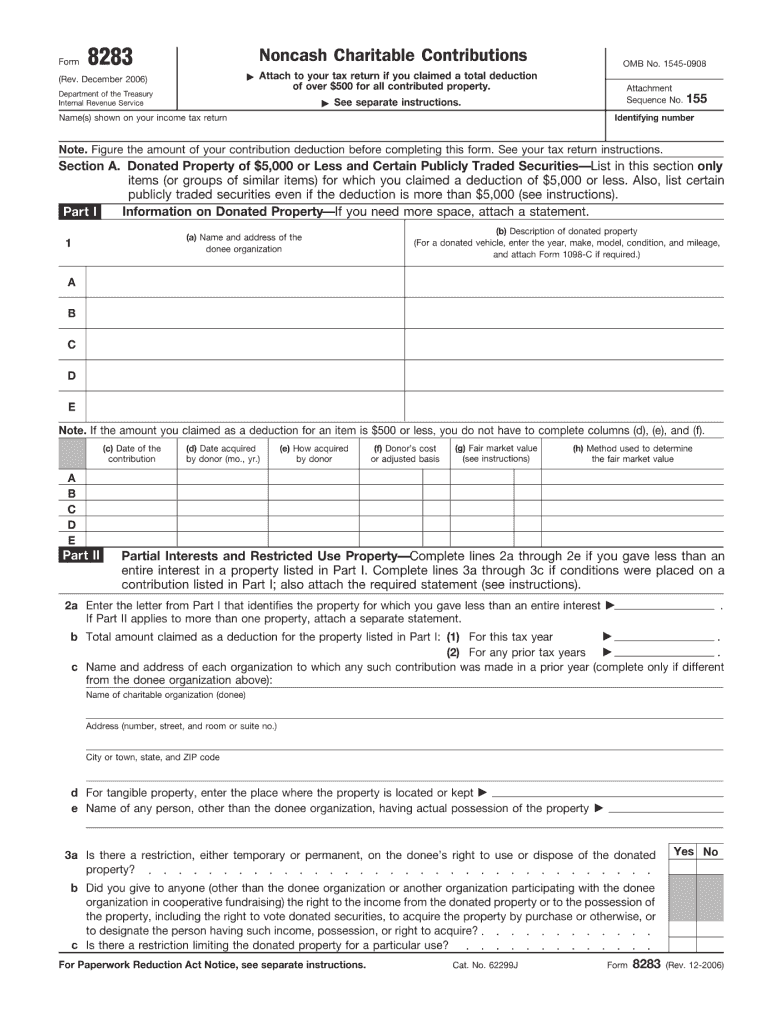







Definition and Purpose of Form 8283
Form 8283 is a U.S. tax form utilized by taxpayers to report noncash charitable contributions, specifically for donations valued over $500. Its primary purpose is to provide the Internal Revenue Service (IRS) with essential details regarding property donated to qualified charitable organizations. Taxpayers must complete this form to claim deductions for these charitable contributions on their federal tax returns, ensuring compliance with tax regulations.
Key Features of Form 8283
-
Section Breakdown: The form includes sections for contributions valued at $5,000 or less and those above that threshold. In the lower-value category, simplified information is required, while higher-value contributions necessitate more extensive details, including appraisals.
-
Donor Information: Taxpayers are required to provide personal information such as name, address, and social security number, alongside details about the charity receiving the donation.
-
Property Description: The form includes spaces to describe the donated property, state its fair market value, and note any restrictions on its use.
This structured approach not only assists taxpayers in accurately reporting their charitable contributions but also aids the IRS in verifying and processing these claims.
Completing the Form 8283: Step-by-Step Instructions
Completing Form 8283 requires careful attention to detail. Here’s a step-by-step guide to help ensure accuracy:
-
Gather Necessary Information: Collect all relevant documents that pertain to your donation. This includes receipts from the charity, descriptions of the property, and any appraisals.
-
Fill Out Donor Information: Enter your name, address, and taxpayer identification number in the designated sections.
-
Describe Your Donation: Clearly outline what you’re donating. This includes specifying the item, its condition, and any relevant restrictions on its use.
-
Determine Fair Market Value: Assess the fair market value (FMV) of your property donation, which is the price a willing buyer would pay a willing seller for the item.
-
Complete the Appraisal Section: If your donation exceeds $5,000, include necessary appraisal information, such as the appraiser's name and contact details, and their declaration that they are qualified to assess the property.
-
Review and Sign: Double-check all information for accuracy and completeness before signing the form. Make sure that all required fields are filled out, especially if you are claiming a deduction over the $5,000 threshold.
Common Mistakes to Avoid
- Failing to provide proper donor identification.
- Neglecting to include an appraisal when required.
- Inaccurate description of donated property.
Obtaining the Form 8283 PDF
To obtain Form 8283, taxpayers can follow these methods:
-
Download from the IRS Website: The easiest way to access Form 8283 is to download it directly from the IRS website. This ensures you have the most current version.
-
Tax Preparation Software: Various tax preparation software, such as TurboTax, often provides access to tax forms, including Form 8283, for ease of use during the filing process.
-
Local IRS Offices: Taxpayers can also obtain physical copies of Form 8283 from local IRS offices if they prefer to fill it out manually.
This accessibility helps streamline the process for taxpayers looking to claim deductions for charitable contributions.
IRS Guidelines for Form 8283
It is critical to adhere to the IRS guidelines when completing Form 8283:
-
Eligibility Requirements: Form 8283 should be used only for noncash contributions exceeding $500. This includes items such as vehicles, real estate, and artwork.
-
Documentation: Taxpayers must retain significant documentation, such as receipts from the charity and any valuation reports. The IRS mandates that these documents be available in case of an audit.
-
Filing with Tax Returns: Form 8283 must be attached to your federal tax return if you are claiming a deduction for your noncash contributions.
Understanding and following these guidelines helps ensure compliance and minimizes the risk of complications during tax season.
Examples of Using Form 8283
When utilizing Form 8283, taxpayers might encounter diverse scenarios reflecting different types of noncash contributions:
-
Example 1: Donating a Vehicle
- A taxpayer donates a used car valued at $3,000. Since the value is under $5,000, only basic information, including the donation date and vehicle description, is required.
-
Example 2: Donating Real Estate
- A donor contributes a piece of commercial real estate appraised at $150,000. The donor must complete all sections of Form 8283, including the appraiser's details, and provide a qualified appraisal document.
Each instance illustrates the critical nature of completing the form accurately to reflect the true value and nature of the donation.
Important Dates and Filing Deadlines
Taxpayers must be mindful of important dates related to Form 8283 to ensure timely compliance:
-
Tax Filing Deadline: Form 8283 must be submitted along with your annual tax return, typically due on April 15. If taxpayers file for an extension, both the extension and the form must be submitted by the extended deadline.
-
Documentation Retention Period: Taxpayers should keep supporting documents for at least three years following the filing of their taxes. This includes receipt copies, appraisals, and any correspondence regarding the donations.
Staying aware of these deadlines is essential to avoid penalties and ensure a smooth filing process.




