




01. Edit your physician telephone order form online
Type text, add images, blackout confidential details, add comments, highlights and more.

Type text, add images, blackout confidential details, add comments, highlights and more.

Draw your signature, type it, upload its image, or use your mobile device as a signature pad.

Send telephone verbal order example via email, link, or fax. You can also download it, export it or print it out.
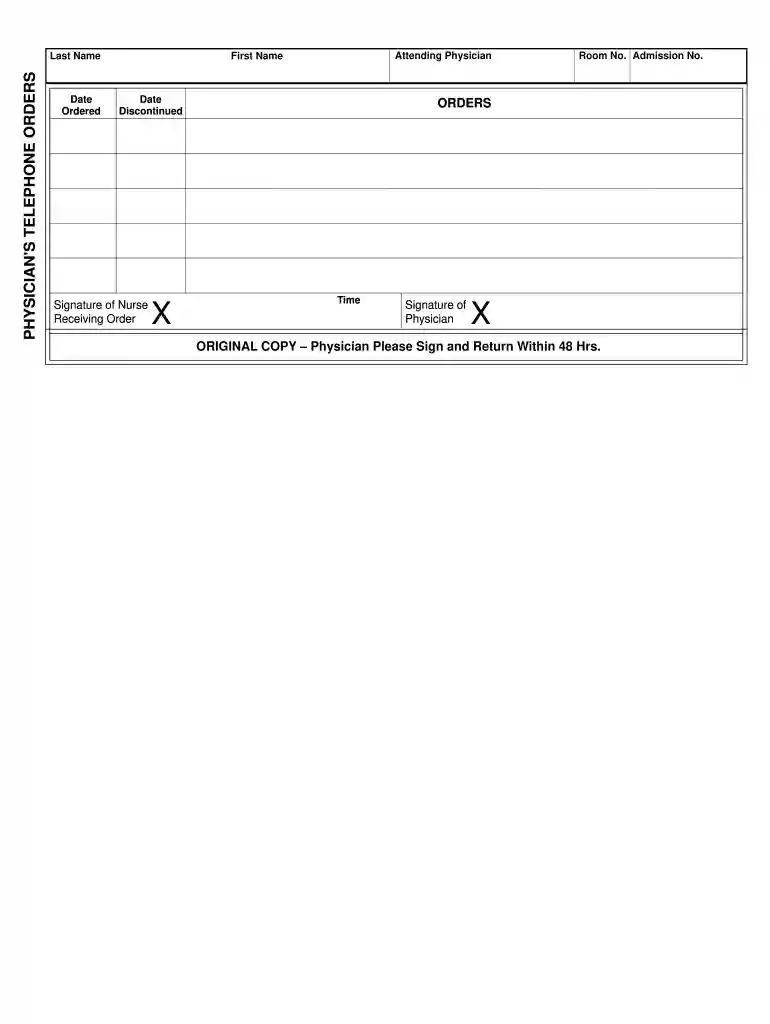
The physician telephone order form is a critical document used in healthcare settings to facilitate communication between physicians and nursing staff regarding patient care decisions. This form serves as a formal written record of instructions conveyed via telephone, allowing healthcare providers to ensure clarity and accountability. It typically includes sections for patient information, details of the attending physician, order dates, and spaces for signatures from both the physician and the nurse receiving the order.
The importance of this form lies in its ability to create a reliable documentation trail for verbal orders, which are often subject to miscommunication without such a structured process in place.
Using the physician telephone order form involves several structured steps, ensuring that orders are correctly communicated and recorded.
This process not only enhances patient safety but also aligns with best practices in healthcare for managing verbal orders.
Several key terms are associated with the physician telephone order form, significant for both clinical staff and administrative personnel in healthcare:
Understanding these terms helps healthcare professionals navigate documentation practices more effectively and enhances compliance with regulatory standards.
The physician telephone order form incorporates several essential components that ensure clarity and legality in verbal medical orders.
These elements work together to create a transparent process for managing patient orders and maintaining accurate health records in compliance with medical regulations.
Regulations surrounding the physician telephone order form can vary significantly from state to state, reflecting differing healthcare laws and standards. Understanding these variations is essential for compliance.
Staying abreast of local regulations helps healthcare organizations avoid compliance issues and reinforces best practices in patient care.
Knowing how to implement a physician telephone order form in practice can facilitate better patient care and adherence to protocols.
These examples underscore the critical role that the physician telephone order form plays in formalizing verbal communications and enhancing patient safety.
We've got more versions of the physician telephone order form form. Select the right physician telephone order form version from the list and start editing it straight away!
| Versions | Form popularity | Fillable & printable |
|---|---|---|
| 1996 | 4.6 Satisfied (46 Votes) |
At DocHub, your data security is our priority. We follow HIPAA, SOC2, GDPR, and other standards, so you can work on your documents with confidence.
ORDERS: Physician or Other Authorized Provider: (Please Print). MD/Provider Address. Signature/Title of Physician or Other Authorized Provider. Date. Time.Read more
All fields must be completed and all required information provided in order for this form to be a valid authorization for service. RETURN THIS COMPLETED FORM TORead more
All forms used to report services for MHC members, MUST be ordered directly from MHC. PM 160 Form Order Desk: (800) 5268196, ext. 127371 or 127350, emailRead more


