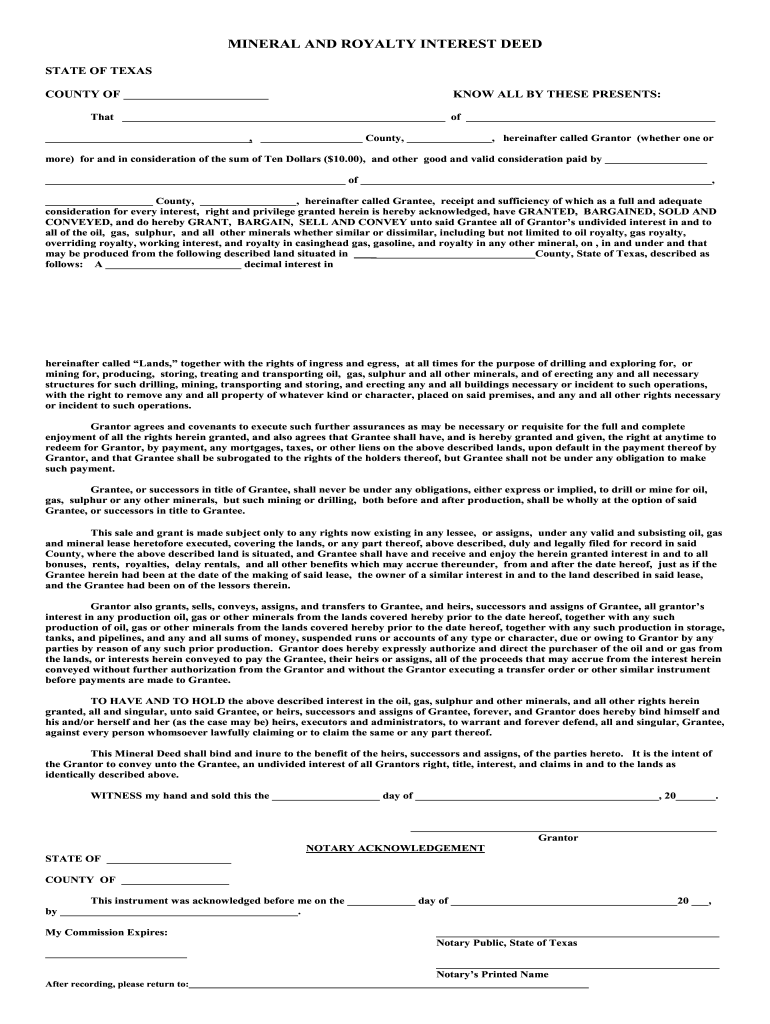







Definition & Meaning
A mineral rights deed transfer form is a legal document used to transfer ownership rights of minerals such as oil, gas, and other valuable resources from one party (Grantor) to another (Grantee). This document serves as a formal agreement that outlines the specific mineral interests being transferred, including any rights to explore, extract, and develop these resources. It is crucial for ensuring that both parties have a mutual understanding of the rights and obligations associated with the mineral interests, particularly for land situated in areas like Texas, where mineral rights can significantly impact land value.
Key Components of the Form
- Grantor and Grantee Information: Details of both parties involved in the transfer.
- Legal Description of Property: Accurate description of the land where the mineral interests exist.
- Consideration Details: The compensation or exchange value for the mineral rights transfer.
- Terms of Transfer: Conditions under which the rights are transferred, including any existing leases.
- Signatures: Both parties must sign the document to authenticate the transfer.
Steps to Complete the Mineral Rights Deed Transfer Form
Completing a mineral rights deed transfer form requires precision to ensure legal validity and protect the interests of both parties involved.
- Gather Necessary Information: Collect all relevant details of the Grantor and Grantee, as well as the exact legal description of the property.
- Describe the Mineral Interests: Clearly outline the scope of mineral rights being transferred, inclusive of any existing lease agreements.
- Fill in Consideration Clause: Specify the financial or trade consideration being provided for the transfer.
- Review Terms and Conditions: Thoroughly read the transfer terms to understand obligations and rights.
- Sign and Date the Document: Both parties need to sign the form in the presence of a notary public for legal validation.
- Record the Deed: Submit the signed document to the appropriate local government office, often the County Clerk, to record the transfer officially.
Key Elements of the Mineral Rights Deed Transfer Form
The form is structured to capture essential information crucial for a seamless transfer process.
- Legal Descriptions: Detailed account of land plots or acreage involved.
- Grantor’s Warranties: Assurances by the Grantor that they own the rights being transferred and that they are free of liens or encumbrances.
- Indemnity Clause: Protects parties against potential legal disputes over ownership claims.
- Habendum Clause: Defines the duration and extent of the Grantee's rights in the mineral resources.
- Existing Agreement Acknowledgment: Documentation of existing leases or rights assignments pertinent to the mineral interests.
State-specific Rules for the Mineral Rights Deed Transfer Form
The rules governing mineral rights transfers can vary significantly from one state to another.
- Texas: Highly intricate due to its historical context of oil and gas extraction. Specific agencies oversee the management of mineral rights.
- Louisiana: Utilizes a unique system called "unitization," which affects the pooling of resources across multiple properties.
- North Dakota: As a part of the Bakken oil field, the state imposes specific zoning and environmental considerations.
Important Terms Related to Mineral Rights Deed Transfer Form
Understanding the terminology associated with this form is crucial for accurate interpretation and execution.
- Royalty Interest: The percentage of revenue from the resource extraction granted without incurring extraction costs.
- Pooling and Unitizing: Combining neighboring land tracts to optimize resource exploration.
- Surface Rights vs. Mineral Rights: Distinction between owning the land surface and subsurface resources.
- Severance: The legal act of separating mineral rights from surface rights.
Examples of Using the Mineral Rights Deed Transfer Form
Real-world scenarios illustrate the practical application of this form.
- Family Transfers: Transferring mineral rights to heirs or family members as part of estate planning.
- Business Transactions: Companies securing the rights to explore and extract minerals as part of oil and gas ventures.
- Investment Sales: When selling land, ensuring that mineral rights are excluded or transferred as per the buyer’s needs.
Legal Use of the Mineral Rights Deed Transfer Form
This form is legally binding and subject to state and federal laws governing mineral rights.
- Compliance with ESIGN Act: Ensures electronic signatures on the form are legally valid.
- Recording Requirements: Must be filed and recorded according to local jurisdiction to affect the transfer officially.
- Resolution of Disputes: Typically requires arbitration or court proceedings based on the form’s agreements.
Who Typically Uses the Mineral Rights Deed Transfer Form
Understanding who frequently engages with this form can provide context.
- Landowners: Individuals owning significant tracts of land with mineral potential.
- Oil and Gas Companies: Entities looking to secure mineral rights for exploration and extraction.
- Investors: Parties interested in purchasing mineral rights as economic investments.
- Heirs and Family Members: Those involved in the inheritance of mineral rights as part of an estate.