




01. Edit your free printable vital signs sheet online
Type text, add images, blackout confidential details, add comments, highlights and more.

Type text, add images, blackout confidential details, add comments, highlights and more.

Draw your signature, type it, upload its image, or use your mobile device as a signature pad.

Send vital signs sheet for multiple patients free via email, link, or fax. You can also download it, export it or print it out.
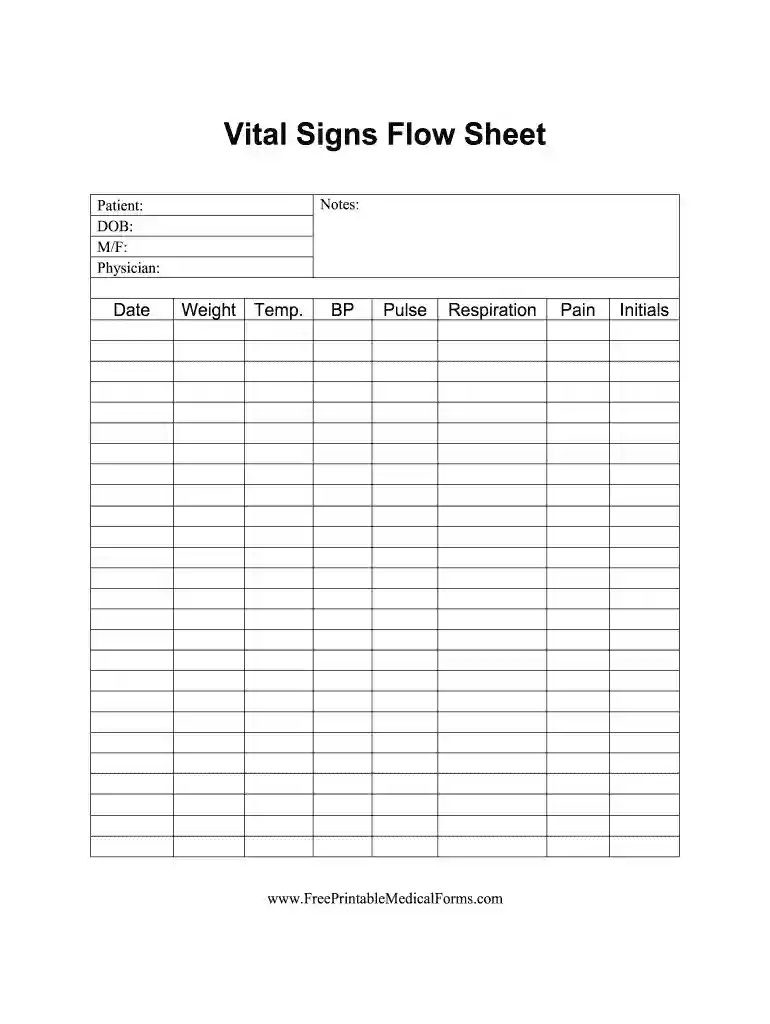
A vital sign sheet is a document used primarily in healthcare settings to record critical patient information, including essential indicators of a patient's health. These indicators often include temperature, blood pressure, pulse, respiration rate, pain levels, and weight. The purpose of this sheet is to provide healthcare practitioners with a standardized method to monitor and track patients' vital signs over time, enabling effective assessment of health conditions and timely interventions when necessary.
The vital sign sheet serves multiple functions:
The vital sign sheet encompasses various fields that contribute to a holistic understanding of a patient’s health status. Key elements typically include:
Accurate completion of these fields is vital for effective patient assessment.
Completing a vital sign sheet requires careful attention to detail to ensure that the information recorded is accurate and useful. The following steps outline this process:
Gather Necessary Equipment: Ensure you have a thermometer, sphygmomanometer (blood pressure cuff), pulse oximeter, and a scale for weight measurement.
Identify the Patient: Confirm the patient's identity using identifiers, such as name and date of birth, to prevent errors in documentation.
Measure Vital Signs:
Document Readings: Record each measurement in the appropriate fields on the vital sign sheet, ensuring to note the date and time of each measurement.
Review and Sign: Double-check the recorded information for accuracy and completeness. Then, sign the sheet if required, verifying that the documentation is complete.
File Appropriately: Ensure the completed sheet is stored in the patient's medical records for future reference by authorized personnel.
The vital sign sheet is utilized by a variety of healthcare professionals, including:
Usage of the vital sign sheet is essential for maintaining high standards of patient care across various healthcare environments.


Using a vital sign sheet is crucial for several reasons:
Each healthcare facility may have specific policies that mandate the regular use of vital sign sheets to uphold care standards.
At DocHub, your data security is our priority. We follow HIPAA, SOC2, GDPR, and other standards, so you can work on your documents with confidence.






4 days ago The Expedition project is done in six stages. After completion of all stages of the Expedition requirements, players can decide to depart withRead more
The primary vital signs include body temperature, heart rate (pulse), respiratory rate, blood pressure, and oxygen saturation. Page 4. 4. Importance ofRead more
Vital Signs. STUDY NAME. Site Number: PtID: Visit Date: / / . d d m m m y y y y.Read more


