




01. Edit your ss4 form example online
Type text, add images, blackout confidential details, add comments, highlights and more.

Type text, add images, blackout confidential details, add comments, highlights and more.

Draw your signature, type it, upload its image, or use your mobile device as a signature pad.

Send ss 4 form via email, link, or fax. You can also download it, export it or print it out.
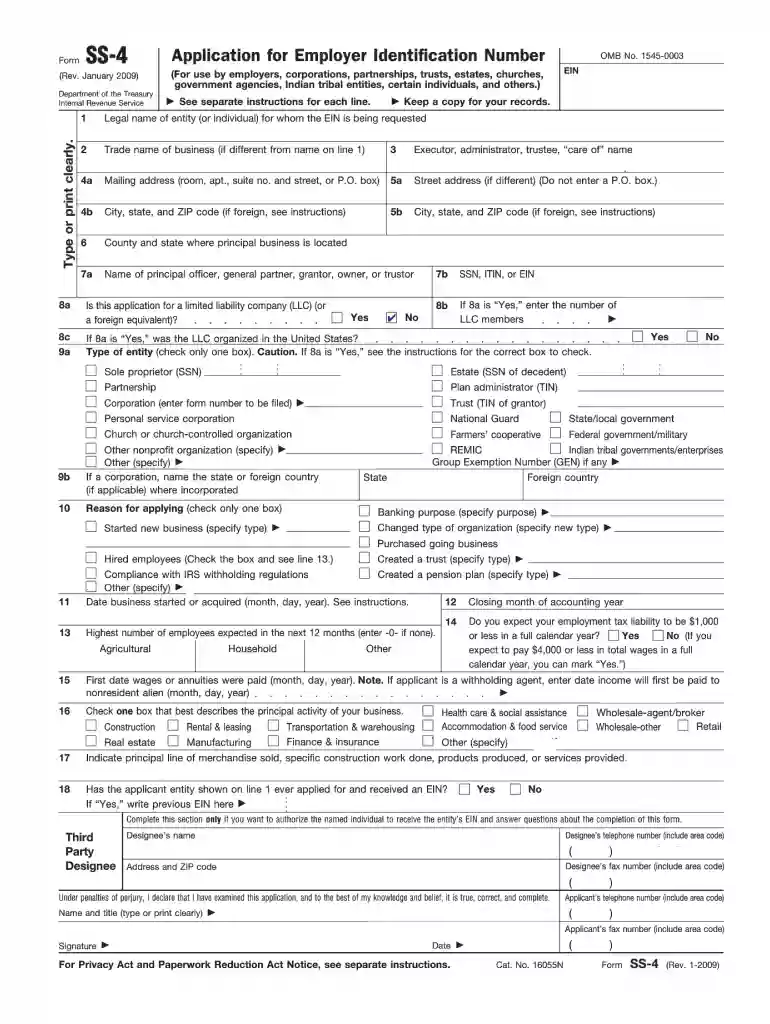
The SS-4 form, officially known as the Application for Employer Identification Number (EIN), is issued by the Internal Revenue Service (IRS). It is primarily used by various entities such as businesses, trusts, and organizations, including 4-H Clubs, to obtain an EIN. An EIN is necessary for tax administration purposes and serves as a unique identifier similar to a social security number for individuals. Entities use this number in fulfilling tax obligations, opening bank accounts, hiring employees, and conducting other business activities.
Identify the Correct Entity Type:
Provide Entity Information:
Specify the Reason for Applying:
Detail Employment Tax Liability:
Signature and Submission:
The SS-4 form can be easily accessed via the IRS website where it is downloadable in PDF format. Alternatively, you can request a paper form by calling the IRS or through various tax software like TurboTax and QuickBooks which offer guided completion of the form.
There is no specific deadline for filing the SS-4 form; however, it is advisable to file the form as soon as you form a new business or hire employees. Prompt filing ensures that business operations are not disrupted due to a lack of an EIN, which may be requested by banks or suppliers at the onset of activities.
Entities such as new businesses, existing businesses undergoing restructuring, or those needing to comply with tax reporting requirements use the SS-4 form. Non-profit organizations, estates, and churches may also apply for an EIN to satisfy federal tax requirements.


The IRS stipulates that the EIN should be used for tax-related purposes only and not for social security or employment identification. Applicants must ensure that they meet the entity definition as provided by IRS guidelines, and any changes after submission need to be communicated directly to the IRS for updates.
A start-up technology company applies for an EIN to open a business bank account and register for payroll taxes. Similarly, a trust established following an estate plan uses the SS-4 form to manage the trust’s financial activities under a recognized IRS identifier.
We've got more versions of the ss4 form example form. Select the right ss4 form example version from the list and start editing it straight away!
| Versions | Form popularity | Fillable & printable |
|---|---|---|
| 2025 | 4.2 Satisfied (52 Votes) | |
| 2023 | 4.5 Satisfied (28 Votes) | |
| 2019 | 4.8 Satisfied (101 Votes) | |
| 2017 | 4.3 Satisfied (121 Votes) | |
| 2010 | 4.1 Satisfied (54 Votes) | |
| 2009 | 4 Satisfied (34 Votes) | |
| 2007 | 4.2 Satisfied (47 Votes) | |
| 2001 | 4 Satisfied (47 Votes) | |
| 2000 | 4 Satisfied (44 Votes) | |
| 1998 | 4 Satisfied (47 Votes) |
At DocHub, your data security is our priority. We follow HIPAA, SOC2, GDPR, and other standards, so you can work on your documents with confidence.
The taxpayer must obtain an employer identification number (EIN) by filing an application with the Internal Revenue Service (IRS) on IRS Form SS-4.Read more
If the entity electing to be classified using. Form 8832 does not have an EIN, it must apply for one on Form SS-4, Application for. Employer IdentificationRead more
to fax the EIN without a cover sheet. Mail. Complete Form SS-4 at least 4 to 5 weeks before you. For more information about filing Form SS-4 and related willRead more


