







Definition and Meaning of Form 1099
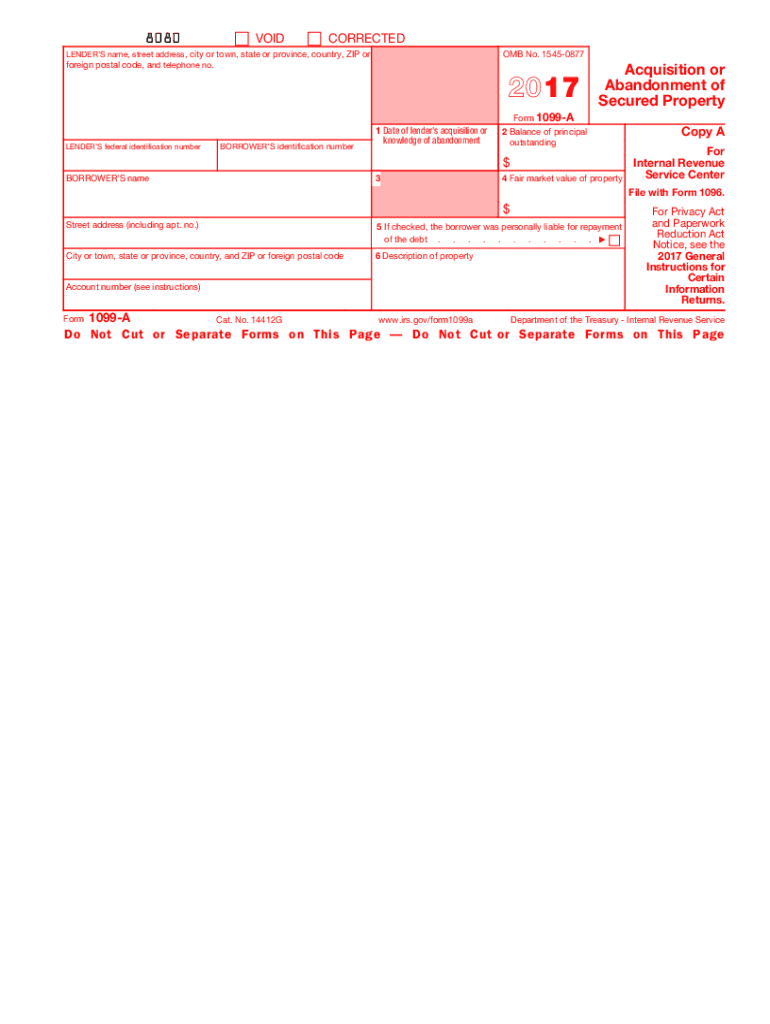
Form 1099 is an essential tax document used to report various types of income other than wages, salaries, and tips. In the context of the 1099 form series, the 1099-A specifically addresses the acquisition or abandonment of secured property, often utilized by financial institutions. It provides detailed information on factors such as the fair market value of the property and the outstanding loan balance at the time of the event. This data is crucial for both tax reporting and compliance purposes, guiding taxpayers through specific situations where traditional income reporting does not apply.
How to Use the Form 1099 for 2017
Utilizing the Form 1099 for the year 2017 requires understanding its application areas. Taxpayers typically receive this form from entities that report income paid to individuals, such as independent contractors, freelancers, and investors. Recipients should review all information reported on the form for accuracy, ensuring figures align with personal records. If discrepancies are found, it is important to contact the issuer immediately to prevent inaccuracies when filing your tax return. After confirming all details, recipients use the 1099 form data to fill out the specified lines on their tax return, accurately reflecting the income to the IRS.
How to Obtain a 2017 Form 1099
Obtaining a 2017 Form 1099 typically involves a few straightforward steps:
-
Contact the Issuer: Financial institutions, businesses, or entities that paid the income are responsible for issuing the form. If you have not received your form by January 31, contact them directly.
-
Access Online Accounts: Many companies allow taxpayers to access their documents through online accounts. Logging into these portals can help you view and download Form 1099 as needed.
-
Request from the IRS: If attempts to contact the issuer fail, taxpayers can contact the IRS for assistance. The IRS may request additional information to facilitate a resolution.
Steps to Complete the Form 1099 for 2017
Completing the Form 1099 for 2017 involves a series of defined steps to ensure accuracy:
-
Verify Personal Details: Ensure that all personal information, such as name, address, and taxpayer identification number (TIN), is correct.
-
Review Financial Figures: Confirm all amounts reported, including total income, are accurate and reflect your records.
-
Reconcile with Personal Records: Cross-check provided data with your own financial records, ensuring consistency across all documents.
-
Fill Out Tax Return: Transfer accurate information from Form 1099 to the appropriate sections of your tax return.
-
Consult a Tax Professional: If complexities arise, consulting with a tax professional can provide clarity and assistance.
Important Terms Related to the Form 1099 for 2017
Understanding the terminology associated with Form 1099 is vital for proper filing:
- Payer: The entity issuing the form and making payments.
- Recipient: The individual or entity receiving income reported on the form.
- Tax Identification Number (TIN): Your unique IRS number necessary for tax purposes.
- Fair Market Value (FMV): The price at which property would sell in a fair sale.
- Box 1, 2, etc.: Specific fields outlining income types and identifiers.
IRS Guidelines for Form 1099 for 2017
The IRS provides strict guidelines dictating the use and submission of Form 1099:
- Deadline: Issuers must send the form to recipients by January 31.
- Electronic and Paper Filing: Ensure single-copy scannability for IRS processing, favoring electronic submission for efficiency.
- Corrections: Follow IRS procedures promptly if errors are detected, preventing filing complications.
Filing Deadlines / Important Dates
- Recipient Deadline: January 31 is the deadline for the form to arrive in the recipient's hands.
- IRS Submission: By March 31, if filed electronically; February 28 for paper submissions.
- Amendment and Correction Penalties: Address inaccuracies promptly to avoid potential penalties.
Form Submission Methods
The Form 1099 can be submitted through several methods, including:
- Online Filing: Use tax software compatible with IRS eFiling systems for ease.
- Mail Submission: For paper forms, ensure precision and timeliness in mailing to prevent late penalties.
- In-Person: Some tax service providers offer direct submission assistance for those requiring additional help.




