




01. Edit your tsp rbco form online
Type text, add images, blackout confidential details, add comments, highlights and more.

Type text, add images, blackout confidential details, add comments, highlights and more.

Draw your signature, type it, upload its image, or use your mobile device as a signature pad.

Send rbco via email, link, or fax. You can also download it, export it or print it out.
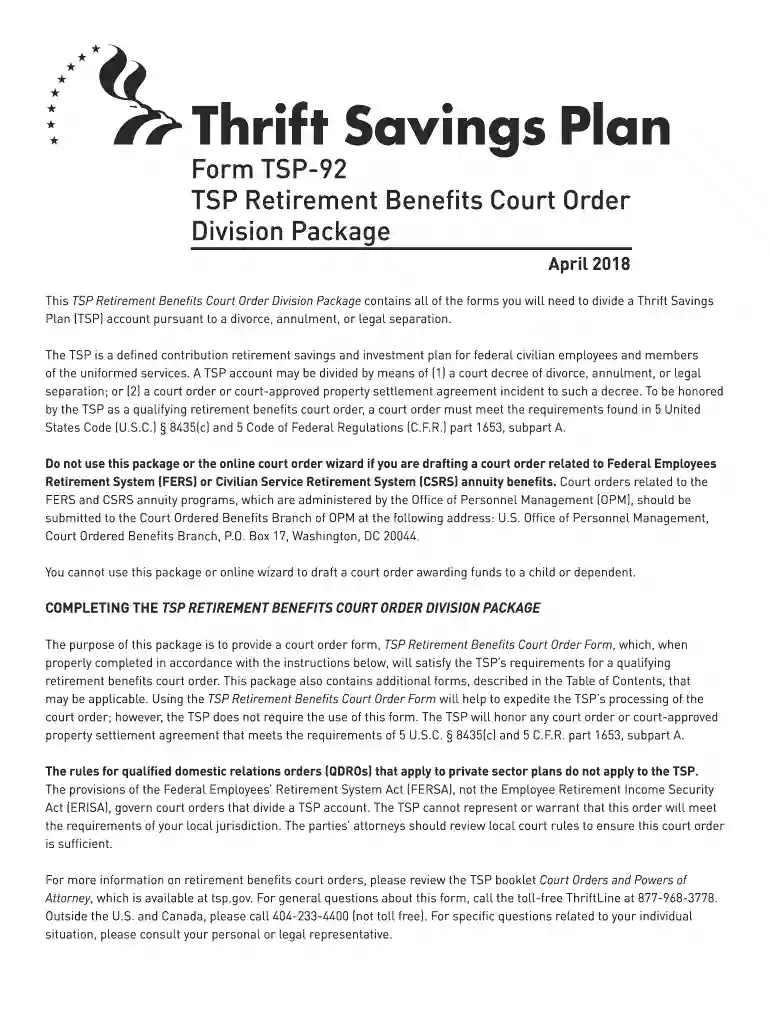
The TSP Retirement Benefits Court Order Division Package is a collection of essential forms and instructions for dividing a Thrift Savings Plan (TSP) account due to divorce, annulment, or legal separation. Understanding these components is crucial for individuals going through family law proceedings that involve this government retirement account.
Court Order Requirements: Only specific court orders are recognized by the TSP, meaning the order should adhere to federal regulations and guidelines laid out by the TSP. This often requires careful drafting to ensure that the language and stipulations align with TSP rules.
Non-Applicability: It is important to note that this package is not applicable for dividing Federal Employees Retirement System (FERS) or Civil Service Retirement System (CSRS) benefits; it is strictly designed for TSP accounts.
Purpose of the Package: The primary purpose of this package is to facilitate the proper and legal allocation of retirement funds between parties undergoing separation. This is vital for ensuring that retirement accounts are equitably divided, which can significantly impact both parties' financial futures.
Completing the TSP Retirement Benefits Court Order Division Package involves several specific steps that must be followed meticulously to ensure compliance with TSP requirements.
Gather Necessary Information: Start by collecting all relevant details about the TSP account, including account numbers and details about the account holder.
Consult Legal Resources: Engage with a legal professional familiar with family law to ensure that the court order meets all legal requirements and accurately represents the intentions of both parties.
Complete Required Forms: Fill out the appropriate forms within the package. This includes the necessary court order and any accompanying documents.
Obtain Court Approval: Submit the completed court order to the appropriate court for approval. The court must officially approve the order before it can be executed.
Submit to the TSP: Once the court has approved the order, submit the signed court order, along with any additional documentation required by the TSP. This can often be sent via mail or electronically, depending on the TSP's guidelines.
Monitor the Process: After submission, monitor the status of the court order within the TSP system to ensure that the division is processed correctly.
Understanding key terminology associated with the TSP Retirement Benefits Court Order Division Package is vital for ensuring compliance and accurate completion.
Qualified Domestic Relations Order (QDRO): A legal order that allows one spouse to receive a portion of the other spouse’s retirement benefits in the event of a divorce or separation. While the QDRO is a widely recognized term, within the context of TSP, the specific court order must meet the TSP's requirements.
Beneficiary Designation: Refers to the individual(s) who will receive the benefits from the TSP account after the account holder's passing. It is crucial to update this designation following any divorce or separation.
Retirement Benefits Specialist: A TSP employee who manages retirement benefit procedures and assists in processing court orders pertaining to TSP accounts.
FERS and CSRS: These are two types of retirement systems for federal employees that are distinct from the TSP. Understanding their differences is essential for accurately handling retirement benefits amid a divorce or legal separation.
The legal usage of the TSP Retirement Benefits Court Order Division Package is governed by federal law, particularly the provisions designed to protect the division of retirement assets during marital dissolution.
Legal Requirements: The court order must explicitly state how the TSP account is to be divided, ensuring that it complies with federal guidelines. This often involves clear language and specific directives regarding the percentage or amount being transferred.
Federal Regulations: Adherence to the TSP guidelines is mandatory for the court order to be recognized. Non-compliance may result in the court order being deemed invalid, thus failing to divide the retirement benefits effectively.
Tax Implications: When a TSP account is divided via a court order, there can be tax implications for both parties. It's crucial to understand how these transactions are taxed to avoid unexpected liabilities.
Real-world examples highlight how the TSP Retirement Benefits Court Order Division Package is utilized in different scenarios, ensuring that individuals understand its practical applications.
Divorce Case: In a divorce scenario where one spouse has been a federal employee, the TSP Retirement Benefits Court Order Division Package enables that spouse to receive a portion of the TSP retirement funds. This helps in achieving a fair financial settlement.
Legal Separation: Similar processes apply during legal separations. Parties may use the package to ensure that retirement benefits are accounted for in their separation agreement.
Amending Prior Agreements: If a couple had a prior agreement that did not address the TSP, they can utilize this package to amend their legal documents and include TSP benefits in their current negotiations.
Understanding deadlines related to the TSP Retirement Benefits Court Order Division Package is crucial for ensuring timely completion and submission.
Court Submission Deadlines: Each state may have specific timelines for submitting court orders during divorce proceedings. It is essential to check local regulations to avoid delays.
TSP Processing Timeframe: After submission, the TSP may require a certain number of days to process the court order. Knowing this timeframe can help in planning for financial adjustments post-divorce.
Time Sensitivity of Financial Decisions: For individuals nearing retirement or considering significant life changes, being aware of these timelines can add urgency to the completion of this package.
We've got more versions of the tsp rbco form form. Select the right tsp rbco form version from the list and start editing it straight away!
At DocHub, your data security is our priority. We follow HIPAA, SOC2, GDPR, and other standards, so you can work on your documents with confidence.
Apr 30, 1971 The 620/L is 100% I/O-and soft- ware-compatible with the 620/i, and new peripherals and software have been added. All peripherals, software, andRead more
Form TSP-5L. INSTRUCTIONS. FOR SECTION II. This form must be certified by the agency for processing. Forms that are not signed will be returned unprocessedRead more


