
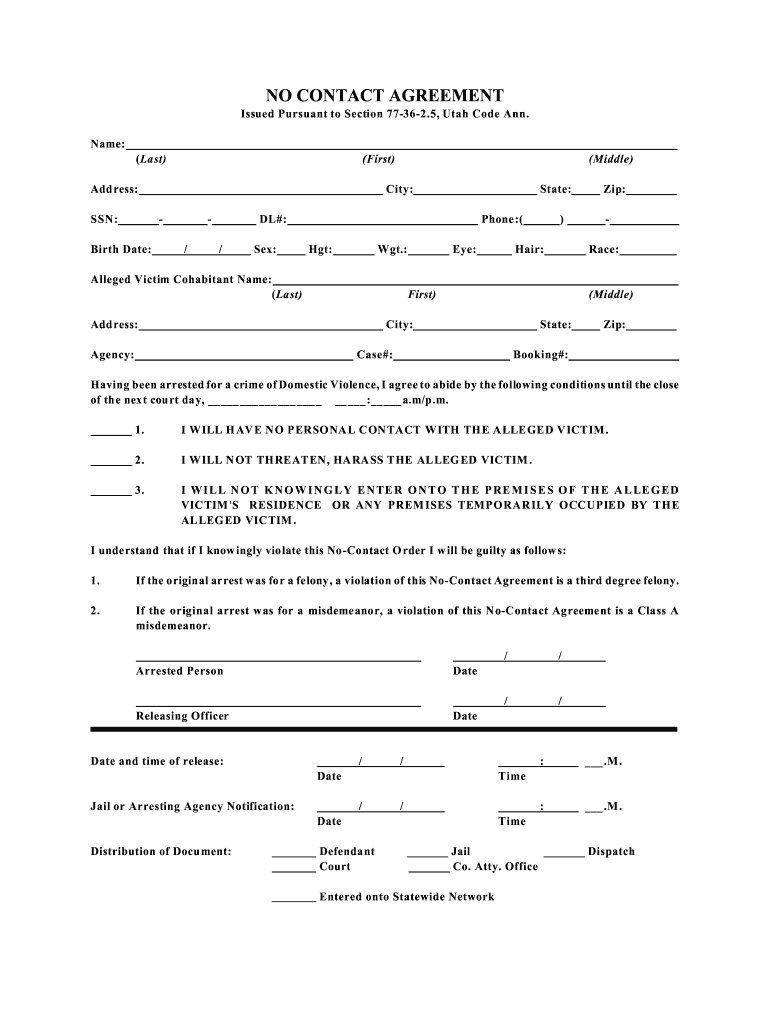







Definition and Meaning of a No Contact Contract
A no contact contract is a legally binding agreement that stipulates that one party must refrain from contacting another party. Often used in situations involving domestic violence, harassment, or conflicts in various contexts such as educational institutions, the primary purpose of this agreement is to protect individuals from unwanted communication. Such contracts outline the specific terms under which contact is prohibited, ensuring that the involved parties understand the limitations and implications of breaching the agreement. A no contact contract may take various forms, including templates tailored for use in schools, legal settings, or personal situations.
Key Purposes of a No Contact Contract
- Protection of individuals: The primary intent is to safeguard the well-being of the individual who may feel threatened or uncomfortable due to contact from another party.
- Clarification of boundaries: The no contact contract defines clear boundaries, helping to eliminate ambiguity concerning what constitutes acceptable versus unacceptable interactions.
- Legal implications: Breaching this agreement could lead to legal consequences, reinforcing the seriousness of adhering to the outlined terms.
Important Terms Related to a No Contact Contract
Understanding the terminology associated with a no contact contract is crucial for all parties involved. Common terms include:
- Complainant: The individual who feels threatened or harassed and seeks the protection of the no contact agreement.
- Respondent: The individual restricted by the contract from contacting the complainant.
- Effective date: The date when the no contact contract becomes enforceable.
- Violation: Any breach of the terms set forth in the agreement, potentially resulting in legal action.
These terms help frame the context in which a no contact contract is applied, allowing all parties to have a clear understanding of their rights and responsibilities.
How to Use the No Contact Contract
Utilizing a no contact contract effectively involves a few essential steps. Here’s how to implement such an agreement:
- Identify the Need for the Contract: Determine the necessity based on the type of situation (e.g., workplace harassment, school conflicts).
- Draft the Contract: Use a no contact contract template suitable for the specific context (e.g., school, legal, personal). Ensure it includes crucial components such as definitions, the effective date, and contact restrictions.
- Review and Sign: Both parties should thoroughly review the terms before signing the contract. It might also be beneficial to have a witness or legal professional present for clarity.
- Distribute Copies: After signing, distribute copies of the signed contract to ensure both parties have access to the terms for future reference.
- Monitor Compliance: Keep track of compliance with the agreement. If violations occur, document them for any necessary legal follow-up.
These steps provide a structured approach to establishing a no contact contract, ensuring all parties are informed and protected.
Who Typically Uses a No Contact Contract?
Various individuals and institutions may utilize a no contact contract, including:
- Victims of domestic violence: Individuals seeking protection from an aggressor often use these contracts to ensure their safety.
- Educational institutions: Schools may implement no contact agreements among students to prevent harassment or bullying.
- Workplaces: Employers may enforce no contact contracts in cases of workplace harassment or disputes between employees.
- Legal situations: Courts may issue no contact contracts as part of protective orders, ensuring that one party refrains from contacting another.
Understanding the diverse contexts in which these contracts are employed can help in recognizing their significance and the necessity for adherence.
Legal Use of the No Contact Contract
The legal standing of a no contact contract can vary based on jurisdiction and specific circumstances. It is vital to ensure that the contract complies with local laws governing harassment and protection orders. Key points regarding the legal use include:
- Enforceability: For a no contact contract to be enforceable, it must be clear, specific, and agreed upon by all parties involved.
- Documentation: Violations of the no contact agreement must be documented as they may serve as evidence in any ensuing legal proceedings.
- Court Involvement: In cases where legal measures are taken, courts may use no contact contracts to determine terms for protective orders and restraining orders.
Grasping these legal nuances ensures both parties are aware of their rights and the potential consequences of violating the agreement.
Examples of Using the No Contact Contract
To illustrate the application of a no contact contract in real-world scenarios, consider the following examples:
- School Setting: A high school student may request a no contact agreement if they are being bullied by a peer. The school would facilitate the contract, clearly stating that both parties must refrain from any form of communication during school hours and events.
- Work Environment: An employee may feel threatened by a coworker’s persistent unwanted advances. They can work with human resources to create a no contact contract, formally stating that the parties cannot communicate in person or through electronic means.
- Domestic Violence Case: A victim may pursue a no contact agreement as part of their protective order, specifying that the perpetrator must avoid all direct or indirect contact.
These examples reflect how no contact contracts can be adapted to various situations, highlighting their importance in personal safety and conflict resolution.




