




01. Edit your pre employment questionnaire equal opportunity employer online
Type text, add images, blackout confidential details, add comments, highlights and more.

Type text, add images, blackout confidential details, add comments, highlights and more.

Draw your signature, type it, upload its image, or use your mobile device as a signature pad.

Send application for employment pre employment questionnaire via email, link, or fax. You can also download it, export it or print it out.
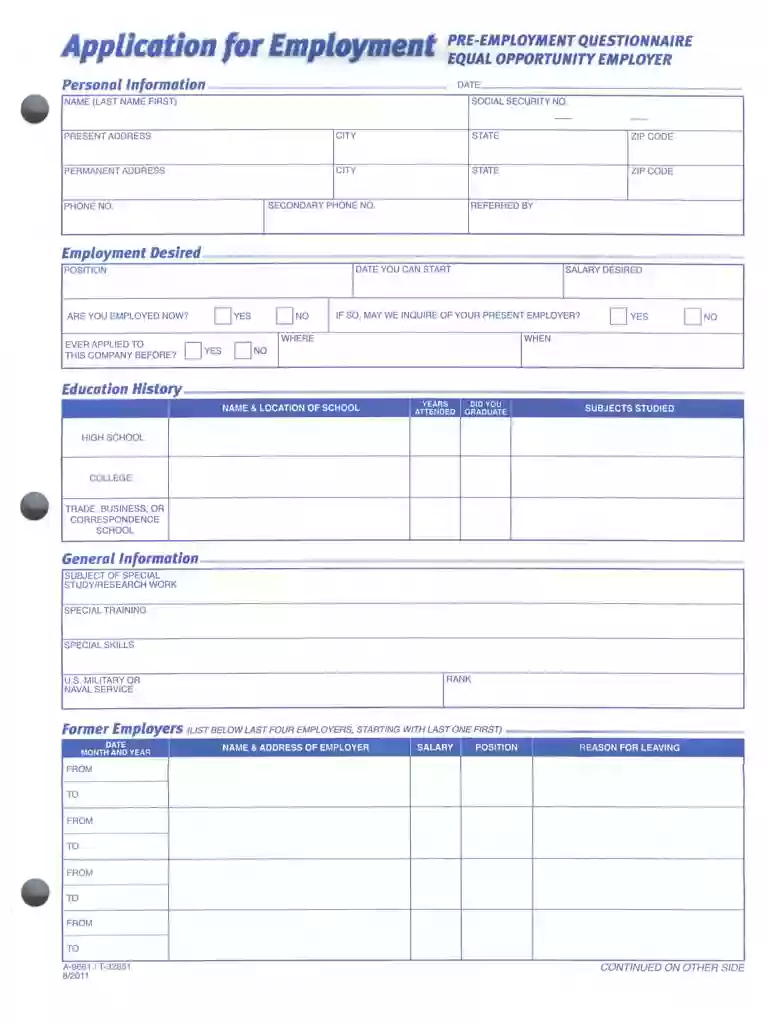
A pre-employment questionnaire for equal opportunity employers is a fundamental tool that organizations use to gather essential information from job applicants while adhering to equal employment opportunity laws. This form typically collects personal information, including the individual's name, contact details, and demographic data, as well as employment history, educational background, and references. The objective of this questionnaire is to establish a structured approach to assessing candidates without discrimination based on race, color, religion, sex, or national origin.
By ensuring that all applicants complete this questionnaire, employers can create a unified hiring process that promotes fairness and transparency.
Completing the pre-employment questionnaire requires careful attention to detail and honesty. Applicants must understand that this document is often the first point of contact with a potential employer.
The pre-employment questionnaire must be designed and implemented following federal and state laws governing equal employment opportunities. Employers have a responsibility to ensure their hiring practices are non-discriminatory.
A well-structured questionnaire is critical for both applicants and employers. The key elements ensure that relevant information is gathered efficiently.
Real-world application of the pre-employment questionnaire demonstrates its importance in various industries. Companies leverage this tool to maintain consistent hiring practices.
Through these examples, organizations can see how standardizing the pre-employment process fosters fairness and efficiency in recruiting new talent.
A structured pre-employment questionnaire benefits both employees and employers. It lays the groundwork for a transparent and equitable hiring process, aligning with the organization's commitment to equal opportunity employment.
In summary, the pre-employment questionnaire for equal opportunity employers is vital for establishing a fair hiring framework, fostering an inclusive workplace, and remaining compliant with legal obligations.
At DocHub, your data security is our priority. We follow HIPAA, SOC2, GDPR, and other standards, so you can work on your documents with confidence.
APPLICATION FOR EMPLOYMENT PRE-EMPLOYMENT QUESTIONNAIRE. PERSONAL INFORMATION. NAME (LAST NAME FIRST). EQUAL OPPORTUNITY EMPLOYER. DATE. SOCIAL SECURITY NORead more
May 8, 2021 Our company is an equal opportunity employer. We do not tolerate discrimination on any factor aside from those which are based on merit orRead more
The ADA places restrictions on employers when it comes to asking job applicants to answer medical questions, take a medical exam, or identify a disability.Read more


