
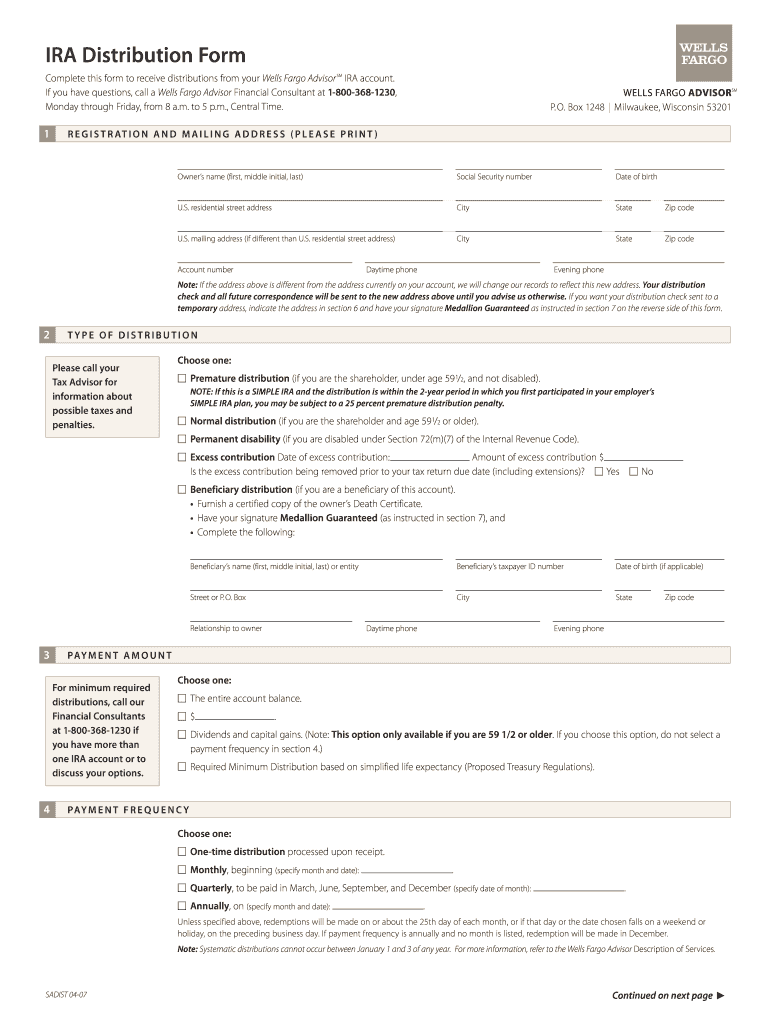







Definition and Meaning of Wells Fargo IRA Distribution Form
The Wells Fargo IRA Distribution Form is an official document designed for account holders of Wells Fargo who wish to request distributions from their Individual Retirement Accounts (IRAs). This form serves multiple purposes, allowing clients to withdraw funds, allocate payment amounts, and specify the frequency of distributions. The importance of the form lies in its role in managing retirement savings and ensuring that withdrawals comply with Internal Revenue Service (IRS) regulations.
By utilizing this form, account holders can navigate the complexities of IRA distributions, including tax implications, required minimum distributions (RMDs), and potential penalties for early withdrawal. It involves sections that require personal information, types of distributions—such as traditional IRA withdrawals or Roth IRA distributions—and key selections regarding tax withholding. Understanding the purpose and details of this form is essential for effective retirement planning and compliance with federal regulations.
How to Obtain the Wells Fargo IRA Distribution Form
The Wells Fargo IRA Distribution Form can be obtained through various channels, ensuring ease of access for account holders. Here are several ways to acquire the necessary document:
- Wells Fargo Online Banking: Account holders can log into their online banking portal. The form is often available in the document section, where users can download it directly in PDF format.
- Branch Location: Clients may visit a local Wells Fargo branch and request the form from bank associates. They are equipped to provide the necessary assistance and answer questions.
- Customer Service: Calling Wells Fargo customer service can facilitate obtaining the form. Representatives can guide clients on how to access it digitally or physically.
- Official Website: The Wells Fargo website often hosts a library of forms in a downloadable format. Clients should navigate to the relevant section for retirement accounts to find and download the IRA distribution form.
Utilizing these channels ensures that clients obtain the correct and most current version of the form for their IRA distribution requests.
Steps to Complete the Wells Fargo IRA Distribution Form
Completing the Wells Fargo IRA Distribution Form involves clear steps to ensure all necessary information is accurately provided. Here is a structured approach:
-
Personal Information Section:
- Fill in your full name, address, Social Security number, and account number. Accuracy in this section is vital to ensure proper identification and processing of your request.
-
Distribution Details:
- Specify the type of distribution you are requesting. This includes options such as unscheduled withdrawals, scheduled periodic payments, or transfers to another IRA.
-
Amount and Frequency:
- Indicate the amount you wish to withdraw and the frequency of distribution (e.g., one-time, monthly, quarterly). This section may require careful calculation, especially for those managing RMDs.
-
Tax Withholding Choices:
- Choose the tax withholding preferences applicable to your situation. The form typically includes a section for selecting federal and state tax withholding percentages.
-
Signature and Date:
- After completing the form, provide your signature and the date. This signifies your agreement with the distribution request and authorizes Wells Fargo to process it.
Each step is important to ensure compliance with IRS guidelines and proper handling of your retirement assets. Failing to complete any section may delay the processing of your distribution request.
Important Terms Related to Wells Fargo IRA Distribution Form
Understanding key terms is essential for effectively navigating the Wells Fargo IRA Distribution Form. Here are some important terms and their meanings:
- IRA (Individual Retirement Account): A tax-advantaged personal savings account designed to help individuals save for retirement. Contributions may be tax-deductible, and the account's earnings grow tax-deferred.
- Distribution: A withdrawal from an IRA account, which can occur under various circumstances, such as retirement, reaching a specific age, or due to financial hardship.
- RMD (Required Minimum Distribution): The minimum amount that must be withdrawn from a traditional IRA after a certain age, typically seventy-two. Not taking RMDs can result in severe penalties.
- Tax Withholding: The portion of a distribution that is retained by the institution to pay federal and state taxes on behalf of the account holder.
- Penalty for Early Withdrawal: A tax penalty incurred when funds are withdrawn from an IRA before reaching age fifty-nine and a half, which is generally ten percent of the taxable amount withdrawn.
Familiarity with these terms aids in understanding how the distribution process operates within the framework of IRA management and IRS regulations.
Key Elements of the Wells Fargo IRA Distribution Form
The Wells Fargo IRA Distribution Form contains several key elements that facilitate the processing of distribution requests. Understanding these components ensures that account holders provide all necessary information:
- Personal Information Section: Essential for identifying the account holder accurately. Must include correct name, address, and account details to prevent processing delays.
- Type of Distribution Options: Allows the account holder to select from various distribution options, such as direct transfers, lump-sum withdrawals, or periodic payments, depending on individual needs.
- Payment Amount and Frequency: Clients must specify the amount to be distributed and how often the distributions will be made. This serves to establish a clear distribution schedule.
- Tax Withholding Instructions: A critical section that allows the account holder to elect how much tax to withhold from distributions to comply with federal and state tax obligations.
- Signature and Authorization: Finalizes the form, ensuring the bank has the account holder’s explicit consent to proceed with the requested distribution.
Each of these elements plays a crucial role in ensuring that the distribution process runs smoothly and in accordance with regulatory requirements. Addressing each component carefully aids in preventing errors that could delay fund disbursement.




