
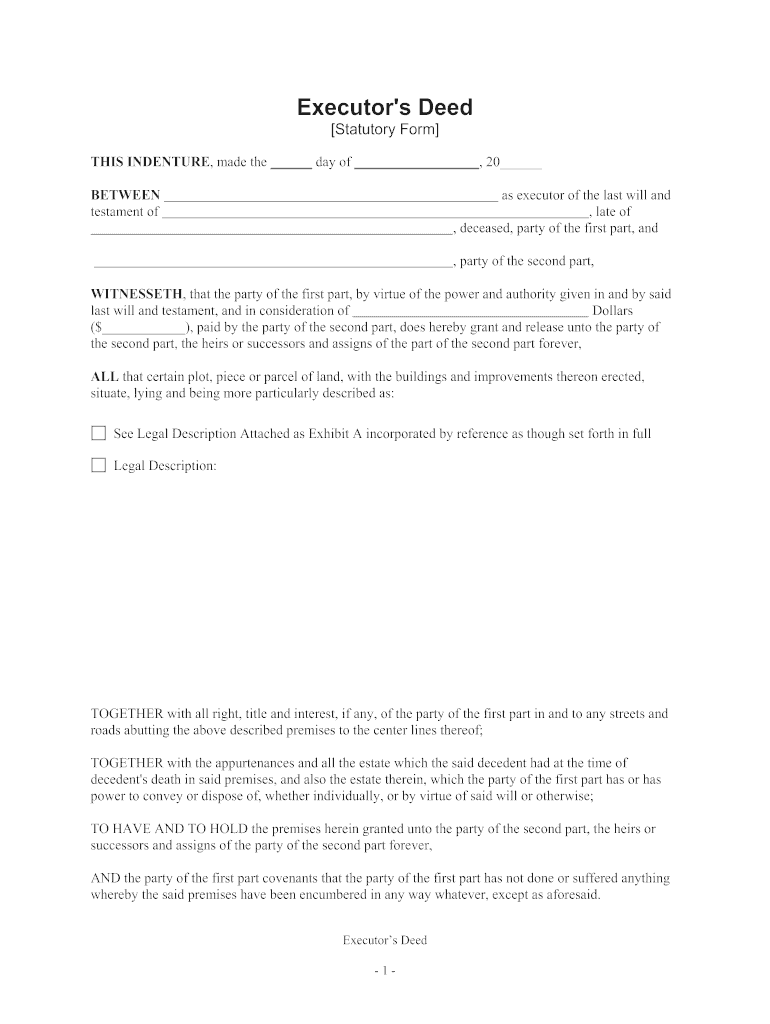







Definition & Meaning of the Executor's Deed in Texas
An executor's deed, or executor's deed Texas, serves as a legal instrument for transferring property from a deceased person's estate to a designated beneficiary, in accordance with the decedent’s last will and testament. This document is crucial in the estate settlement process, allowing the executor—who is the individual appointed to manage the decedent's estate—to convey real estate comprising various forms, such as residential, commercial, or undeveloped land.
Key elements of the executor’s deed include:
- Identification of the parties: Names of the deceased (grantor), executor, and the grantee (beneficiary).
- Description of the property: A clear legal description of the real estate being conveyed.
- Consideration: Any payment or compensation for the property, often nominal if the deed is transferring property as part of inheriting the estate.
- Covenants and assurances: Statements regarding any encumbrances on the property and the executor’s authority to transfer property.
This deed must be duly executed by the appointed executor and acknowledged before a notary public and then filed with the appropriate county clerk's office.
Key Elements of the Executor's Deed in Texas
Understanding the specific components of an executor's deed is essential for ensuring that the document meets legal requirements and serves its purpose effectively. Below are critical elements to include:
- Legal Description: A precise description of the property is essential for legal validity. This often includes lot numbers, block numbers, and references to recorded plats.
- Authority of Executor: The deed must state that the executor has the authority to act under the provisions of the decedent’s will, often citing certain powers outlined within the will.
- Signatures: The signature of the executor must be included, with notarization to validate the document for legal purposes.
- Transfer Clauses: Specific clauses that indicate the passing of property rights from the decedent to the beneficiary should also be included.
Accurate completion of these elements ensures compliance with Texas property laws and avoids potential disputes among heirs regarding property ownership.
Steps to Complete the Executor's Deed in Texas
Completing an executor's deed involves several important steps to ensure legal compliance and proper transfer of property:
- Gather Documentation: Collect necessary documents such as the decedent's will, any relevant court orders appointing the executor, and a legal description of the property.
- Draft the Deed: Utilize a template or legal form to draft the executor's deed. Ensure all required elements are included: parties' details, property description, and executor's authority.
- Obtain Signatures: The executor must sign the document before a notary public. If applicable, it may also require the signature of the grantee.
- File the Deed: Submit the signed deed to the county clerk's office in the county where the property is located. This filing usually incurs a small fee.
- Confirm Recording: After filing, obtain a stamped copy of the recorded deed as proof that the property transfer has been officially documented.
These procedures help mitigate future disputes regarding property ownership and ensure that all legal requirements are satisfied.
Who Typically Uses the Executor's Deed in Texas?
The executor’s deed is typically utilized by the following parties:
- Executors: Individuals appointed under the will who manage the deceased's estate, responsible for executing the will’s terms and transferring property to beneficiaries.
- Beneficiaries: Individuals or entities named in the will to receive property, who will benefit from the deed's execution and formal transfer of title.
- Legal Representatives: Attorneys specializing in estate law may assist executors and beneficiaries in drafting and filing the deed, ensuring compliance with all relevant legal frameworks.
Utilizing the executor's deed is crucial for these parties, as it formalizes the transfer of property rights and helps prevent potential legal disputes.


Important Terms Related to the Executor's Deed in Texas
Familiarity with relevant terminology can enhance comprehension of the executor’s deed process in Texas:
- Grantor: The deceased individual whose property is being transferred.
- Grantee: The individual or entity receiving the property title through the executor's deed.
- Probate: The legal process of validating a deceased person’s will and overseeing the distribution of their estate.
- Estate: The total of all assets and liabilities owned by the deceased, which may include real estate, financial accounts, and personal belongings.
- Encumbrance: Any claim against the property that may affect its transfer, such as mortgages or liens.
Understanding these terms is beneficial for all parties involved in estate management, enabling clearer communication and informed decision-making.
State-Specific Rules for the Executor's Deed in Texas
Texas has specific regulations governing the preparation and filing of executor’s deeds:
- Probate Requirement: An executor must be formally appointed through probate court to validate their authority in transferring property.
- Legislative Compliance: The deed must conform to the Texas Property Code, which outlines necessary provisions for real estate transactions, ensuring legality.
- Filing Procedures: Executor’s deeds must be recorded with the county clerk in the county where the property is located within a specific timeframe, often within thirty days of execution, to maintain a clear public record.
Compliance with these state-specific rules safeguards the validity of the deed and supports the lawful execution of the estate. Understanding these nuances will enhance the effectiveness of estate settlements in Texas.




