




01. Edit your form online
Type text, add images, blackout confidential details, add comments, highlights and more.

Type text, add images, blackout confidential details, add comments, highlights and more.

Draw your signature, type it, upload its image, or use your mobile device as a signature pad.

Send it via email, link, or fax. You can also download it, export it or print it out.
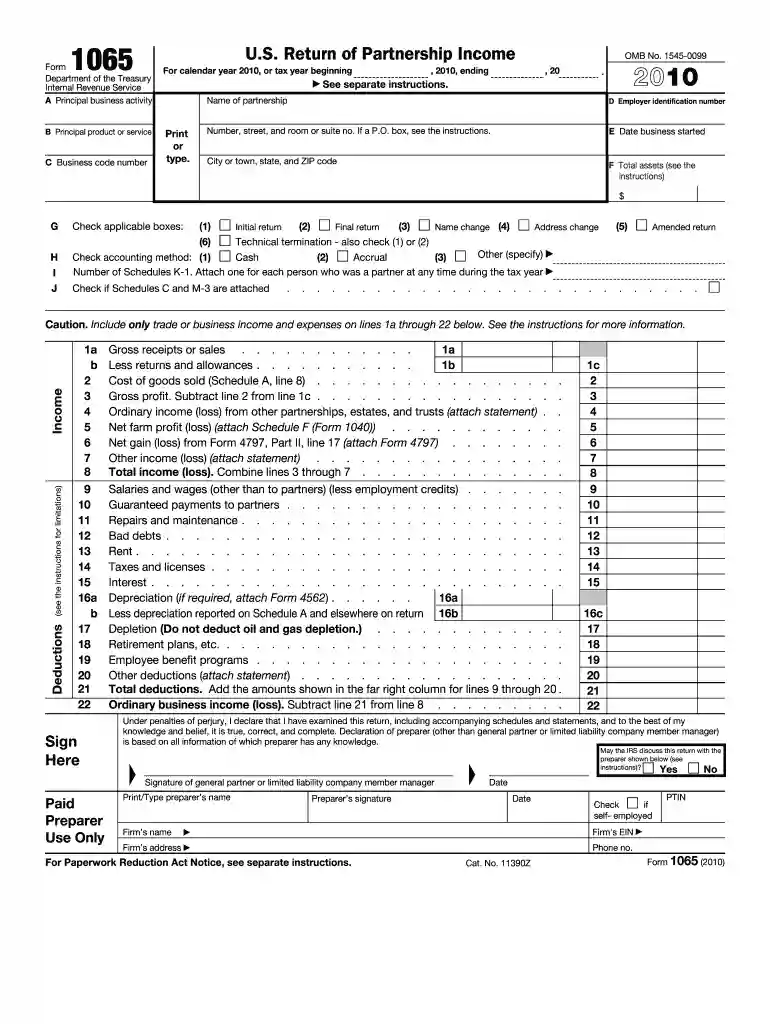
The 2010 Form 1065, known as U.S. Return of Partnership Income, serves as a comprehensive financial document required by the IRS for partnerships operating in the United States. This form is essential for reporting income, deductions, gains, and losses of a partnership. Each financial section of the form captures detailed data about the partnership's financial activities during the given tax year, ensuring adherence to federal tax regulations.
Using the 2010 Form 1065 involves a systematic approach to detailing a partnership's financial situation. The form must be accurately completed with all necessary financial data, which can be gathered from the partnership’s accounting records. Each section requires specific financial inputs, such as income and deductions, making it vital to ensure correctness in every field. The form is then used to calculate a partnership's overall tax obligations and distributions to individual partners.
Understanding specific terminology related to the 2010 Form 1065 is crucial for precise completion:
The IRS mandates specific deadlines for filing the 2010 Form 1065. The original due date is March 15th of the year following the tax year. If an extension is required, partnerships may apply for an automatic six-month extension, moving the deadline to September 15th. Filing on time is crucial to avoid penalties.
Failure to file the 2010 Form 1065 on time can result in significant penalties. The IRS typically charges penalties based on each month the form is late, multiplied by the number of partners involved. It's vital for partnerships to file timely and accurately to avoid these financial repercussions.
Completing the 2010 Form 1065 can be streamlined using tax software such as TurboTax or QuickBooks. These platforms offer guidance and automated calculations that ensure accuracy and compliance. Compatibility with these systems can simplify the process, making it accessible even to partnerships without in-house tax expertise.
The 2010 Form 1065 primarily applies to partnerships and LLCs that have elected partnership tax treatment. These business structures allow income and deductions to pass through to partners or members, who then report this information on their personal tax returns. It's tailored for business entities with multiple owners or managing members.


The completion and submission of the 2010 Form 1065 are required by law for qualifying partnerships. This ensures that all income, deductions, and other financial activities are accurately reported to the IRS. Adherence to legal requirements when using this form is essential for maintaining compliance with U.S. tax laws.
We've got more versions of the 2010 1065 form form. Select the right 2010 1065 form version from the list and start editing it straight away!
| Versions | Form popularity | Fillable & printable |
|---|---|---|
| 2025 | 4.6 Satisfied (56 Votes) | |
| 2024 | 4.3 Satisfied (48 Votes) | |
| 2023 | 4.4 Satisfied (52 Votes) | |
| 2022 | 4.9 Satisfied (24 Votes) | |
| 2021 | 4.8 Satisfied (81 Votes) | |
| 2020 | 4.3 Satisfied (145 Votes) | |
| 2019 | 4.4 Satisfied (171 Votes) | |
| 2018 | 4.3 Satisfied (138 Votes) | |
| 2017 | 4.3 Satisfied (233 Votes) | |
| 2016 | 4.4 Satisfied (678 Votes) | |
| 2015 | 4.2 Satisfied (57 Votes) | |
| 2014 | 4.1 Satisfied (30 Votes) | |
| 2013 | 4.3 Satisfied (36 Votes) | |
| 2012 | 4.2 Satisfied (30 Votes) | |
| 2011 | 4 Satisfied (42 Votes) |
At DocHub, your data security is our priority. We follow HIPAA, SOC2, GDPR, and other standards, so you can work on your documents with confidence.
Form 1065 by the 15th day of the 4th month. 2011 tax year on the 2010 Form 1065 and. The partnerships tax year ends on the following the date its tax yearRead more
Report the gain or (loss) following the instructions for Form 1065, Schedule K, line 10, or Form 1120S, Schedule K, line 9. Skip lines 8, 9, 11, and 12Read more
THE GUIDELINE. 5. 3.1. Organ retrieval and transplantation surgery. 5. 3.1.1 Living-donor nephrectomy. 5. 3.1.2 Organ preservation.Read more


