
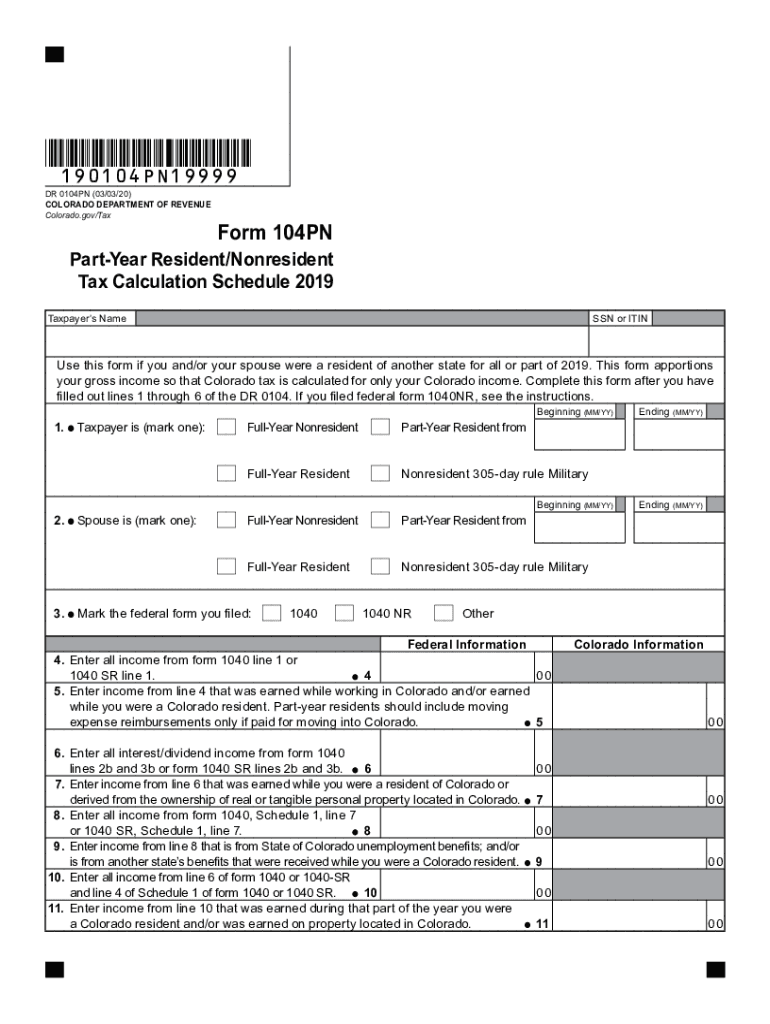







Definition and Purpose of Colorado Tax Form 104PN
The Colorado Tax Form 104PN is designed for part-year residents and nonresidents of Colorado who need to calculate their taxable income for the state while accounting for the time or income earned outside Colorado. The form is essential for determining the precise taxable amount that applies to Colorado state taxes, enabling taxpayers to report their income accurately according to their residency status within the tax year. This form is pivotal in ensuring compliance with Colorado tax regulations for those who have not lived in the state for the entire year.
How to Use the Colorado Tax Form 104PN
The process of using Form 104PN involves several steps aimed at accurate income apportionment. Taxpayers must:
- Collect all relevant income data, breaking down earnings between Colorado and other states.
- Utilize the form's sections to report different income types, including wages, dividends, and pensions.
- Deduct adjustments applicable to the Colorado portion of the income.
- Follow the instructions carefully to calculate the apportioned taxation amount due to Colorado.
Each section of the form has detailed instructions to guide users through reporting income and claiming deductions properly, ensuring that only the income subject to Colorado taxes is considered.
Steps to Complete the Colorado Tax Form 104PN
Completing Form 104PN requires adherence to specific steps:
- Gather Documentation: Collect W-2s, 1099s, and other income statements.
- Calculate Total Income: Determine the total income earned during the tax year.
- Determine Colorado-Source Income: Apportion income based on the time spent in Colorado or income sourced from within the state.
- Complete Adjustments: Report deductions and exemptions specific to Colorado residency.
- Submit Apportioned Income: Enter the calculated figures into the designated sections to find the taxable income relative to Colorado.
Each step is crucial for ensuring accuracy in reporting and compliance with state tax obligations.
Who Typically Uses the Colorado Tax Form 104PN
Form 104PN is typically used by:
- Part-year residents who lived in Colorado for only a portion of the tax year.
- Nonresidents who earn income from Colorado-based sources such as rental properties, businesses, or employment.
- Individuals who move to or from Colorado during the year, needing to split income according to residency periods.
Understanding the form's intended users helps clarify its application and relevance for specific taxpayer situations.


Key Elements of the Colorado Tax Form 104PN
Form 104PN consists of major components crucial for tax assessment:
- Income Calculation Sections: These sections help taxpayers break down earned income within and outside Colorado.
- Apportionment Factor: A calculation that helps determine the percentage of income taxed by Colorado.
- Adjustments and Deductions: Allows for necessary modifications and reductions relevant to the state's tax regulations.
These elements work in tandem to ensure accurate reporting of income relative to taxpayer residency status.
Required Documents for Form 104PN
Taxpayers should prepare the following documents to complete Form 104PN:
- W-2 Forms: To report wage and salary income.
- 1099 Forms: To report additional income sources like interest and freelance earnings.
- State Residency Proofs: Documents validating time spent in or out of Colorado.
- Expense Receipts: Necessary for claiming specific deductions or adjustments.
Having these documents ready ensures a smoother process in completing and submitting the form.
Form Submission Methods and Deadlines
Submitting Form 104PN involves specific methods and timelines:
- Online Submission: Utilize the Colorado Department of Revenue's online portal for electronic filing.
- Mail: Paper submissions can be sent to the designated state address.
- In-Person: Available at certain Colorado Department of Revenue service locations.
The form is due by April 15th, aligning with the standard federal tax-filing deadline. Late submissions may incur penalties, emphasizing the importance of timely filing.
Penalties for Non-Compliance
Failure to accurately complete or submit Form 104PN can result in:
- Fines: Monetary penalties for underreporting or late payment of due taxes.
- Interest Charges: Accrue on unpaid taxes from the due date until the full payment is made.
- Legal Consequences: Potential audits or legal actions for significant discrepancies or fraudulent reporting.
These penalties underscore the necessity for careful and timely completion of Form 104PN.




