
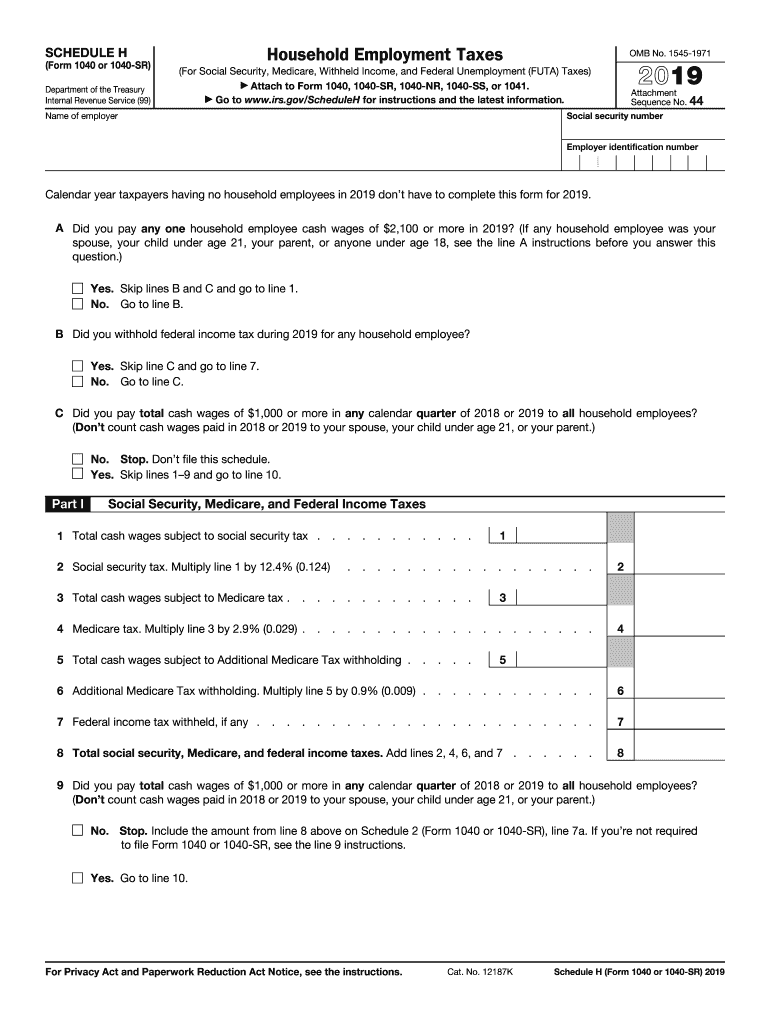







Definition and Meaning
Schedule H is a form used by household employers in the United States to report household employment taxes. It encompasses a few key tax types, including Social Security, Medicare, and Federal Unemployment Tax (FUTA). The form is relevant for those who employ domestic workers such as nannies, caregivers, and housekeepers. While commonly associated with individual employers, Schedule H is integral to ensuring compliance with federal employment tax laws applicable to household employment.
Detailed Breakdown
- Purpose: To report taxes tied to household employment, such as those for nannies and cleaners.
- Relevant Taxes: Covers Social Security, Medicare, and FUTA.
- Focus: Targets household employers, different from other business or corporate tax forms.
- Annual Requirement: Typically filed with annual tax returns.
Household employers must ensure they meet the obligations set forth by Schedule H to avoid penalties related to unpaid taxes for their household employees.
Who Typically Uses Schedule H
Target Audience
Primarily, Schedule H is used by household employers. This includes individuals who hire household workers and pay them a certain threshold amount in wages. For 2023, once total wages exceed $2,400, Social Security and Medicare taxes must be reported via Schedule H.
Examples of Employers
- Families Hiring Nannies: Those employing nannies to care for children.
- Elderly Caregivers: Individuals employing caregivers for elderly family members.
- Domestic Services: Employers of cooks, housekeepers, and gardeners.
Special Cases
The form is designed to simplify tax reporting for employers handling household staff. Those hiring on a less frequent basis or paying below the wage threshold might not need to file Schedule H.
Steps to Complete Schedule H
Step-by-Step Instructions
- Gather Necessary Documentation: Collect all wage-related data for household employees, including payment records and employee details.
- Calculate Total Wages: Sum the total wages paid to each employee.
- Determine Tax Owed: Follow instructions on the form to calculate Social Security, Medicare, and FUTA taxes.
- Complete the Form: Enter amounts such as Social Security wages and tax calculations.
- Attach to Federal Tax Return: Submit Schedule H with your annual tax return (Form 1040 or equivalent).
- Maintain Records: Keep copies for future reference and verification.
Completing Schedule H accurately is crucial for complying with federal tax laws and avoiding penalties.
Key Elements of Schedule H
Essential Components
- Tax Computation: Outlines the parts needed to compute Social Security, Medicare, and FUTA taxes.
- Employee Information: Sections for detailing household employee information.
- Wage Reporting: Specifies how to enter total wages paid.
- Tax Deductions: Instructions on possible deductions related to household employment.
Calculations and Entries
Each section of Schedule H is pivotal in reporting the correct tax amounts and employee details, which directly affects the tax liabilities.
Important Terms Related to Schedule H
Definitions
- Household Employee: An individual who performs household work including gardening, caregiving, cleaning, etc.
- FUTA: Federal Unemployment Tax Act, related to unemployment compensation.
- FICA: Federal Insurance Contributions Act, related to Social Security and Medicare taxes.
Contextual Understanding
Recognizing these terms is essential to accurately complete Schedule H and understand the tax responsibilities associated with household employment.
Penalties for Non-Compliance
Potential Repercussions
Failing to file Schedule H when required can lead to significant penalties, interest charges, and possible audits by the IRS.
- Late Filing Penalties: Charges incurred for not submitting the form on time.
- Interest on Unpaid Taxes: Accrues on any unpaid employment taxes.
- Legal Action: Severe cases may lead to legal consequences or actions from the IRS.
Avoiding these penalties involves careful attention to deadlines and accurate tax reporting.
Filing Deadlines and Important Dates
Key Timeframes
- Annual Filing: Due with federal tax returns, typically by April 15.
- Quarterly Estimates: If taxes owed are substantial, quarterly estimates may be necessary to avoid penalties.
Specific Considerations
Being aware of these deadlines ensures compliance and prevents unnecessary fines.
IRS Guidelines
Compliance Instructions
The IRS provides detailed instructions and guidelines to fill out Schedule H correctly. These include:
- Step-by-Step Instructions: Provided with the form to guide through each section.
- Tax Tables and Rates: Directives on how to compute various tax obligations.
- Contact Points: Where to seek help if uncertainties arise during the filing process.
Following IRS guidelines closely ensures that household employers meet their tax reporting responsibilities accurately and fully.




