Iters score sheet 2026

Get Form
infant toddler environment rating scale Preview on Page 1

Here's how it works

01. Edit your infant toddler environment rating scale online
Type text, add images, blackout confidential details, add comments, highlights and more.
02. Sign it in a few clicks
Draw your signature, type it, upload its image, or use your mobile device as a signature pad.
03. Share your form with others
Send toddler environment rating scale pdf via email, link, or fax. You can also download it, export it or print it out.

How to use or fill out iters score sheet with our platform

Form edit decoration
9.5
Ease of Setup
DocHub User Ratings on G2
9.0
Ease of Use
DocHub User Ratings on G2
  1. Click ‘Get Form’ to open the iters score sheet in the editor.
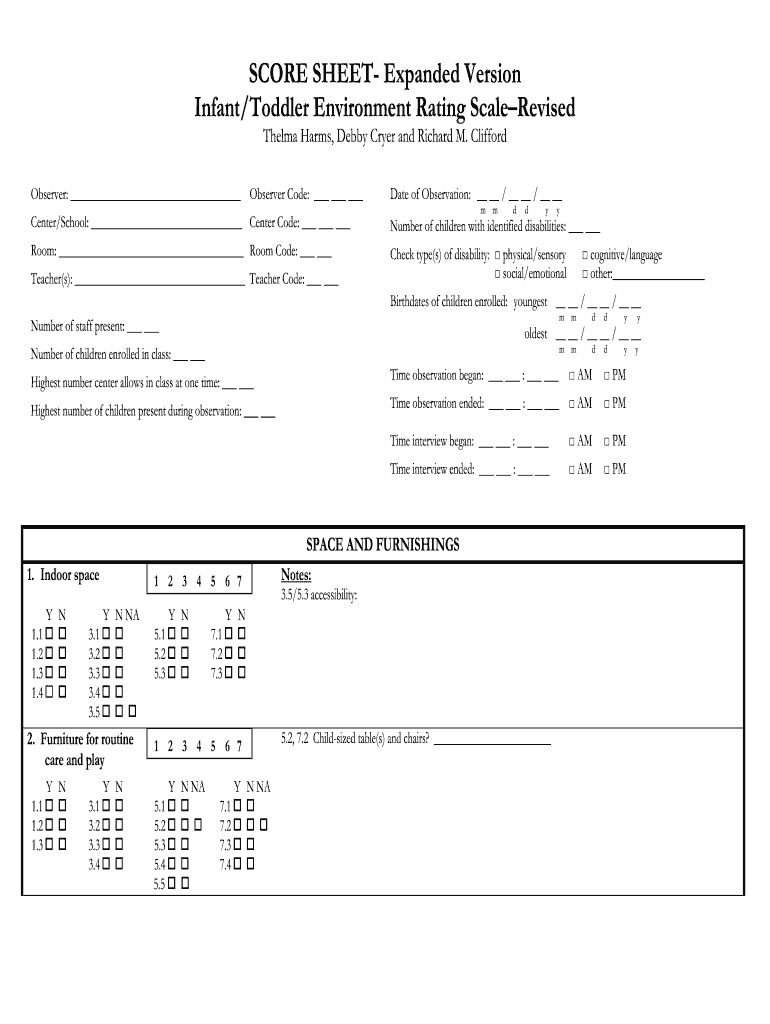
  2. Begin by filling in the observer's name and code, along with the date of observation. This information is crucial for tracking and referencing your assessment.
  3. Next, enter details about the center/school and room, including codes and the number of children with identified disabilities. Be sure to check the types of disabilities present.
  4. Proceed to document birthdates of enrolled children, staff present, and class enrollment numbers. This data helps provide context for your observations.
  5. In the 'SPACE AND FURNISHINGS' section, evaluate each item by marking 'Y', 'N', or 'NA' as applicable. Use notes sections for additional comments or observations.
  6. Continue through each section systematically, ensuring all fields are completed accurately. Utilize our platform’s features to save your progress as you go.

Start using our platform today to streamline your iters score sheet completion for free!

be ready to get more

Complete this form in 5 minutes or less

Get form

Got questions?

We have answers to the most popular questions from our customers. If you can't find an answer to your question, please contact us.
Contact us
Percentage breakdown of ECERS-R scores by quality level in the EPPE and SEED studies. Quality is classified as Inadequate (
The CDRS-R, which was based on the adult Hamilton Depression Rating Scale, was originally developed as a rating scale for children aged 612 years. It is a 17-item scale, with items ranging from 1 to 5 or 1 to 7 (possible total score from 17 to 113), rated by a clinician via interviews with the child and parent.
Suitable for use in inclusive and culturally diverse programs, ITERS-3 subscales evaluate: Space and Furnishings, Personal Care Routines, Language and Books, Activities, Interaction, and Program Structure.
The ECERS is a classroom assessment tool designed to measure the quality of group programs for infants and toddlers (birth to age 3) by collecting data through classroom observations and a staff interview.
Theses are organized into 7 (seven) different subscales based on what is most likely to be found under similar circumstances. The subscales for SACERS are: Space and Furnishings, Health and Safety, Activities, Interactions, Program Structure, Staff Development and Special Needs Supplementary Items.

Security and compliance

At DocHub, your data security is our priority. We follow HIPAA, SOC2, GDPR, and other standards, so you can work on your documents with confidence.

Learn more
ccpa2
pci-dss
gdpr-compliance
hipaa
soc-compliance

People also ask

Negative indicators on the minimal level were removed from one item and are now found only in the 1 (inadequate) level. In levels 3 (minimal), 5 (good), and 7 (excellent) only indicators of positive attributes are listed. This eliminates the one exception to the scoring rule in the original ITERS.
There are 4 (four) different tools that are used in the ERS: the Infant and Toddler Environment Rating Scale (ITERS), the Early Childhood Environment Rating Scale (ECERS), the Family Child Care Environment Rating Scale (FCCERS) and the School Age Care Environment Rating Scale (SACERS).
The widely used Early Childhood Environment Rating Scale (ECERS-3) is designed for use in preschools and kindergarten. ECERS-3 assesses both environmental provisions and teacher-child interactions that affect the broad developmental needs of young children ages 3 to 5, as well as health and safety.

version infant scale blank