




01. Edit your form 8949 2011 online
Type text, add images, blackout confidential details, add comments, highlights and more.

Type text, add images, blackout confidential details, add comments, highlights and more.

Draw your signature, type it, upload its image, or use your mobile device as a signature pad.

Send 2017 form 8949 via email, link, or fax. You can also download it, export it or print it out.
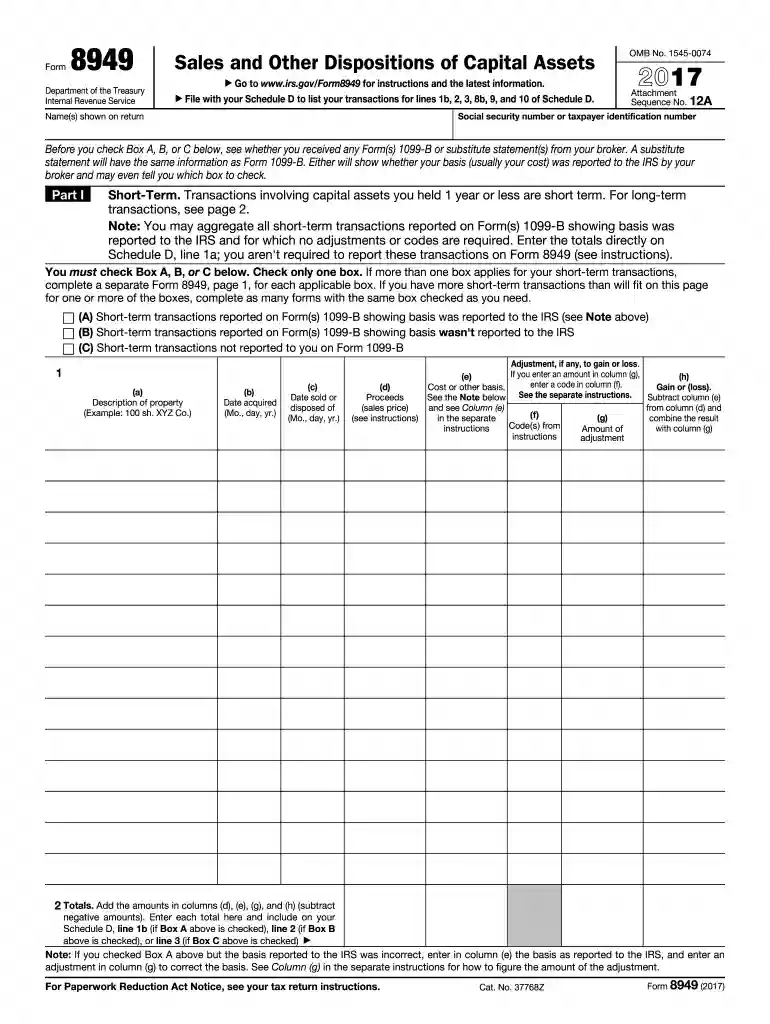
The 2017 Form 8949 is an Internal Revenue Service (IRS) form essential for reporting the sale and other dispositions of capital assets. This form is used to document the capital gains and losses incurred by taxpayers during a given tax year. It distinguishes between short-term and long-term transactions and requires the taxpayer to specify whether basis information was previously reported to the IRS. By capturing critical transaction details such as proceeds, dates, and adjustments to gain or loss, the form plays a central role in calculating the capital gains or losses that must be reported on a taxpayer’s Schedule D.
For accurate tax reporting, the IRS mandates the inclusion of each capital asset transaction on Form 8949. This involves providing comprehensive details, such as:
Filing the 2017 Form 8949 requires careful attention to detail. Accurate completion involves several steps:
Understanding key terms associated with the 2017 Form 8949 is crucial for correct usage and compliance:
Compliance with IRS regulations dictates the proper use of Form 8949. It is legally required for taxpayers who sell or dispose of reportable capital assets. Failing to file or misreporting can result in penalties or legal repercussions. The form accurately documents financial activities affecting tax obligations, thereby ensuring lawful adherence to tax requirements.
Taxpayers can submit the 2017 Form 8949 through various channels:
The IRS provides detailed guidelines to assist taxpayers in accurately completing and filing Form 8949. These guidelines encompass stipulations for:
Typically, individuals or entities engaged in capital asset transactions are required to use Form 8949. This includes:


Several taxpayer scenarios necessitate the use of the 2017 Form 8949:
By adhering to these structured guidelines, taxpayers ensure compliance with IRS standards while effectively managing their tax obligations related to capital asset transactions.

We've got more versions of the form 8949 2011 form. Select the right form 8949 2011 version from the list and start editing it straight away!
| Versions | Form popularity | Fillable & printable |
|---|---|---|
| 2025 | 4.3 Satisfied (53 Votes) | |
| 2024 | 4.3 Satisfied (58 Votes) | |
| 2023 | 4.2 Satisfied (49 Votes) | |
| 2022 | 4.8 Satisfied (35 Votes) | |
| 2021 | 4.8 Satisfied (47 Votes) | |
| 2020 | 4.4 Satisfied (165 Votes) | |
| 2019 | 4.3 Satisfied (129 Votes) | |
| 2018 | 4.4 Satisfied (280 Votes) | |
| 2017 | 4.2 Satisfied (50 Votes) | |
| 2016 | 4.4 Satisfied (280 Votes) | |
| 2015 | 4 Satisfied (32 Votes) | |
| 2014 | 4.1 Satisfied (32 Votes) | |
| 2013 | 4.2 Satisfied (38 Votes) | |
| 2012 | 4.4 Satisfied (39 Votes) | |
| 2011 | 4.1 Satisfied (56 Votes) |
At DocHub, your data security is our priority. We follow HIPAA, SOC2, GDPR, and other standards, so you can work on your documents with confidence.
Sales and Other Dispositions of. Assets. Form (and Instructions). Profit or Loss. From Business (Sole Proprietorship). Investment Credit. Credit for Increasing
If more than one box applies for your short-term transactions, complete a separate Form 8949, page 1, for each applicable box. If you have more short-termRead more
Frank reported the disposition in part II of Form 8949, Sales and Other Dispositions of Capital Assets, which follows. In box 1f, he used code D to indicateRead more


