Bpst 2026

Get Form
bpst Preview on Page 1

Here's how it works

01. Edit your bpst online
Type text, add images, blackout confidential details, add comments, highlights and more.

02. Sign it in a few clicks
Draw your signature, type it, upload its image, or use your mobile device as a signature pad.

03. Share your form with others
Send bpst iii via email, link, or fax. You can also download it, export it or print it out.

Definition and Purpose of the Basic Phonics Skills Test (BPST-III)

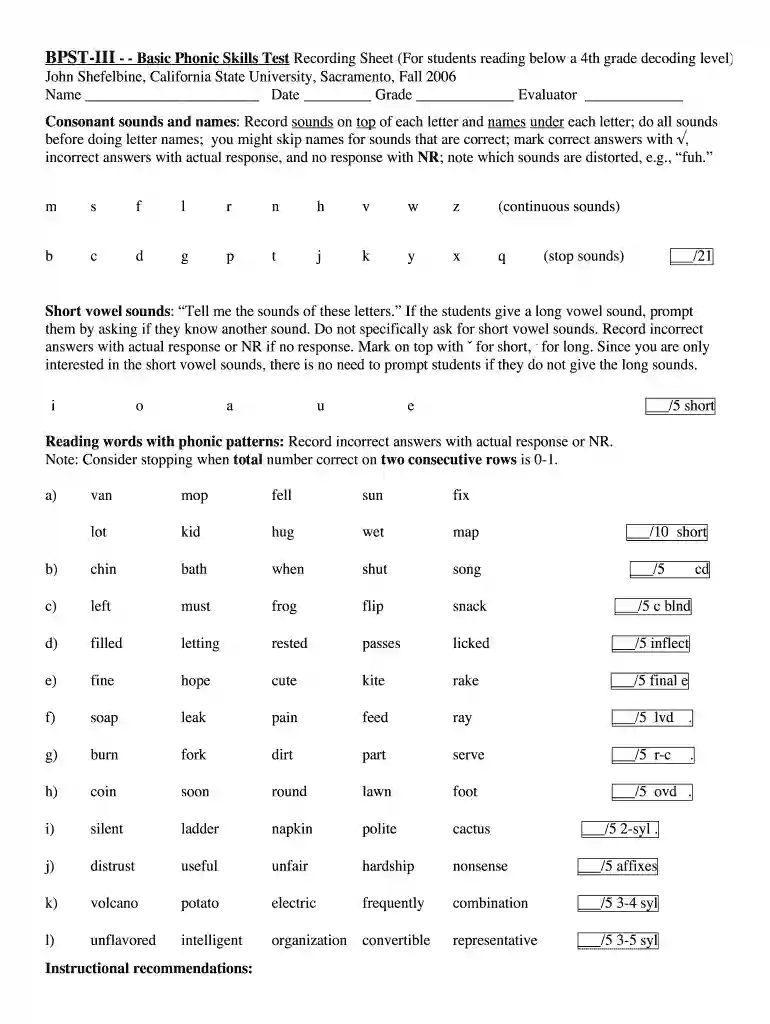
The Basic Phonics Skills Test (BPST-III) is an assessment tool designed to evaluate the phonics skills of students, particularly those whose reading abilities are below a fourth-grade decoding level. This standardized test focuses on key areas of phonics such as consonant and vowel sounds, as well as various phonic patterns. It serves educators by providing a structured method for identifying students who may need additional support in their reading development.

The assessment is utilized primarily to:

  • Measure students’ understanding of phonetic principles
  • Identify specific areas where students may struggle
  • Guide instructional decisions for targeted intervention
  • Provide a record of student progress over time

By utilizing the BPST, educators can tailor their teaching strategies to meet the individual needs of their students, ensuring that each child receives the necessary support to improve their reading skills.

Steps to Complete the BPST-III Evaluation

Completing the BPST-III involves a systematic approach to ensure accurate measurement of a student's phonics skills. The process includes the following steps:

  1. Preparation: Gather necessary materials, including the BPST-III recording sheet and scoring guide.
  2. Instruction: Briefly explain the purpose of the test to the student, ensuring they understand what is expected during the assessment.
  3. Administering the Test:
    • Start with the consonant sounds section, where students react to a series of phonemic prompts.
    • Proceed to the vowel sounds, prompting the student to articulate various sounds.
    • Finally, assess word reading, focusing on phonic patterns and structure.
  4. Recording Responses: As the student completes each section, the evaluator notes correct and incorrect answers on the recording sheet.
  5. Analyzing Results: After completion, review the answers to determine areas of strength and those requiring further instruction.
  6. Instructional Recommendations: Based on performance, provide tailored instructional strategies to support the student's phonics development.

This structured methodology ensures that educators can effectively assess and address the diverse phonics needs of their students.

Key Elements of the BPST-III Scoring Guide

The scoring guide for the BPST-III is crucial for interpreting test results and making informed instructional decisions. Key components include:

  • Scoring Criteria: Each response is categorized as correct or incorrect, allowing evaluators to calculate an overall score.
  • Benchmarks: The guide may include age and grade-level benchmarks, indicating how students' scores compare against standard expectations.
  • Interpretation Guidelines: It provides detailed descriptions of what scores indicate about a student’s phonics skills, helping educators identify areas needing support.
  • Instructional Strategies: Recommendations for interventions are included, tailored to the specific needs identified through the assessment process.

By utilizing the scoring guide effectively, educators can gain valuable insights into their students' phonics capabilities and take actionable steps to enhance their learning outcomes.

Typical Users of the BPST-III Assessment

The BPST-III is primarily used by various educational professionals who play a critical role in student learning outcomes. Typical users include:

  • Teachers: Educators across grade levels often administer the test to assess students' phonics skills and inform their teaching strategies.
  • Special Education Professionals: Special education teachers utilize the BPST-III to identify students with reading difficulties and customize interventions accordingly.
  • School Psychologists: They may administer the assessment as part of a broader evaluation strategy to diagnose reading-related learning disabilities.
  • Reading Specialists: These professionals are focused on improving literacy skills and may use the BPST-III to tailor reading programs.

These users are integral to the educational process, working collaboratively to ensure that students receive the necessary support to enhance their reading abilities.

Legal Use of the BPST-III in Educational Settings

The BPST-III adheres to legal regulations governing educational assessments, which ensure its appropriate use within school systems. Important legal aspects include:

  • Compliance with Education Law: The test aligns with state and federal guidelines that mandate effective assessment practices in public education, particularly under laws such as the Individuals with Disabilities Education Act (IDEA).
  • Confidentiality of Student Data: When administering the BPST-III, educators must protect student privacy and adhere to local policies regarding data collection and storage.
  • Use for Appropriate Purposes: The BPST-III should be utilized solely for educational improvement and not for punitive measures against students or educators.

By complying with these legal requirements, institutions can ensure that the BPST-III contributes positively to student assessment and instructional practices while maintaining ethical standards in education.

be ready to get more

Complete this form in 5 minutes or less

Get form

Got questions?

We have answers to the most popular questions from our customers. If you can't find an answer to your question, please contact us.
Contact us
The Parliament of India has made arrangements for exhaustive study of and training in Parliamentary system by establishing Bureau of Parliamentary Studies and Training (BPST).
The Basic Phonics Skills Test (BPST) is an informal assessment tool developed by John Shefelbine to evaluate a childs knowledge of essential phonics skills. Phonics is the relationship between letters and sounds, and its a critical component of learning to read.
PAST: The Phonological Awareness Screening Test (PAST) (opens in a new window) is a widely used informal diagnostic tool that helps you evaluate 14 separate aspects of phonological awareness.
Basic Phonics Skills Test (BPST) is a phonics assessment that consists of the recognition of letter sounds, specific phonics patterns, and the blending of single syllable and polysyllabic words out of context.
The purpose of the phonics screening check is to confirm that all children have learned phonic decoding to an age appropriate standard.

Security and compliance

At DocHub, your data security is our priority. We follow HIPAA, SOC2, GDPR, and other standards, so you can work on your documents with confidence.

Learn more

People also ask

Essential Guide to the BPST: How the Basic Phonics Skills Test Supports Homeschooling Success One-Room Education.
At the first stage of a randomized blinded placebo-controlled trial, 318 patients with Alzheimer disease (AD) with clinically docHub agitated behavior were treated in an open design with a psychological intervention (brief psychosocial therapy [BPST]) for 4 weeks, preceding randomization to pharmacotherapy.

bpst iii printable pdf free download