




01. Edit your appraisal transfer letter online
Type text, add images, blackout confidential details, add comments, highlights and more.

Type text, add images, blackout confidential details, add comments, highlights and more.

Draw your signature, type it, upload its image, or use your mobile device as a signature pad.

Send appraisal transfer letter template via email, link, or fax. You can also download it, export it or print it out.
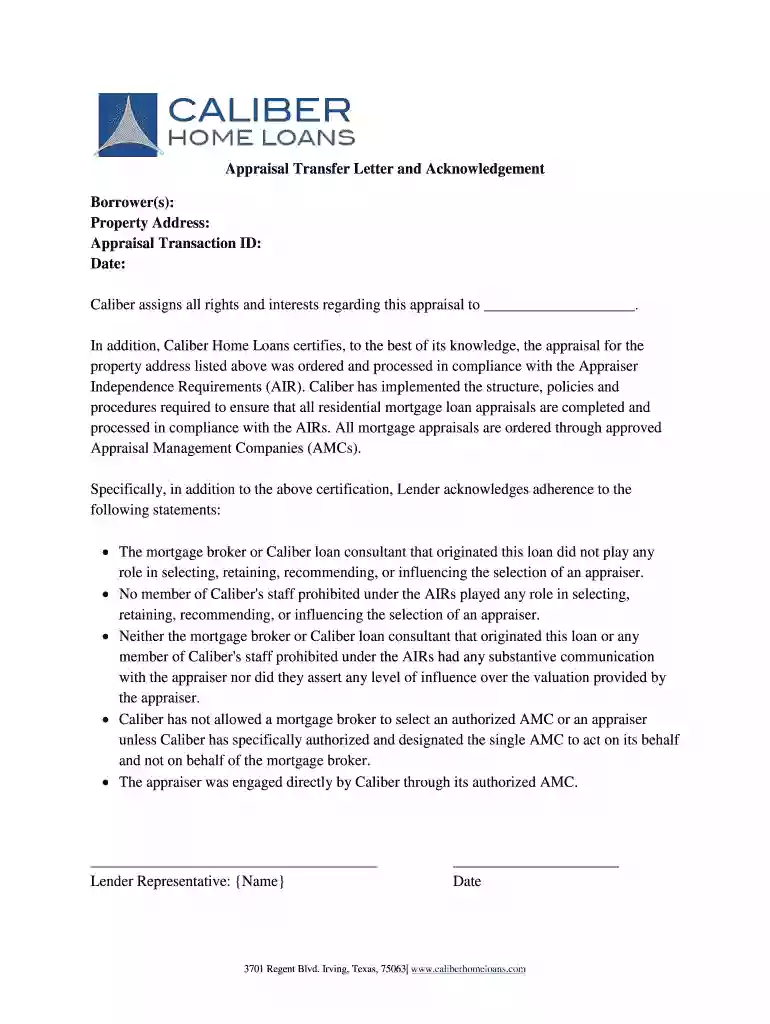
An appraisal transfer letter is a formal document used primarily in the real estate and mortgage sectors to acknowledge the transfer of appraisal rights and responsibilities from one party to another. This letter is essential for ensuring compliance with various regulations, most notably the Appraiser Independence Requirements (AIR), which dictate that appraisals must be conducted without undue influence from various stakeholders, such as mortgage brokers or loan officers. The appraisal transfer letter certifies that the appraisal was completed according to industry standards and helps to avoid conflicts of interest by outlining all parties involved in the appraisal process.
Sender and Recipient Information: This includes the names and addresses of both the party transferring the appraisal and the receiving party. Accurate contact details ensure the letter can be referenced correctly.
Property Details: Identification of the property involved, which typically includes the address, legal description, and any relevant identifiers (e.g., parcel number).
Appraisal Details: The letter should include specific details about the appraisal, such as the date it was conducted and the name of the appraiser.
Compliance Confirmation: A statement affirming that the appraisal adheres to the AIR. This is crucial for regulatory compliance and helps maintain trust among all parties.
Signatures: Authorized signatures from both the transferring and receiving parties serve as proof of the agreement's validity.
Completing an appraisal transfer letter involves a series of systematic steps to ensure its accuracy and effectiveness.
Gather Necessary Information: Collect all relevant details regarding the property and appraisal. This includes appraisal reports, property documents, and the parties’ contact information.
Draft the Letter: Begin by writing the letter's header, including the date and address information. Clearly state the purpose of the letter at the beginning.
Document Specifics: Fill in all required fields, such as property details and appraisal information. Be sure to provide clear references to the AIR guidelines to confirm compliance.
Review for Accuracy: Carefully proofread the letter for factual correctness and completeness. Ensure all required elements are included and that the legal language meets the necessary standards.
Obtain Signatures: Have both parties sign the document. Depending on the circumstance, this may require noting notary acknowledgment for additional legal validation.
Distribute Copies: After the letter is completed and signed, distribute copies to all relevant parties for their records. Retain a copy for your own files to ensure all transactions are documented.
The appraisal transfer letter holds substantial legal weight in the real estate process.
Regulatory Adherence: Compliance with the AIR is critical for avoiding legal penalties and maintaining ethical standards within the industry. The letter serves as a written record that demonstrates adherence to these requirements.
Risk Mitigation: By clearly documenting the transfer of appraisal rights, parties can mitigate risks associated with disputes over appraisal integrity or financial discrepancies.
Transparency in Transactions: This document fosters transparency among stakeholders, which is essential for maintaining trust throughout the transaction process. Any potential issues regarding appraisal biases or disputes can be addressed effectively with a well-documented appraisal transfer letter.
Providing specific examples can help clarify how an appraisal transfer letter should be structured.
plaintext [Date] [Your Name] [Your Address] [City, State, Zip] [Email] [Phone Number]
[Recipient Name] [Recipient Address] [City, State, Zip]
Subject: Appraisal Transfer Letter
Dear [Recipient Name],
This letter serves as a formal notice of the transfer of appraisal rights for the property located at [Property Address]. The appraisal for this property was completed on [Appraisal Date] by [Appraiser's Name] and adheres to the Appraiser Independence Requirements.
Please find the details of the appraisal included below:
Sincerely,
[Your Signature] [Your Printed Name]
plaintext [Date] [Your Name] [Your Address] [City, State, Zip] [Email] [Phone Number]
[Recipient Name] [Recipient Address] [City, State, Zip]
Subject: Appraisal Transfer Letter
Dear [Recipient Name],
This correspondence officially acknowledges the transfer of appraisal rights concerning the property at [Property Address], completed on [Appraisal Date]. The appraisal conforms to both the Fannie Mae appraisal transfer guidelines and AIR.
Key details include:
Thank you for your attention to this matter.
Best regards,
[Your Signature] [Your Printed Name]
An appraisal transfer letter may incorporate specific legal terminology that reflects regulatory compliance. Common phrases include:
Appraisal Independence Requirements (AIR): Refers to regulations ensuring no influence is exerted over appraisers by stakeholders involved in the loan process.
Legally Binding Agreement: An affirmation that the contents of the letter constitute a binding agreement under state and federal laws.
Confidentiality Clauses: Emphasis that all details shared remain confidential among the signing parties.
Understanding these terms is crucial for both those drafting and receiving the appraisal transfer letter, as it provides structural clarity and assures adherence to regulatory requirements.
At DocHub, your data security is our priority. We follow HIPAA, SOC2, GDPR, and other standards, so you can work on your documents with confidence.
Dec 19, 2016 CASE TRANSFER TEMPLATE. Last Revision 12/19/2016. CASE TRANSFER REQUEST. The information presented is compiled and excerpted from Handbooks andRead more
The appraisal of each element of job performance should be followed by comments explaining the rating and recommending specific areas of improvement orRead more
May 20, 2016 An example is performing an appraisal of the air conditioning systems while leaving the rest of the department unexamined. 13.1.5.3 Sampling.Read more


