







Understanding the Police Licensing & Regulatory Department – Singapore Customs
The Police Licensing & Regulatory Department (PLRD) of Singapore Customs plays a critical role in the regulation and oversight of the import, export, and transshipment of arms and explosives. This department's primary function is to ensure that such activities adhere to stringent safety and legal standards. Singapore, known for its strict regulatory environment, requires comprehensive documentation to maintain its high standards of security and safety.
Key Elements of the Form
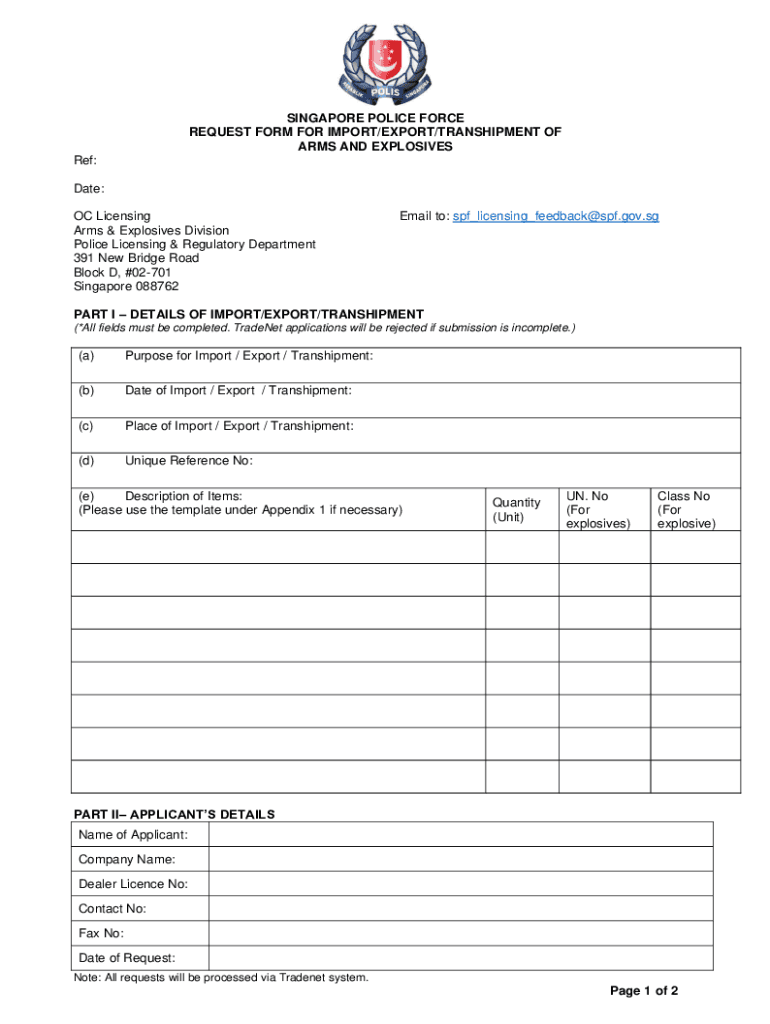
The form utilized by the PLRD is intricate, demanding precision and completeness in all sections. Here are some essential components:
- Applicant Details: Information about the requesting entity, including name, address, and contact information.
- Item Description: Detailed descriptions of the arms or explosives involved, encompassing specifications, quantities, and intended use.
- Date and Purpose: The requested shipment dates and explicit purpose for the transaction, ensuring alignment with legal requirements.
- Supporting Documents: A checklist of documents needed to process the form, such as certifications and safety assessments.
Steps to Complete the Form
Filling out this form involves several detailed steps:
- Gather Necessary Information: Collect all required applicant details and item specifications.
- Complete Each Section: Accurately fill in each part of the form, ensuring no details are omitted.
- Attach Supporting Documents: Compile additional documentation required for verification.
- Submit via Tradenet: The form and associated documents must be submitted through the Tradenet system for processing.
Eligibility Criteria for Form Submission
Eligibility for engaging with the PLRD encompasses specific conditions:
- Accredited Entities: Only entities accredited by the Singapore government are eligible to submit these forms.
- Purpose Validation: Applicants must substantiate the necessity of the items for either industrial, commercial, or research purposes.


Legal Use and Compliance
Utilizing this form legally involves understanding several critical factors:
- Regulations Adherence: Compliance with both local and international laws governing arms and explosives is mandatory.
- Monitoring and Auditing: Submissions are subject to review and auditing by relevant authorities to ensure regulatory compliance.
Required Documents for Submission
Several documents are typically required to accompany the main form:
- Licensing Certificates: Proof of licenses held by the applicant organization.
- Safety Documentation: Evidence of safety protocols in handling and transporting hazardous materials.
- Previous Transaction Records: Historical transaction records, if applicable, to provide context and support for current applications.
Important Terms Related to the PLRD
Familiarity with numerous terms is beneficial for accurately completing the form:
- Transshipment: The process of shipping goods to an intermediate destination before reaching the final destination.
- Certification of End Use: A document proving the intended legal usage of the items listed.
- Declarant: The individual who officially submits the form on behalf of the organization.
Obtaining and Using the Form
How to Obtain the Form
Entities requiring the PLRD form can access it through official Singapore Customs channels. Online portals like the Tradenet system provide a streamlined way to download and submit documents digitally.
Utilizing the Form Effectively
Practical usage of the form demands thorough preparation:
- Ensure Completeness: Double-check that all fields are thoroughly completed before submission.
- Consult Experts: Organizations often engage compliance consultants to aid in form preparation and submission.
- Review Regularly: Regular updates in regulations necessitate periodic reviews and updates to already filed documentation.
Submission Methods: Online, Mail, or In-Person
Submitting the PLRD form can be done through various methods:
- Online Submission: The most efficient route, utilizing the Tradenet system’s secure online environment.
- Mail or In-Person: Alternative submission methods, though less common, are available for entities unable to use digital platforms.
Differences in Digital vs. Paper Versions
Choosing between digital and paper versions comes with distinct considerations:
- Digital Advantages: Offers enhanced efficiency, quick submission, and better tracking capabilities.
- Paper Trail Necessities: Hard copies may be beneficial for record-keeping and situations where electronic submission is not feasible.
By comprehensively understanding the requirements and procedures for the Police Licensing & Regulatory Department - Singapore Customs form, applicants can ensure compliance and smooth processing of their submission, maintaining alignment with both local and international regulatory standards.




