




01. Edit your miami subpoena online
Type text, add images, blackout confidential details, add comments, highlights and more.

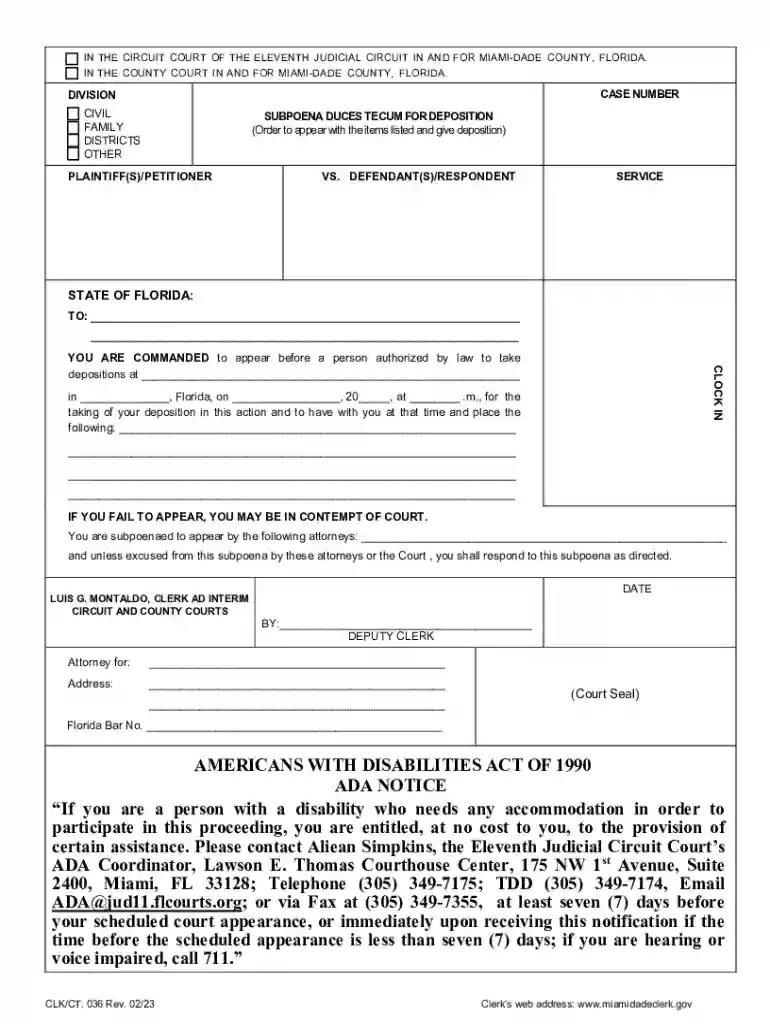
Type text, add images, blackout confidential details, add comments, highlights and more.

Draw your signature, type it, upload its image, or use your mobile device as a signature pad.

Send duces tecum deposition via email, link, or fax. You can also download it, export it or print it out.
The "public notice: hearing examiners for appointment to panel" is an official statement that informs the public about the appointment of hearing examiners to a particular panel. This notice serves several purposes: notifying interested parties of the availability of positions, providing details about the role and expectations, and ensuring transparency in the appointment process. Such notices are often mandated by governmental or legal entities to maintain fairness and openness in judicial and quasi-judicial appointments.
Purpose and Importance: The primary goal of the public notice is to invite qualified candidates to apply, ensuring that only those with the necessary qualifications and experience are considered. It also provides an opportunity for stakeholders to provide input or objections before appointments are finalized.
Contextual Background: In the U.S., public notices are common across various governmental departments and typically adhere to established legal frameworks. They are a vital part of ensuring due process and maintaining the integrity of the appointment process.
To effectively utilize the public notice, it is essential to understand the steps involved and the criteria outlined:
Review the Notice: Begin by thoroughly reading the notice to understand the requirements and details about the positions available.
Assess Eligibility: Evaluate whether your qualifications align with the criteria stated in the notice. This involves reviewing educational requirements, experience levels, and any specific competencies needed.
Prepare Necessary Documentation: Compile all relevant documents, such as resumes, certification degrees, and other evidences of qualifications.
Submit Application: Follow the specified procedures for application submission. This may include online application portals, email submissions, or physical mail.
Await Feedback: After submission, be prepared for any additional requests for information or interviews, which are typically part of the appointment process.
Consider a legal professional who discovers a public notice regarding positions for hearing examiners within a state department. The professional assesses that their judicial experience meets the specified criteria and submits an application, subsequently receiving an invitation for an interview.
Completing the public notice involves a structured process to ensure compliance and accuracy:
Gather Information: Assemble all required personal and professional details needed to fill out the application.
Complete All Fields: Ensure that every section of the accompanying application is filled out comprehensively, including personal data, educational background, and work experience.
Attach Supporting Documents: Affix all necessary documentation, ensuring they are current and relevant to the requirements mentioned in the notice.
Review for Accuracy: Double-check all entries for accuracy and completeness to avoid rejection due to errors or omissions.
Submit by Deadline: Ensure that the complete application, including all forms and documentation, is submitted by the stated deadline in the notice.
In scenarios where an applicant may have equivalent experience not specifically mentioned in the notice, it is crucial to clearly articulate how such experiences align with the role requirements during the application process.
Understanding the core components of the public notice is crucial:
Position Details: Provides an overview of the role, responsibilities, and the framework within which the hearing examiners operate.
Eligibility Requirements: Lists the qualifications, education, and experience required for applicants to be considered.
Application Process: Describes the steps involved in applying, submission formats, and any associated timelines.
Contact Information: Offers contact details for inquiries or support during the application process.
Legal Provisions: Outlines any legal bases or regulations that govern the appointment process, ensuring compliance with relevant laws.
Public notices are governed by legal standards to ensure fairness and transparency:
Statutory Compliance: They must adhere to federal and state laws that regulate public appointments and ensure equal opportunity.
Disclosure Requirements: The notice must disclose all necessary information in a manner that allows for informed participation by potential applicants.
Transparency Measures: Includes measures to ensure the process is open to scrutiny and free from bias.
Providing real-world examples enhances understanding:
Example 1: A local government entity issues a public notice to appoint hearing examiners for municipal dispute panels. This ensures community involvement in dispute resolution.
Example 2: A federal agency seeks to appoint hearing examiners to a regulatory board. The public notice attracts experienced professionals who provide oversight and adjudication on industry compliance matters.
Regional variations can influence the appointment process:
State Regulations: Each state may have specific laws or guidelines that govern how public notices should be structured and disseminated.
Application Variations: Application processes may vary by state, incorporating specific forms, deadlines, or supplementary requirements.
Divergent Eligibility Standards: States might have different eligibility criteria based on their unique legal and administrative frameworks.
Identifying the target audience assists in focusing efforts:
Legal Professionals: Attorneys and other legal practitioners who meet the qualifications and are interested in serving in a quasi-judicial capacity.
Government Employees: Current employees within governmental departments with relevant experience seeking advancement or a change in role.
Academics and Researchers: Individuals from academic backgrounds who possess expertise relevant to the positions, often from fields such as law, public policy, or administration.
By understanding these aspects, stakeholders can effectively navigate the process of applying for hearing examiner positions through public notices.


We've got more versions of the miami subpoena form. Select the right miami subpoena version from the list and start editing it straight away!
Yes, and it’s really easy! DocHub is a web-based PDF editor with advanced document processing features that allow you promptly edit your documents, fill out blank fields and drop new ones for others to fill out, and create electronic signatures in several ways. Upload your florida subpoena deposition, provide information as required, and decide how you want to eSign your document - by typing your name, drawing your signature, uploading its picture, or utilizing a QR code.
You can find the latest and most relevant version of the public notice: hearing examiners for appointment to panel in our DocHub forms collection. Browse it by categories or use the search field to find the exact template that fits your case. You can open this form for editing once you find it.
At DocHub, your data security is our priority. We follow HIPAA, SOC2, GDPR, and other standards, so you can work on your documents with confidence.
Oct 5, 2018 PUBLIC LAW 115254OCT. 5, 2018. Public Law 115254. 115th Congress. An Act. To provide protections for certain sports medicine professionalsRead more
In general, the notice is required to state the time, date and place for the hearing, a citation to the agencys statutory authority to hold the hearing and toRead more
Miami-Dade County is currently seeking ten (10) candidates to serve as Hearing Examiners to conduct hearings pertaining to any protest made by a participant


