




01. Edit your form online
Type text, add images, blackout confidential details, add comments, highlights and more.

Type text, add images, blackout confidential details, add comments, highlights and more.

Draw your signature, type it, upload its image, or use your mobile device as a signature pad.

Send it via email, link, or fax. You can also download it, export it or print it out.
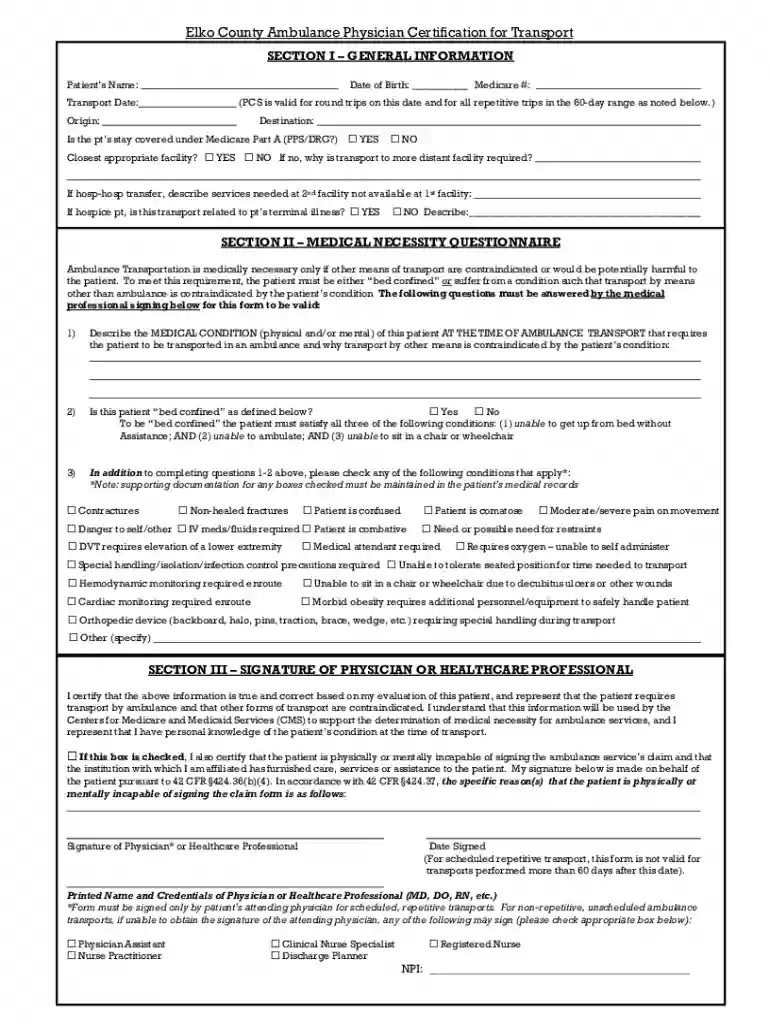
The Physician Certification Statement (PCS) is a critical document used primarily in the medical transportation industry to certify the medical necessity of non-emergency ambulance services for a patient. This form is generally required by Medicare and other insurers to demonstrate that transportation by ambulance is appropriate due to the patient's medical condition. It justifies the need for such services and provides essential details supporting the medical situation of the patient.
Patient Identification: This section requires comprehensive information about the patient, including name, address, and unique identifiers like a Medicare ID. Accurate input is crucial as it forms the basis for verifying the right recipient of services.
Medical Condition Assessment: Here, the physician must detail the patient’s medical condition that necessitates ambulance transport. This assessment provides evidence supporting the medical necessity claim, required under Medicare regulations.
Certification by Healthcare Professional: The attending physician or qualified healthcare professional confirms the details and necessity of transport. This section includes their name, signature, date, and professional credentials, thereby making the statement official and legally binding.
The PCS serves as a legal document and needs careful completion to ensure compliance with Medicare or insurance requirements.
Obtain the Form: Typically, the healthcare provider or ambulance service will supply the PCS. It’s crucial to use the most current version to meet all regulatory requirements.
Complete Patient Information: Enter all personal details of the patient, ensuring accuracy in every field to avoid processing delays.
Document Medical Necessity: Provide a thorough medical assessment. The statement should include specific conditions that necessitate ambulance transportation, such as non-ambulatory status or monitored oxygen requirements.
Review and Sign: The responsible healthcare provider should thoroughly review the completed PCS for accuracy and sign it to certify the information provided is true and complete.
Submit the Form: Depending on the insurance provider's requirements, you might need to submit the form directly to them, often coordinated by the healthcare facility or transport service.
Completing the PCS involves several well-defined steps:
Begin with Patient Details: Ensure all identifying information is updated and correct. This database supports patient tracking and billing processes, so accuracy is essential.
Assess Medical Need: The physician must evaluate the patient’s medical condition extensively. This evaluation may include current health status, ongoing treatments, and specific needs during transportation.
Fill in the Certification Details: The physician should certify the necessity of ambulance transport. This is crucial as it legally enforces the claim for insurance purposes.
Authorization and Signature: The form must be signed and dated by the certifying medical professional. The signatory must hold valid credentials and authorization to make such certifications.
Final Assessment: Review the form for completeness and accuracy before submission. Any errors or omissions can lead to claims rejection.
Several critical elements ensure the PCS fulfills its purpose effectively:
Detailed Medical Explanation: This section of the PCS is not just a checkbox; it requires a detailed explanation of why other transportation modes are unsuitable.
Identification and Contact Information: Comprehensive contact and ID numbers facilitate quicker processing and verification by insurance providers or Medicare.
Authorization and Compliance Information: Ensuring that the certifying professional is authorized to complete this form helps meet compliance standards stipulated by Medicare.
Submission Requirements: Depending on your geographic location or healthcare facility policies, submission methodologies may vary from electronic uploads to physical mailing systems.
The PCS plays a vital role in maintaining legal and insurance compliance within the healthcare system.
Medical Necessity: As Medicare requires proof of medical necessity, failing to provide a completed PCS could lead to denials or penalties.
Documentation: The PCS serves as a legal document and must be preserved within patient records just as other essential medical documents are safeguarded.
Audit Trails and Disputes: In the event of insurance claims audits or disputes, the PCS can serve as a crucial piece of supporting documentation.
Elderly or Disabled Patients: Older adults facing mobility challenges often require ambulance services for routine check-ups or transfer between facilities. A PCS justifies the need based on frailty and medical conditions.
Patients Requiring Constant Medical Monitoring: Individuals undergoing critical treatments, such as dialysis, may need ambulance transport to hospitals from home or care facilities. The PCS ensures Medicare or insurance covers these trips, acknowledging medical necessity.
Post-Surgical Transport: The form can also apply to patients post-major surgery who require careful monitoring and cannot safely travel via personal or public transportation.
State regulations regarding the PCS may vary, affecting how it is completed and submitted.
Regulatory Requirements: Certain states may have additional rules or constraints surrounding who can fill out the form, adding a layer of complexity to inter-state medical transport.
Submission Methods: Depending on state-specific electronic health systems, you might find unique methods for submitting or reporting the PCS electronically.
Understanding these state-specific nuances can prevent compliance issues and ensure medical transport services are processed efficiently.
We've got more versions of the Physician Certification Statement form. Select the right Physician Certification Statement version from the list and start editing it straight away!
At DocHub, your data security is our priority. We follow HIPAA, SOC2, GDPR, and other standards, so you can work on your documents with confidence.
Physician certification statement means a statement signed and dated by the beneficiarys attending physician which certifies that the medical necessityRead more
Sep 27, 2012 Under Medicaid, the individual must elect hospice care and a written physician certification that the individual is terminally ill must haveRead more
CERTIFICATION. I DocHub that the above information is true and correct based on my evaluation of this patient at or just prior to the time of transport, andRead more


