




01. Edit your form online
Type text, add images, blackout confidential details, add comments, highlights and more.

Type text, add images, blackout confidential details, add comments, highlights and more.

Draw your signature, type it, upload its image, or use your mobile device as a signature pad.

Send it via email, link, or fax. You can also download it, export it or print it out.
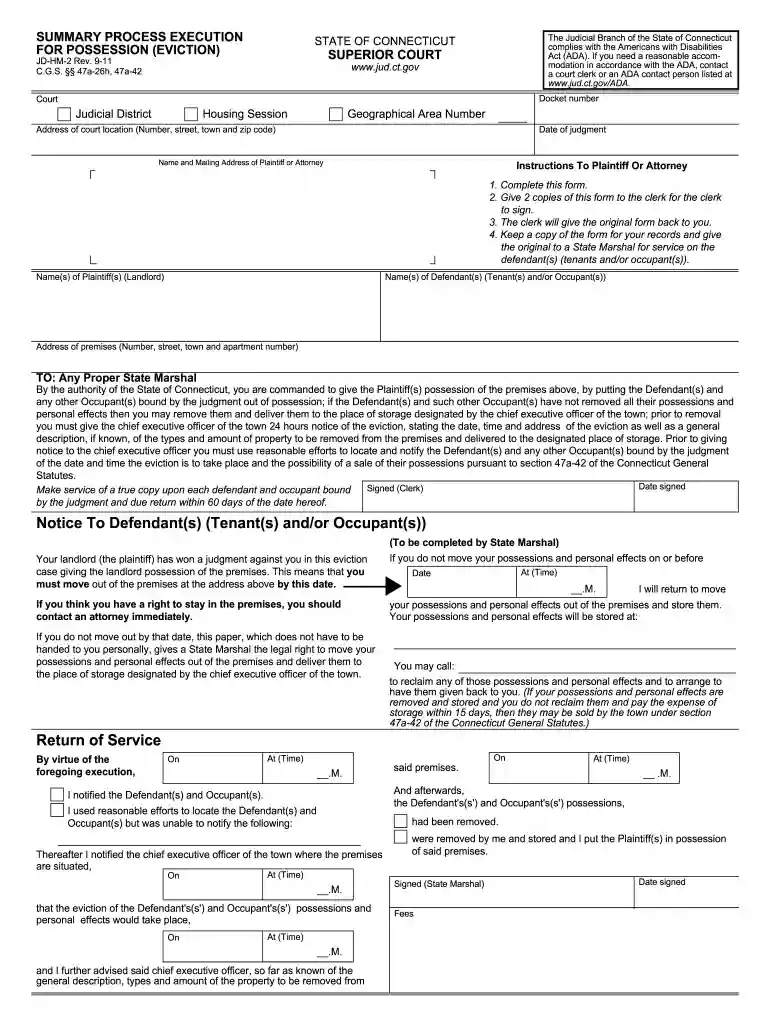
The JD HM 2 form is an essential document used in the legal process of executing a summary possession, commonly known as eviction, in the State of Connecticut. This form outlines the procedural requirements for plaintiffs, including landlords or their representatives, to initiate and carry through with the eviction process legally. It details how defendants, primarily tenants, are to be notified of eviction judgments, safeguarding the legal rights of all parties involved. In addition, the document underscores compliance with the Americans with Disabilities Act (ADA), ensuring that the eviction process does not discriminate based on disability.
Utilizing the JD HM 2 effectively requires a thorough understanding of the eviction process in Connecticut. Here's a step-by-step guide:
Filing the Form: Begin by completing the JD HM 2 form accurately, providing all necessary details about the eviction case. This includes information about the plaintiff and defendant, the property in question, and the grounds for eviction.
Notification of Defendants: The form must be used to notify tenants of the eviction judgment. This involves delivering a copy of the form to the tenant, either in person, through a state marshal, or by following other legally prescribed methods to ensure the tenant is informed.
Compliance with Legal Standards: Ensure that the form and the process adhere to ADA guidelines, accommodating tenants with disabilities during the eviction process. This may involve alternative communication methods or timelines.
Filling out the JD HM 2 requires attention to detail and adherence to legal standards. Follow these steps:
Provide Accurate Information: Enter details about the landlord, tenant, and rental property accurately. This includes names, addresses, and relevant contact information.
State the Grounds for Eviction: Clearly outline the reasons for the eviction, which could include failure to pay rent, violation of lease terms, or other justifiable causes.
Include Legal References: Cite relevant legal statutes or precedents that support the eviction claim, enhancing the form's legality and strength.
Attach Supporting Documents: If necessary, include any supporting evidence such as lease agreements, payment records, or notices previously sent to the tenant.
Review and Submit: Double-check all entered information for accuracy and completeness before submitting the form to the appropriate court for processing.
In Connecticut, the JD HM 2 serves as an official legal document that initiates the eviction process. It must be used in accordance with state laws governing summary possession. Legal use entails:
Following Statutory Requirements: The form must comply with Connecticut’s landlord-tenant statutes to ensure the eviction process is legal and enforceable.
Ensuring Judicial Compliance: It should be filed with the appropriate court and adhere to judicial procedures.
Respecting Tenant Rights: Tenants must be given fair notice and the opportunity to contest the eviction in court, providing a balanced legal approach.
The JD HM 2 comprises several crucial components:
Identifying Information: Data about both plaintiff and defendant, including contact details.
Property Details: Explicit description of the rental property involved in the eviction.
Legal Justification: A section for articulating the legal basis for seeking eviction.
Procedural Requirements: A checklist of procedural steps that need to be followed to ensure compliance with legal requirements.
The JD HM 2 is specific to Connecticut, reflecting state laws and regulations concerning eviction:
Eviction Notice Timelines: Dictates specific timeframes within which tenants must be notified and allowed to respond before eviction proceeds.
Court Protocols: Instructions on how the form should be filed with the court, including potential fees.
ADA Compliance: Rules to ensure the eviction process is accessible and fair to tenants with disabilities.
Case Study 1: Nonpayment of Rent: A landlord uses the JD HM 2 to evict a tenant who has consistently failed to pay rent, following legal procedures to notify and give a fair chance for resolution before filing in court.
Case Study 2: Lease Violation: A tenant breaches the lease contract by subletting without permission, prompting the landlord to use the JD HM 2 to legally enforce lease terms and pursue eviction.
Timelines are critical in the eviction process:
Notice to Quit: 3-30 days, depending on the grounds.
Filing After Notice: Must adhere to the timeline after serving a notice to quit.
Court Hearing Dates: Be aware of scheduled court hearings post-filing for tenant or landlord appearances.
Utilizing the JD HM 2 effectively ensures compliance with Connecticut’s legal framework, safeguarding landlords’ rights while respecting tenants' protections under the law.
We've got more versions of the jd hm 2 form. Select the right jd hm 2 version from the list and start editing it straight away!
At DocHub, your data security is our priority. We follow HIPAA, SOC2, GDPR, and other standards, so you can work on your documents with confidence.
by HW Duerbeck 1990 Spectroscopic observations of the flare stars HM1 and HM2 (V667 CrA) in the direction of the R Coronae Austrinae aggregate are presented.Read more
The Court commands of you the following: (1) Put plaintiff(s) in possession of the Premises by putting the defendant(s) and occupant(s) out of possession; (2)Read more
by TH Wiedemeier Cited by 364 This report is a work prepared for the United States Air Force Center for Environmental Excellence (AFCEE) Intrinsic Remediation Flow Chart. J.


