




01. Edit your airway centric orthotics online
Type text, add images, blackout confidential details, add comments, highlights and more.

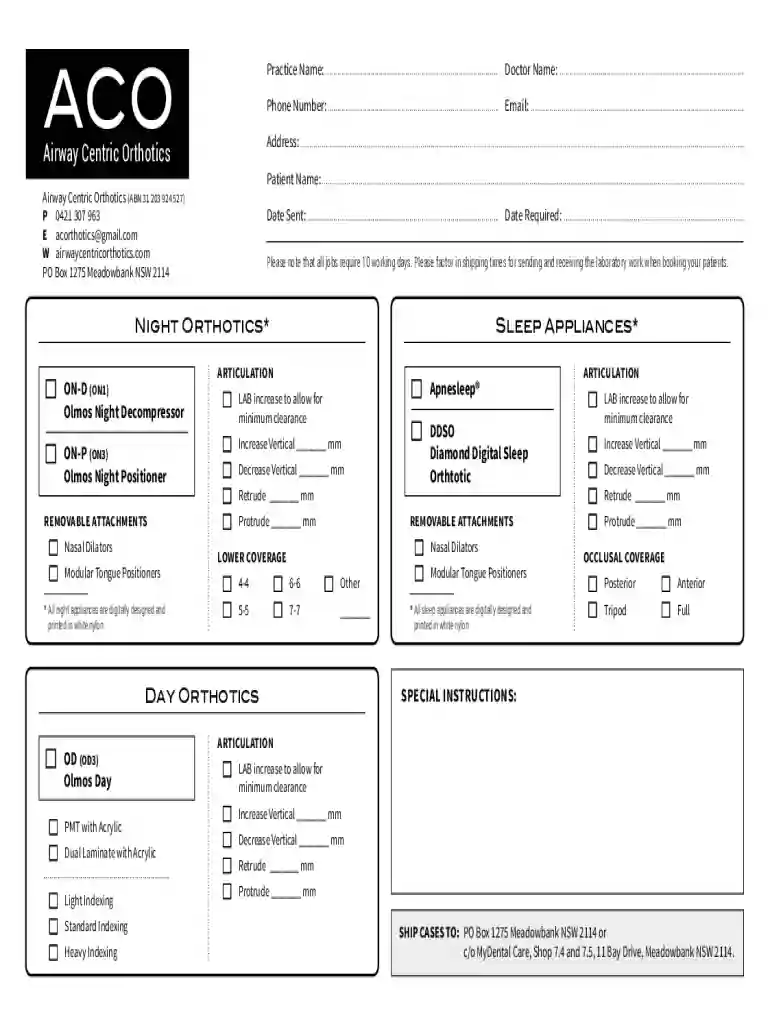
Type text, add images, blackout confidential details, add comments, highlights and more.

Draw your signature, type it, upload its image, or use your mobile device as a signature pad.

Send centric orthotics via email, link, or fax. You can also download it, export it or print it out.
Airway centric orthotics refer to specialized orthodontic devices designed to improve the alignment of both the airway passage and the dental arch. These orthotics are mainly utilized in addressing issues related to sleep apnea, snoring, and other breathing-related conditions by repositioning the jaw to facilitate better airflow. The approach focuses on ensuring optimal airway space, enhancing the wearer’s overall respiratory health. In addition to their medical utility, these orthotics can assist in reducing symptoms associated with temporomandibular joint (TMJ) disorders and can play a role in improving overall sleep quality.
Airway centric orthotics are typically worn during sleep to ensure that the airway remains open throughout the night. These orthotics should be fitted by a healthcare professional who will take impressions of the user’s dental structure to create a customized appliance. Users are advised to wear the orthotic every night for maximum effectiveness. Regular follow-ups with a healthcare provider are recommended to adjust the fit or make modifications if needed, ensuring the device is functioning as intended in opening the airway without causing discomfort.
To acquire airway centric orthotics, individuals should first consult with a physician or a dentist specialized in orthodontics or sleep medicine. A thorough assessment, including the evaluation of medical history and potentially a sleep study, will determine if these devices are suitable. Following the consultation, a fitting will involve taking dental impressions to ensure the orthotic is customized to the user’s mouth. After fabrication, the healthcare provider will guide the user on proper placement and care of the device.
Airway centric orthotics are commonly used by individuals suffering from obstructive sleep apnea, chronic snoring, or TMJ disorders. Those with mild to moderate sleep apnea may especially benefit from these devices as a non-invasive alternative to continuous positive airway pressure (CPAP) therapy. Additionally, individuals experiencing jaw discomfort or related symptoms without apnea may find relief through proper repositioning of the jaw provided by these orthotics.
In the United States, airway centric orthotics are considered Class II medical devices and are regulated by the Food and Drug Administration (FDA). They must be prescribed by a licensed healthcare provider, and any provider creating or providing these devices must comply with FDA standards and regulations. Compliance ensures the devices meet safety and efficacy benchmarks for therapeutic use. Individuals considering airway centric orthotics should consult their practitioners for proper guidance, ensuring both legal and optimal clinical use.
We've got more versions of the airway centric orthotics form. Select the right airway centric orthotics version from the list and start editing it straight away!
| Versions | Form popularity | Fillable & printable |
|---|---|---|
| 2011 | 4.3 Satisfied (43 Votes) |
At DocHub, your data security is our priority. We follow HIPAA, SOC2, GDPR, and other standards, so you can work on your documents with confidence.


