




01. Edit your 1544 form online
Type text, add images, blackout confidential details, add comments, highlights and more.

Type text, add images, blackout confidential details, add comments, highlights and more.

Draw your signature, type it, upload its image, or use your mobile device as a signature pad.

Send irs 1544 via email, link, or fax. You can also download it, export it or print it out.
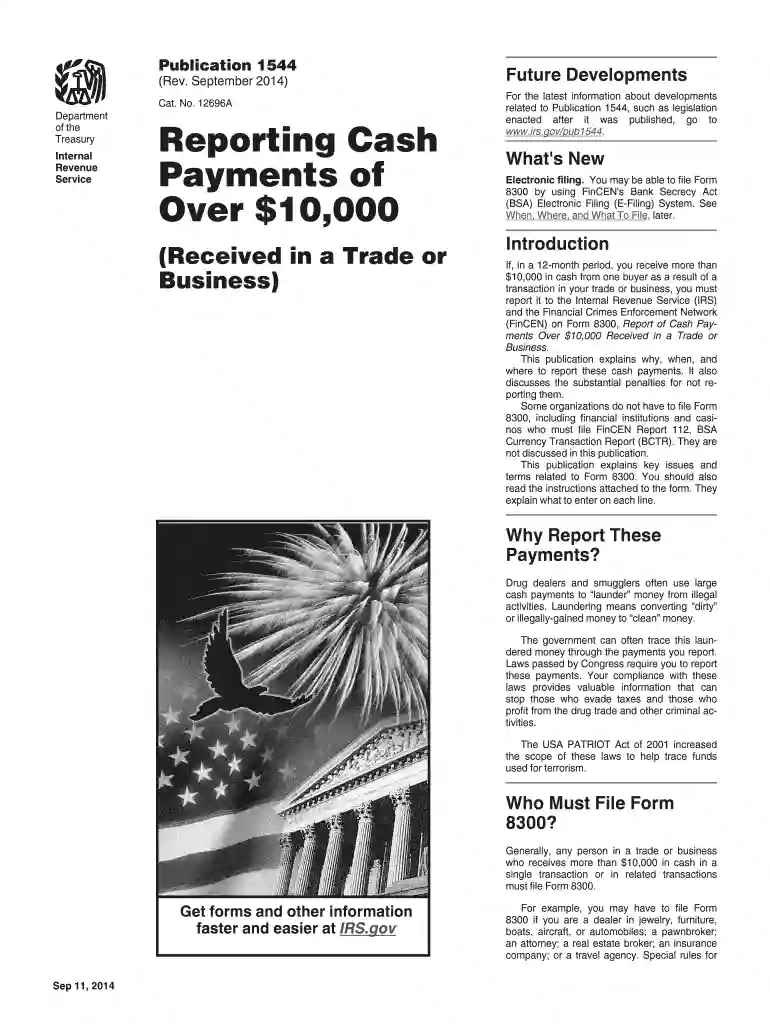
Publication 1544 serves as a crucial document from the IRS, detailing the guidelines for reporting cash payments exceeding $10,000 in the course of a trade or business. This publication elaborates on the obligations for filing Form 8300, aligning with legal requirements to prevent money laundering and tax evasion. It outlines what constitutes a reportable cash payment, who is responsible for reporting, and the potential penalties for failing to comply with these guidelines.
Understanding the terminology used in Publication 1544 is vital for accurate compliance. Key terms include:
Following specific steps is essential when completing Form 8300 per Publication 1544:
Filing Form 8300 timely and accurately fulfills legal obligations and supports national efforts to curb financial crimes. By reporting these significant transactions, businesses aid in enhancing financial transparency and accountability.
The publication is frequently used by businesses across various sectors, particularly those with significant cash dealings. This includes:


Publication 1544 is entwined with IRS guidelines that set expectations for compliance. Businesses must not only report significant cash transactions but also maintain records for five years. Non-compliance can result in substantial penalties, emphasizing the importance of understanding the guidelines.
Failing to adhere to the reporting requirements can lead to:
To comply with Publication 1544, maintain records including:
While the standard publication pertains to cash transactions over $10,000, similar guidelines and requirements may apply to other financial situations. Businesses with specific needs might explore variants or related publications by the IRS tailored to distinct transaction types or sectors.
We've got more versions of the 1544 form form. Select the right 1544 form version from the list and start editing it straight away!
As outlined by eSignature laws, forms approved digitally have the same validity as traditionally approved ones. You can electronically sign almost any business and private documentation. Four types of paperwork still require handwritten signatures only - wills and testamentary trusts, court orders and other court papers, state statutes governing divorce, adoption, or other family law, and notice of cancellation of utility services. If you adhere to the guidelines and use a trustworthy and compliant software solution, like DocHub, you can eSign your Page 1 of 6 of Publication 1544 - irs ustreas without printing it.
Apart from an extensive toolset for editing PDFs on mobile phones, DocHub enables you to sign your Page 1 of 6 of Publication 1544 - irs ustreas along the way. Open our editor in your internet browser, make changes using DocHub’s toolset, and complete your editing by eSigning the completed form.
At DocHub, your data security is our priority. We follow HIPAA, SOC2, GDPR, and other standards, so you can work on your documents with confidence.
Sep 11, 2014 What Payments Must Be. Reported? You must file Form 8300 to report cash paid to you if it is: 1. Over $10,000,.Read more
For Additional information is available at IRS Publication 1544, Reporting of Cash Payments of Over $10,000 2. required to track cash payments greater than $10
Apr 15, 1976 Page 6 ship your products if they have a life longer than one year and meet the following requirements. They qualify as property used in your


