
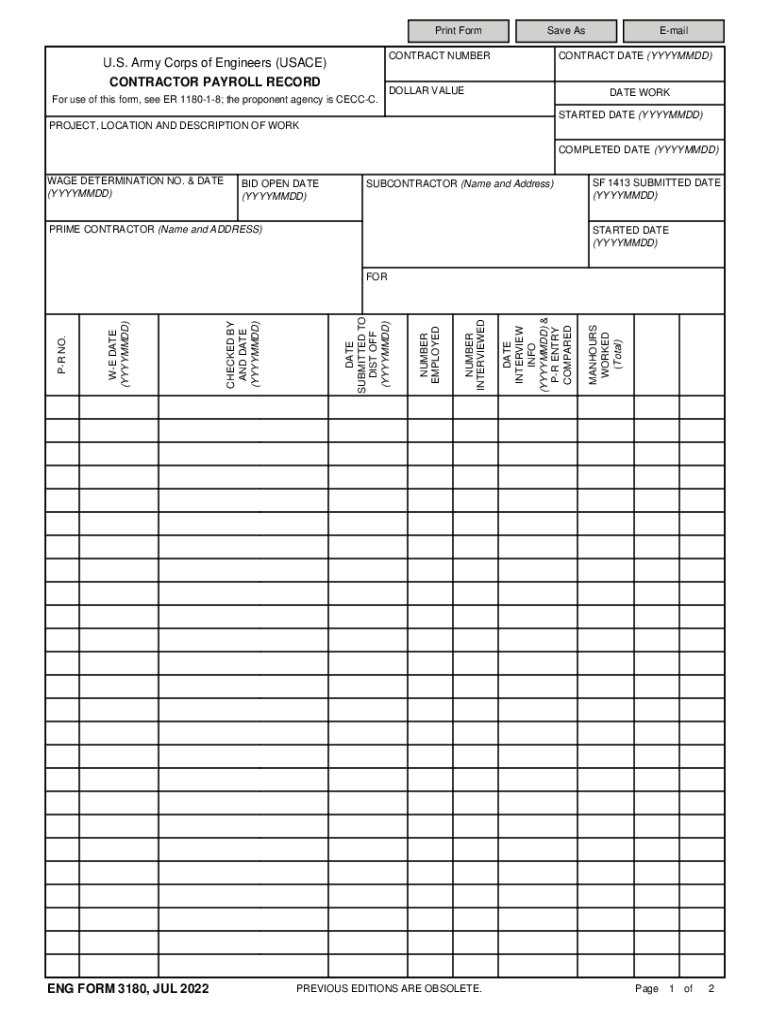







Definition and Purpose of the Contractor Payroll Record
The Contractor Payroll Record is a critical document used for recording payroll information in various contractual and construction projects, particularly those under the U.S. Army Corps of Engineers (USACE). This form captures essential details pertaining to contractors and subcontractors working under a specific contract. It includes sections on contract details, wage determinations, manhours worked, and interview data. The primary purpose of this form is to ensure compliance with labor regulations and facilitate the accurate tracking of workforce involvement in project execution.
How to Use the Contractor Payroll Record
Utilizing the Contractor Payroll Record involves accurately documenting each contractor and subcontractor's payroll information on the form. This process includes:
- Enter Contract Details: Specify the contract number and project location.
- List Contractor Information: Include names, addresses, and other identifying details of both contractors and subcontractors.
- Detail Wage Determinations: Record pertinent wage and related payroll data.
- Capture Manhours and Work Classification: Outline the number of hours worked by each employee and their respective job classifications.
- Conduct Interviews: Conduct and note employee interviews to verify payroll data accuracy.
Throughout these steps, maintaining consistency and accuracy is vital to ensure the form fulfills its regulatory and tracking objectives.
Steps to Complete the Contractor Payroll Record
Completing the Contractor Payroll Record step-by-step involves methodical documentation:
- Gather Necessary Information: Collect data on all current contractors and associated workers.
- Fill in Contract Details: Document the project’s specific contract ID and employer-related information accurately.
- Include Wage Data: Accurately record all relevant wage and payroll information for compliance.
- Report Manhours Worked: Note the total hours worked and classify them by job type.
- Conduct and Log Interviews: Ensure that each worker's interview regarding wage correctness and employment conditions is completed and documented.
Attention to detail throughout this process ensures compliance with applicable regulations and facilitates efficient payroll management.
Key Elements of the Contractor Payroll Record
The Contractor Payroll Record comprises several key elements essential for comprehensive documentation:
- Contract and Wage Information: Captures key contract identifiers and wage determinations governing employee compensation.
- Contractor and Subcontractor Data: Lists vital contact and identification information for all involved contractors and subcontractors.
- Manhour Details: Records the number of hours worked by employees, segmented by job classification to accurately reflect project workforce contributions.
- Interview Records: Documentation of interviews conducted to verify accuracy and compliance with wage standards.
These elements collectively enable robust payroll tracking and compliance verification across contractual projects.
Importance of the Contractor Payroll Record
The Contractor Payroll Record is indispensable for several reasons:
- Regulatory Compliance: Ensures adherence to labor laws, particularly when federal contracts are involved.
- Accurate Payroll Tracking: Facilitates precise documentation of all payroll data for contractors and subcontractors.
- Verification Tool: Acts as a mechanism to verify employment conditions through employee interviews, ensuring all data matches actual work conditions.
Collectively, these factors emphasize the record's importance in contract management and labor regulation compliance.
Examples of Using the Contractor Payroll Record
The Contractor Payroll Record finds application in various scenarios:
- Government Construction Projects: Used extensively to document payroll compliance for public infrastructure projects.
- Federal Contract Fulfillment: Serves as a necessary tool for contractors engaged in federally funded projects.
- Corporate Accountability: Corporations leverage the record to uphold payroll accuracy and labor compliance standards dictated by federal bodies.
These examples highlight the record's utility across diverse contract management contexts.
Legal Use of the Contractor Payroll Record
Legally, the Contractor Payroll Record serves as a compliance instrument:
- Labor Law Compliance: Ensures adherence to federal wage and labor standards on government contracts.
- Verification and Auditing: Provides a documentation trail during audits and labor inspections.
- Dispute Resolution: Acts as an official record during dispute resolution regarding labor and wage discrepancies.
Through these legal uses, the record mitigates risks and reinforces contractual obligations under labor laws.
Penalties for Non-Compliance
Failing to comply with regulations concerning the Contractor Payroll Record can lead to significant penalties:
- Fines and Sanctions: Non-compliance can result in financial penalties imposed by regulatory bodies.
- Contract Revocation: Persistent inaccuracies or negligence in recordkeeping may lead to loss of contract opportunities.
- Legal Action: Potential for legal consequences arising from wage disputes or compliance failures.
These penalties underscore the necessity of meticulous compliance with the Contractor Payroll Record's requirements to avoid adverse outcomes.
Eligibility Criteria for Using the Contractor Payroll Record
Eligibility to use the Contractor Payroll Record typically includes:
- Contractors Engaged in Government Projects: Required for those working under U.S. Army Corps of Engineers contracts.
- Subcontractors Under Federal Contracts: Any subcontractor involved in federally funded projects must maintain accurate payroll records.
- Prime Contractors: Primary contractors on federal and state projects that necessitate detailed labor documentation.
Understanding these criteria ensures appropriate and lawful application of the Contractor Payroll Record.






