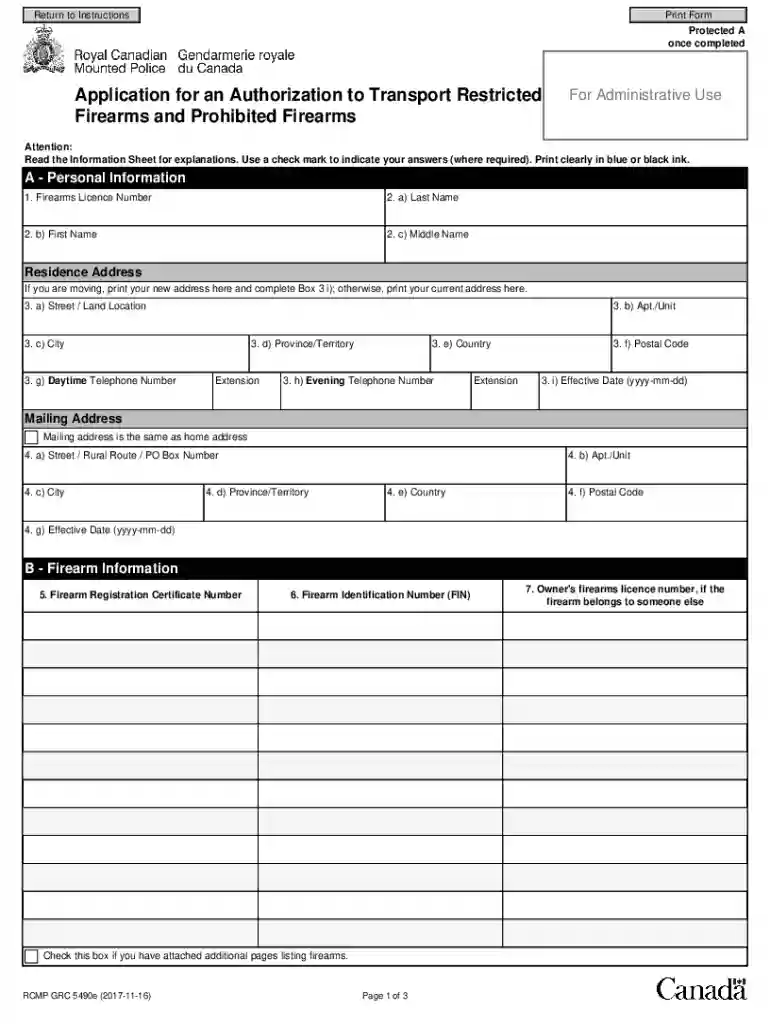
Information Sheet: Application for an Authorization to Transport Restricted 2026

Get Form
Information Sheet: Application for an Authorization to Transport Restricted Preview on Page 1

Here's how it works

01. Edit your form online
Type text, add images, blackout confidential details, add comments, highlights and more.

02. Sign it in a few clicks
Draw your signature, type it, upload its image, or use your mobile device as a signature pad.

03. Share your form with others
Send it via email, link, or fax. You can also download it, export it or print it out.

Definition & Purpose of the Information Sheet

The "Information Sheet: Application for an Authorization to Transport Restricted" is a critical document for individuals in Canada seeking permission to transport restricted or prohibited firearms. More than just a form, it provides comprehensive details needed to authorize the transportation of these firearms under strict regulations. Applicants must secure approval from the Chief Firearms Officer of their respective province or territory, ensuring that all transportation activities are within the confines of the law. This process is vital for maintaining public safety and ensuring that firearms are transported only when absolutely necessary and under controlled conditions.

Steps to Complete the Application

Complete the application by following these detailed steps:

  1. Gather Required Personal Information: Include personal details such as full name, address, and contact information. Ensure that these details are accurate and up-to-date to avoid delays.

  2. Document Firearm Details: Clearly specify the make, model, and serial number of each firearm intended for transport. This information helps in tracking and verifying the firearms involved.

  3. State Purpose for Transport: Explicitly note the reason for transportation. Common acceptable purposes include attending a shooting event, a repair requirement, or changing residence.

  4. Define Transport Dates and Routes: Provide precise dates and times of travel, including the start and end points of the transportation route. The route should be direct and planned to minimize time and distance to ensure security.

  5. Confirmation and Declaration: Conclude by signing a declaration statement, confirming the accuracy of the provided information.

Each step requires careful attention to detail to ensure compliance with all regional laws and regulations.

Important Terms and Their Meanings

Understanding related terminology is crucial for accurately completing the Information Sheet:

  • Restricted Firearm: A category of firearms that require special permission for purchase and transport.
  • Chief Firearms Officer: The provincial authority responsible for approving firearm transport applications.
  • Authorization to Transport (ATT): The official permit that grants permission to move restricted firearms under specified conditions.

These terms help clarify the requirements and responsibilities involved in the application process.

Who Typically Uses This Form?

The Information Sheet is primarily utilized by individuals in Canada who own restricted or prohibited firearms. This includes:

  • Sports Shooters: Those participating in competitive events where restricted firearms are necessary.
  • Firearm Collectors: Individuals who collect restricted firearms and may need to transport them for display or appraisal.
  • Licensed Firearm Dealers: Businesses involved in the sale and transfer of firearms that require transportation for transactions.

These users must follow exact guidelines to ensure compliant transportation.

Key Elements of the Form

Important components of the Information Sheet include:

  • Personal Information: Identifying data about the applicant.
  • Firearm Details: Specifics about the firearms involved.
  • Reason for Transport: The purpose for moving the firearm.
  • Transport Schedule and Route: Detailed plan involving when and how the firearms will be moved.

Understanding these elements is essential for successfully completing the form and obtaining the necessary authorization.

State-Specific Rules & Variations

Rules and requirements can vary slightly depending on the province or territory in Canada:

  • Quebec and Ontario: May have additional documentation or specific security requirements.
  • British Columbia: Could impose more stringent timelines for submission and approval.
  • Prairie Provinces: Potentially differ in terms of transport duration and permissible routes.

Applicants must be aware of regional differences that could affect their application processes.

Legal Use of the Form

Using the form correctly ensures compliance with Canadian firearm laws. This involves:

  • Adhering to Specified Conditions: Applications must align with legal conditions such as approved routes and times.
  • Obtain Required Approvals: Ensuring that the Chief Firearms Officer has approved all transport activities.

Legal compliance is essential to avoid penalties and maintain lawful standing.

Required Documents for Submission

Applicants need several documents when submitting their applications:

  • Personal Identification: Government-issued ID such as a driver's license.
  • Firearm License: Proof of a valid firearms possession and acquisition license.
  • Transport Justification: Any documents that substantiate the reason for the transport, such as event invitations or repair orders.

Including these documents ensures a complete application, reducing the likelihood of delays or denials.

Submission Methods

There are multiple ways to submit the application:

  • Online Submission: Through provincial firearm services if available, providing convenience and speed.

  • Mail Submission: Traditional postal delivery, which may take longer but ensures physical confirmation of submission.

  • In-Person Submission: Directly at the Chief Firearms Officer's office for immediate feedback and potential quick approvals.

Choosing the most suitable method depends on personal preference and urgency.

Penalties for Non-Compliance

Non-compliance with the application process or transport regulations can result in significant penalties, including:

  • Fines: Monetary penalties that vary depending on the severity of the infraction.
  • License Suspension: Temporary revocation of the firearms license.
  • Legal Action: Possible criminal charges leading to court appearances and further implications.

Understanding these penalties underscores the importance of strict adherence to all requirements specified in the Information Sheet.

See more Information Sheet: Application for an Authorization to Transport Restricted versions

We've got more versions of the Information Sheet: Application for an Authorization to Transport Restricted form. Select the right Information Sheet: Application for an Authorization to Transport Restricted version from the list and start editing it straight away!
Versions Form popularity Fillable & printable
2017 4.7 Satisfied (28 Votes)
2014 4.2 Satisfied (34 Votes)
be ready to get more

Complete this form in 5 minutes or less

Get form

Got questions?

We have answers to the most popular questions from our customers. If you can't find an answer to your question, please contact us.
Contact us
You need to obtain an Authorization to Transport from the provincial or territorial Chief Firearms Officer: if you own a restricted or prohibited firearm and are moving to a new address.
Personal Firearm Eligibility Check Application Submission Requirements (Continued): o The Personal Firearm Eligibility Check (PFEC) fee is $20. Please submit a check or money order payable to the. Department of Justice. DO NOT SEND CASH. o The application must be notarized by a licensed California Notary Public.
If you are coming into Canada with a firearm, please fill out a Non-Resident Firearms Declaration form ( RCMP 5589) before you arrive at your entry point into Canada to save you time. Do not sign the form; a Canada Border Services Agency ( CBSA ) customs officer must witness your signature. The fee is $25.
Visiting Canada Non-residents must be 18 years of age or older to use a firearm in Canada or to bring one into the country. If you are coming into Canada with a firearm, please fill out a Non-Resident Firearms Declaration form ( RCMP 5589) before you arrive at your entry point into Canada to save you time.
For more detailed information you may wish to contact the Canadian Firearms Program directly by calling 1-800-731-4000.

Security and compliance

At DocHub, your data security is our priority. We follow HIPAA, SOC2, GDPR, and other standards, so you can work on your documents with confidence.

Learn more
ccpa2
pci-dss
gdpr-compliance
hipaa
soc-compliance

People also ask

When a restricted or prohibited firearm is sold, given or traded to a new owner, the registration record must be updated to reflect this transfer, and a new registration certificate must be issued to the new owner. This happens as part of the transfer process.
Mail: An application to transfer a restricted or prohibited firearm can be initiated by mail. Use form RCMP 5492 for restricted and prohibited firearms. Both the transferor (seller) and the transferee (buyer) must complete the form.
Declaration (Form RCMP 5589 / CAFC 909) Canadian firearm safety regulations Canadian Firearms Program for Non-Residents As a visitor, you will need to fill out a Non-Resident Firearm Declaration (form RCMP 5589) to bring weapons into Canada.

Related links