




01. Edit your form online
Type text, add images, blackout confidential details, add comments, highlights and more.

Type text, add images, blackout confidential details, add comments, highlights and more.

Draw your signature, type it, upload its image, or use your mobile device as a signature pad.

Send it via email, link, or fax. You can also download it, export it or print it out.
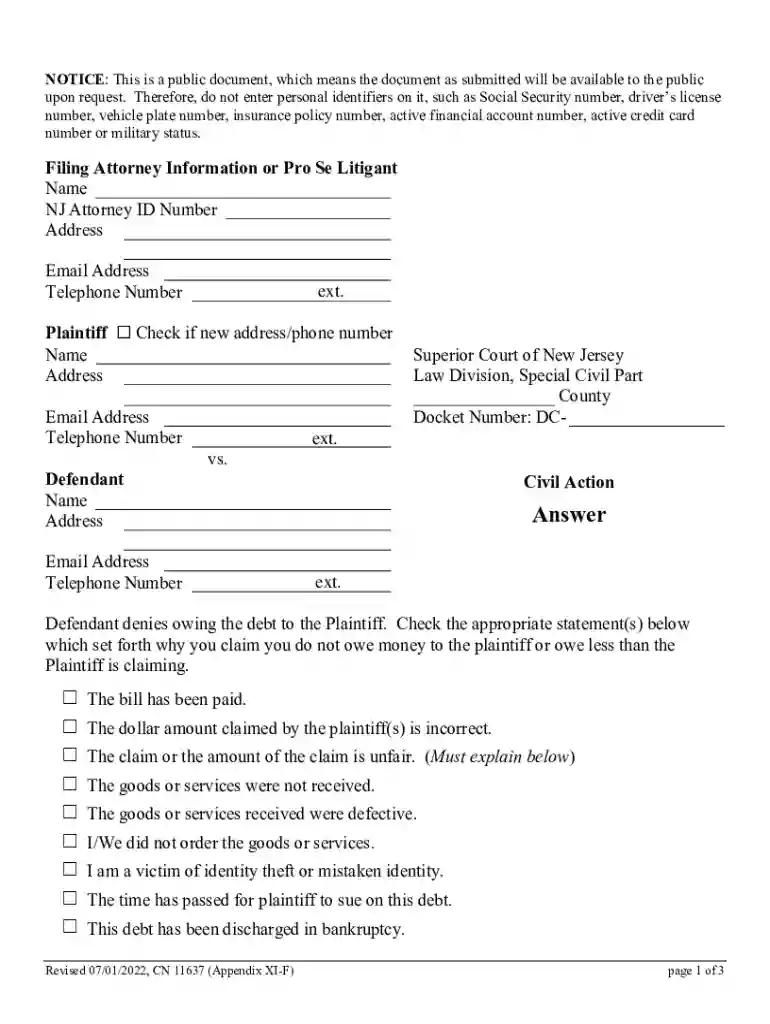
The Civil Action - Answer (Appendix XI-F) - NJ Courts form is used by defendants responding to civil complaints in the Superior Court of New Jersey. This document allows defendants to formally answer allegations made against them and assert any relevant defenses. It is a critical part of the procedural process and ensures that defendants have the opportunity to contest claims while presenting counterclaims or affirmative defenses.
To effectively use the Civil Action - Answer form, defendants must carefully review the plaintiff's complaint and methodically address each point.
Completing the form involves a series of detailed steps, ensuring that all necessary legal requirements are met.
This form is generally utilized by parties involved in civil litigation within New Jersey.


Understanding legal terminology is essential for effectively completing and using this form.
Several critical elements must be included in the form to ensure it meets legal standards.
Legally, the form serves numerous functions within the judicial process.
Real-world scenarios illustrate the application of the form in various contexts.
These examples emphasize the Civil Action - Answer form's role in equipping defendants with a formal mechanism to contest claims and introduce defenses or counterclaims.
We've got more versions of the Civil Action - Answer (Appendix XI-F) - NJ Courts form. Select the right Civil Action - Answer (Appendix XI-F) - NJ Courts version from the list and start editing it straight away!
At DocHub, your data security is our priority. We follow HIPAA, SOC2, GDPR, and other standards, so you can work on your documents with confidence.
Oct 29, 2024 Neither Supreme Court order directed the courts to conduct a complete review of all residential eviction complaints for legal sufficiency.Read more
The document is intended to serve as a technical and regulatory guide for stakeholders, regulators, and technology implementers involved in selecting andRead more


