




01. Edit your pecs phases cheat sheet online
Type text, add images, blackout confidential details, add comments, highlights and more.

Type text, add images, blackout confidential details, add comments, highlights and more.

Draw your signature, type it, upload its image, or use your mobile device as a signature pad.

Send pecs phases via email, link, or fax. You can also download it, export it or print it out.
The Picture Exchange Communication System (PECS) is a structured method used primarily to aid communication in individuals with autism spectrum disorders and other related difficulties. Designed to support learners in expressing themselves, PECS employs visual symbols to bridge communication gaps. This system enables users, particularly non-verbal children, to form meaningful sentence structures using pictures, fostering improved interaction in educational and domestic environments.
PECS was developed by Bondy and Frost in the 1980s with the aim of aiding non-verbal communication. Recognizing the potential of visual symbols, they structured a program that empowers individuals to communicate desires, thoughts, and needs effectively. The system is versatile, catering to the varying cognitive abilities of users, which makes it an essential tool in many special education programs.
By emphasizing these objectives, the PECS assists learners in not just responding, but also in taking initiative in communication.
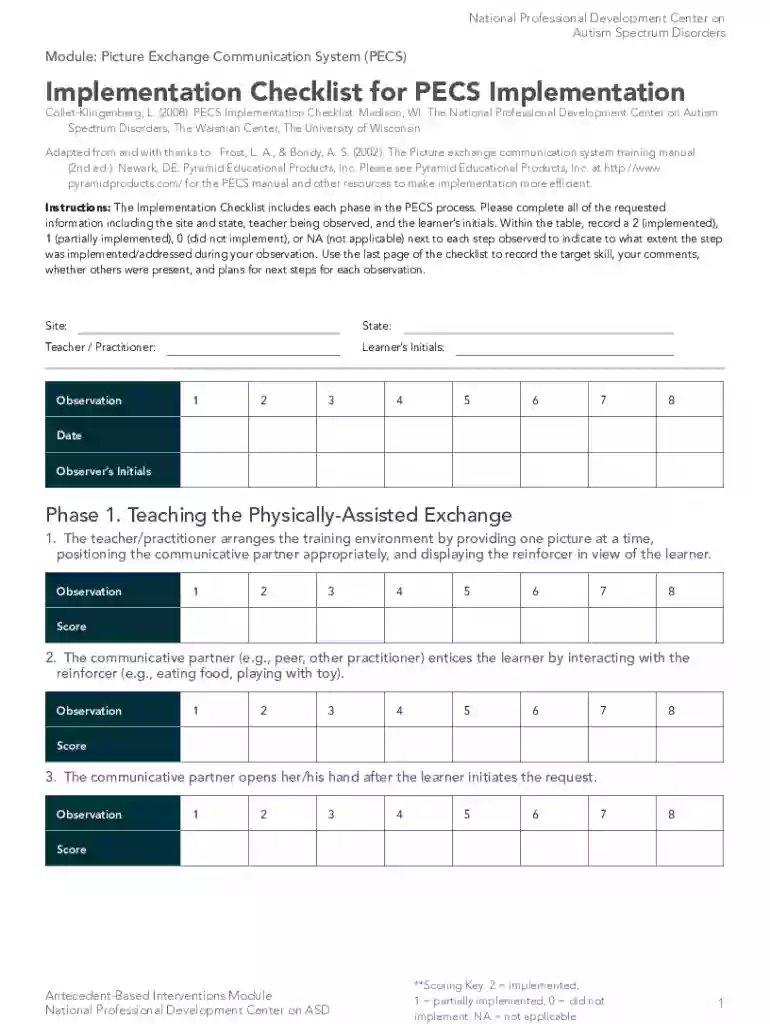
Completing the Implementation Checklist for PECS involves several defined steps, ensuring thorough assessment of each communication phase. The checklist is meticulously laid out to guide educators, therapists, or family members through the systematic implementation of PECS in diverse settings.
Assess Current Communication Skills: Begin by evaluating the existing communication abilities of the user. Determine their comfort with visual aids and adjust the strategy accordingly.
Phase Wise Step Completion: Follow the distinct phases outlined for PECS, which include:
Scoring and Feedback: Use the checklist as a scoring tool to evaluate the effectiveness of each phase, noting areas for improvement and adaptation.
Monitor Progress: Consistently record progress at each phase, making necessary adjustments based on user interactions and responses.
The Implementation Checklist for PECS is composed of critical elements ensuring rigorous adherence to each stage of PECS deployment. These components are designed to oversee the practicality and efficacy of the system within a structured environment.
Physical Exchange: Involves teaching the user to physically exchange a picture for a desired item or action.
Spontaneity Prompting: Encourages users to initiate communication without external cues.
Sentence Strip Usage: Guides users on arranging symbols on a sentence strip to construct valid sentences.
These tools are imperative within the checklist to provide a comprehensive feedback mechanism. The clear allocation of scores helps in identifying successful implementation levels and areas needing further attention.
The primary users of the PECS Implementation Checklist include educators, therapists, and guardians involved in the direct support of individuals with communication challenges. Their involvement is crucial in facilitating the transition from non-verbal to verbal identifiers through visual aids.


Schools offering special education programs employ this checklist to evaluate progress and effectiveness within classrooms, catering to children who benefit from structured communication systems.
Speech language pathologists utilize the checklist to incorporate PECS within therapy sessions, enhancing communicative capabilities through repeated, guided practice.
Parents and caregivers who adopt PECS in home settings play a significant role in reinforcing learned communication methods, using the checklist as a tool for consistency and feedback.
The checklist serves as a step-by-step guide for implementing and tracking the progress of the PECS program. Utilizing this tool effectively requires careful planning and execution.
Initial Setup: Understand the various phases and requirements of PECS before implementing. Comprehensive knowledge ensures proper usage and adaptability to the learner’s needs.
Regular Monitoring: Consistently track progress against the checklist to recognize both accomplishments and challenges, adapting strategies to better align with user abilities.
Group Sessions: Utilize the checklist during group sessions to foster peer interactions, simulating realistic communication scenarios for enhanced learning.
Real-world scenarios demonstrate the checklist's versatility, illustrating how different settings benefit from its structured approach.
In a suburban elementary school, the PECS Implementation Checklist serves as a guide for special education teachers to facilitate communication in non-verbal students. By tracking individual progress, teachers identify specific areas needing focus, resulting in noticeable improvements in sentence construction among students.
A speech pathologist integrates the checklist into weekly therapy sessions. By observing and noting progress, they tailor interventions to better serve individual client needs, ensuring each session builds upon the last for cumulative growth.
At home, a parent uses the checklist to facilitate daily communication with their child. By maintaining a consistent approach, the child becomes more confident in using picture exchanges to convey needs, reducing frustration considerably.
The application of PECS can vary based on state regulations and policies regarding special education and therapy practices.
Certain states necessitate alignment with specific educational standards or therapeutic guidelines when implementing communication systems like PECS.
States offer varying levels of funding and compliance mandates for the facilitation of communication programs, impacting how PECS and its implementation checklist are used institutionally.
Understanding these variations is critical for successfully leveraging PECS to its fullest potential across diverse educational and therapeutic contexts.
We've got more versions of the pecs phases cheat sheet form. Select the right pecs phases cheat sheet version from the list and start editing it straight away!
At DocHub, your data security is our priority. We follow HIPAA, SOC2, GDPR, and other standards, so you can work on your documents with confidence.
by DI Rapolti 2024 Cited by 2 The checklist comprises three phases and 19 items addressing a variety of perioperative safety measures. improving teamwork and communication.
by L Rubio-Fuentes 2025 Current systems lack IoT communication protocols for the most part, the system discussed in this paper would allow the advantages of Mioty technology to be


