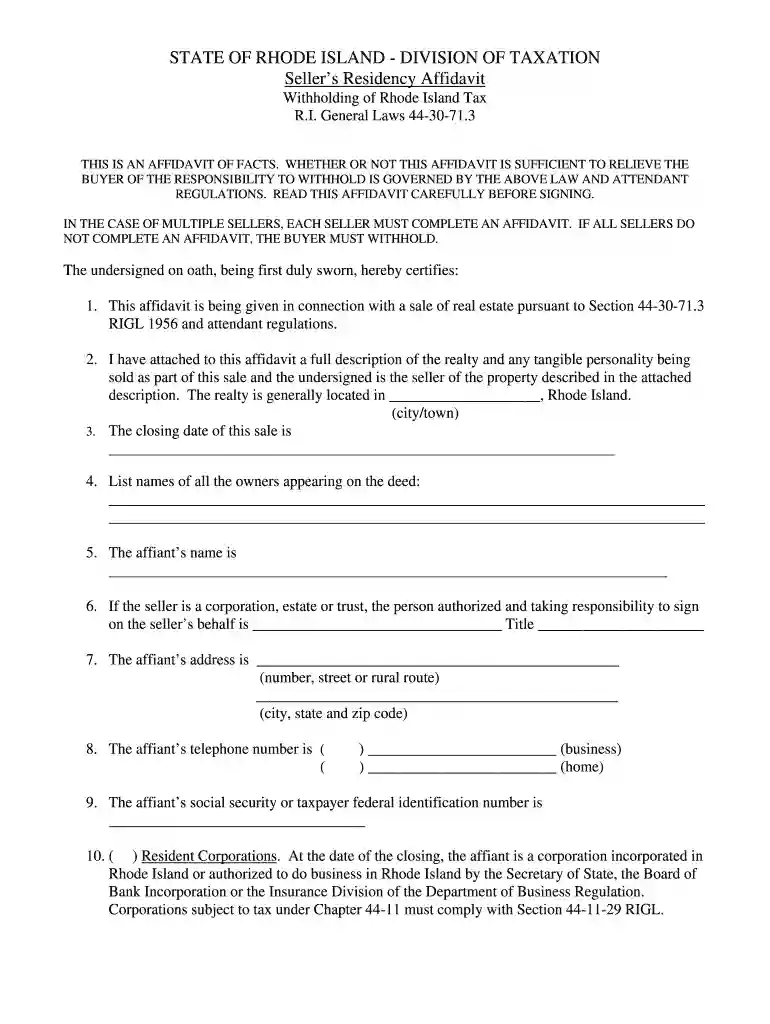
Ri residency affidavit 2026

Get Form
affadavit of residency Preview on Page 1

Here's how it works

01. Edit your affadavit of residency online
Type text, add images, blackout confidential details, add comments, highlights and more.

02. Sign it in a few clicks
Draw your signature, type it, upload its image, or use your mobile device as a signature pad.

03. Share your form with others
Send affidavit of residency via email, link, or fax. You can also download it, export it or print it out.

Definition and Purpose of the RI Residency Affidavit

The Rhode Island Residency Affidavit is a crucial document required during real estate transactions in the state of Rhode Island. It serves to certify the residency status of the seller, which is important for determining withholding tax obligations. By completing this affidavit, a seller declares their residency status, which influences whether taxes must be withheld by the buyer at the time of the property sale. This document ensures compliance with the state’s tax regulations and facilitates smooth property transactions.

Key Elements of the RI Residency Affidavit

To effectively complete the RI Residency Affidavit, several critical components must be carefully addressed:

  • Seller’s Identity: The affidavit must clearly state the names and contact information of all sellers involved in the transaction.
  • Property Information: Detailed information about the property being sold, including its address and legal description, is necessary.
  • Residency Declaration: Sellers must declare their residency status, whether they are residents or non-residents of Rhode Island.
  • Signature and Attestation: Each seller must sign the affidavit in the presence of a notary, attesting to the accuracy of all information provided.

Steps to Complete the RI Residency Affidavit

Completing the RI Residency Affidavit involves several methodical steps:

  1. Gather Seller Information: Collect the full names and contact details of each seller.
  2. Detail Property Information: Ensure the property’s address and legal description are accurately recorded.
  3. Declare Residency Status: Indicate whether each seller is a resident or a non-resident of Rhode Island.
  4. Notarize the Document: Schedule a meeting with a notary. All sellers must sign the affidavit in the notary’s presence for it to be valid.
  5. Provide to Buyer: Submit the completed affidavit to the buyer, who will retain it for their records and tax reporting purposes.

Importance of the RI Residency Affidavit

The RI Residency Affidavit is essential for both sellers and buyers during property sales due to its implications on tax obligations. Sellers are required to provide this document to certify their residency status, which determines the withholding tax responsibilities of the buyer. Without a completed affidavit, buyers are generally mandated to withhold taxes, potentially complicating the transaction. Ensuring the completion and accurate filing of this affidavit facilitates transparency and compliance with state tax requirements.

Legal Implications and Compliance with the RI Residency Affidavit

Using the RI Residency Affidavit correctly is pivotal for legal compliance in real estate transactions in Rhode Island:

  • Buyer’s Obligations: Buyers are obligated to withhold taxes from the sale proceeds unless a properly completed residency affidavit is received from the seller.
  • Proof of Residency: This affidavit serves as the legal documentation of the seller’s residency status, which is crucial for tax assessment.
  • Retention of Records: Buyers must retain the affidavit as it may be required for audit purposes or state taxation review.

Who Typically Uses the RI Residency Affidavit

This affidavit is particularly relevant to individuals involved in selling real estate in Rhode Island:


  • Individual Sellers: All individuals selling property must complete this affidavit to declare their residency status.
  • Real Estate Agents and Attorneys: Professionals facilitating the sale process often assist in ensuring the proper completion of these documents.
  • Buyers: Although not responsible for completing the affidavit, buyers need it for their tax records to safeguard against potential tax audits.
decoration image ratings of Dochub

State-Specific Rules for the RI Residency Affidavit

Rhode Island has specific rules governing the use and submission of the Residency Affidavit:

  • Mandatory Notarization: The affidavit must be notarized to be legally effective.
  • Timely Submission: The affidavit should be completed and presented to the buyer before the closing of the real estate transaction.
  • Record Retention: Both sellers and buyers should retain copies of the affidavit for potential future reference by tax authorities.

Examples of Using the RI Residency Affidavit

Understanding practical scenarios where the RI Residency Affidavit is used can provide clear insights:

  1. Single Family Home Sale: A resident of Rhode Island selling a home must complete the affidavit to certify their residency status, thus alleviating the buyer from withholding taxes.
  2. Investment Property: Non-resident sellers of investment properties must declare their status, often resulting in tax withholding by the buyer.
  3. Multi-Seller Transactions: In cases where multiple individuals own a property, each seller must complete the affidavit to ensure all parties' residency statuses are clearly documented.

Submission Methods and Software Compatibility

When submitting the RI Residency Affidavit, understanding the available methods is essential:

  • In-Person Delivery: While not always necessary, some transactions may benefit from in-person delivery of the affidavit.
  • Mail Submission: The affidavit can be mailed to the required parties, ensuring it is processed alongside other closing documents.
  • Digital Platforms: With platforms like DocHub, users can complete, sign, and share the affidavit electronically, streamlining the overall workflow without the need for physical documents.

These elements provide a comprehensive overview of the RI Residency Affidavit, emphasizing its importance, usage, and procedural details in the context of real estate transactions in Rhode Island.

See more ri residency affidavit versions

We've got more versions of the ri residency affidavit form. Select the right ri residency affidavit version from the list and start editing it straight away!
Versions Form popularity Fillable & printable
2020 4.8 Satisfied (163 Votes)
2008 4 Satisfied (47 Votes)
be ready to get more

Complete this form in 5 minutes or less

Get form

Got questions?

We have answers to the most popular questions from our customers. If you can't find an answer to your question, please contact us.
Contact us
An affidavit of residency in the U.S. is a legally binding document serving as a sworn statement affirming an individuals place of residence. docHubd and signed under oath, this statement helps establish where a person lives. Different states might have specific variations in their requirements for the document.
A lease or utility bill in your name would work. If you live with relatives, a copy of a lease or utility bill in their name, with an additional document proving that relationship between you and that relative, should be fine.
In 2015, Rhode Island governor Gina Raimondo proposed a tax on second homes in the state worth over $1 million, which quickly became known as the ``Taylor Swift tax, inspired by that Watch Hill purchase.
One (1) proof of identity document, such as a valid or expired (less than 5 years) drivers license, a certified copy of a birth certificate filed with a State Office of Vital Statistics or equivalent agency (RI city or town halls) in the individuals State of birth OR an unexpired passport.
A Resident is an individual that is domiciled in Rhode Island or an individual that maintains a place of abode in Rhodes Island spending at least 183 days in the state.

Security and compliance

At DocHub, your data security is our priority. We follow HIPAA, SOC2, GDPR, and other standards, so you can work on your documents with confidence.

Learn more
ccpa2
pci-dss
gdpr-compliance
hipaa
soc-compliance