




01. Edit your victorian refugee health network online
Type text, add images, blackout confidential details, add comments, highlights and more.

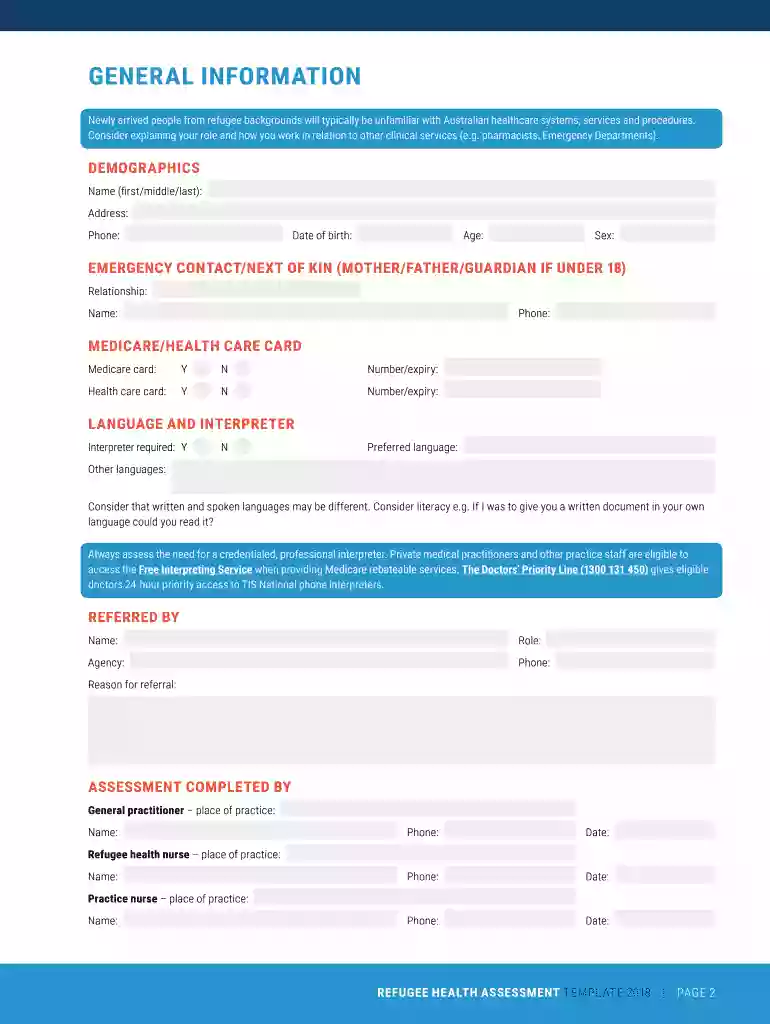
Type text, add images, blackout confidential details, add comments, highlights and more.

Draw your signature, type it, upload its image, or use your mobile device as a signature pad.

Send refugee health assessment template via email, link, or fax. You can also download it, export it or print it out.
Screening for Social Determinants of Health (SDOH) in populations refers to the process of identifying non-medical factors that influence health outcomes. These determinants include socioeconomic status, education, physical environment, employment, and social support networks. By understanding these elements, healthcare providers and public health officials can tailor interventions to improve healthcare access and outcomes.
Understanding SDOH can help address inequities in health caused by factors such as poverty, inadequate housing, and lack of education. This assessment helps practitioners foresee potential health risks associated with social conditions to create more comprehensive care plans.
Collect Demographic Information: Begin by gathering detailed demographic data, including age, gender, race, and primary language, which are crucial for understanding the context of health inequities.
Assess Socioeconomic Factors: Identify income levels, educational attainment, and employment status to evaluate economic stability.
Evaluate Social Environment: Analyze the individual's support networks, community engagement, and cultural influences, as these can affect health behaviors and access to healthcare.
Review Physical Environment: Consider the living conditions, housing quality, and accessibility to essential services like transportation and healthcare facilities.
Analyze Psychosocial Aspects: Examine stress levels, exposure to violence, and mental health status to identify potential impacts on overall health.
Interpret Findings: With gathered data, compare against health outcomes to identify correlations, enabling tailored interventions.
Screening for SDOH provides valuable insights that can lead to improved health outcomes by identifying obstacles that patients face outside clinical settings. Recognizing these factors allows healthcare providers to offer personalized healthcare interventions and connect patients with necessary community services.
For example, identifying transportation issues can lead to offering telehealth services or partnering with local transport for healthcare access. Moreover, understanding educational barriers helps in providing health literacy programs, empowering patients with knowledge to manage their health conditions.
Addressing SDOH is fundamental in reducing healthcare disparities and promoting preventative care.
Healthcare providers, including physicians, nurses, and social workers, often utilize SDOH screenings to gain a holistic view of patient health. Public health organizations, policymakers, and community service providers also engage in these screenings to develop interventions at population levels.
These screenings are instrumental in designing public health campaigns and influencing policy changes to improve healthcare delivery systems. For instance, a public health agency might use collected data to advocate for increased funding for affordable housing or educational programs.


Understanding these elements provides a comprehensive perspective on how non-medical factors affect health and wellness.
SDOH screenings may vary in terms of implementation and resources across states, with some states having specific frameworks or guidelines to ensure thoroughness and relevance.
Tailoring SDOH initiatives to reflect local needs and state policies ensures screenings are more effective and policy-compliant.
The use of SDOH screenings must adhere to patient privacy laws such as the Health Insurance Portability and Accountability Act (HIPAA). Ensuring data confidentiality and secure handling of sensitive information is paramount.
Legal considerations involve obtaining informed consent from participants, clearly explaining the purpose of data collection, and permitting patients to opt out. Moreover, it's essential to use the information solely for the intended purpose of improving health outcomes and not for discriminatory practices.
Real-world applications of SDOH screenings include:
By adopting these practices, organizations are better equipped to encourage health equity and provide supportive interventions.
We've got more versions of the victorian refugee health network form. Select the right victorian refugee health network version from the list and start editing it straight away!
| Versions | Form popularity | Fillable & printable |
|---|---|---|
| 2018 | 4.8 Satisfied (28 Votes) |
At DocHub, your data security is our priority. We follow HIPAA, SOC2, GDPR, and other standards, so you can work on your documents with confidence.
by DT OGUREK Cited by 191 Three screening tools can aid physicians in addressing multiple social determinants of health in a primary care setting. Screening tool. Number of questions.Read more
Orion Health provides an end-to-end population health management platform integrating clinical data, health information exchange, patient engagement tools, and
by M Moen 2020 Cited by 130 This review is a practice brief that can help health care institutions and clinicians implement screening and interventions related to HRSC.


