
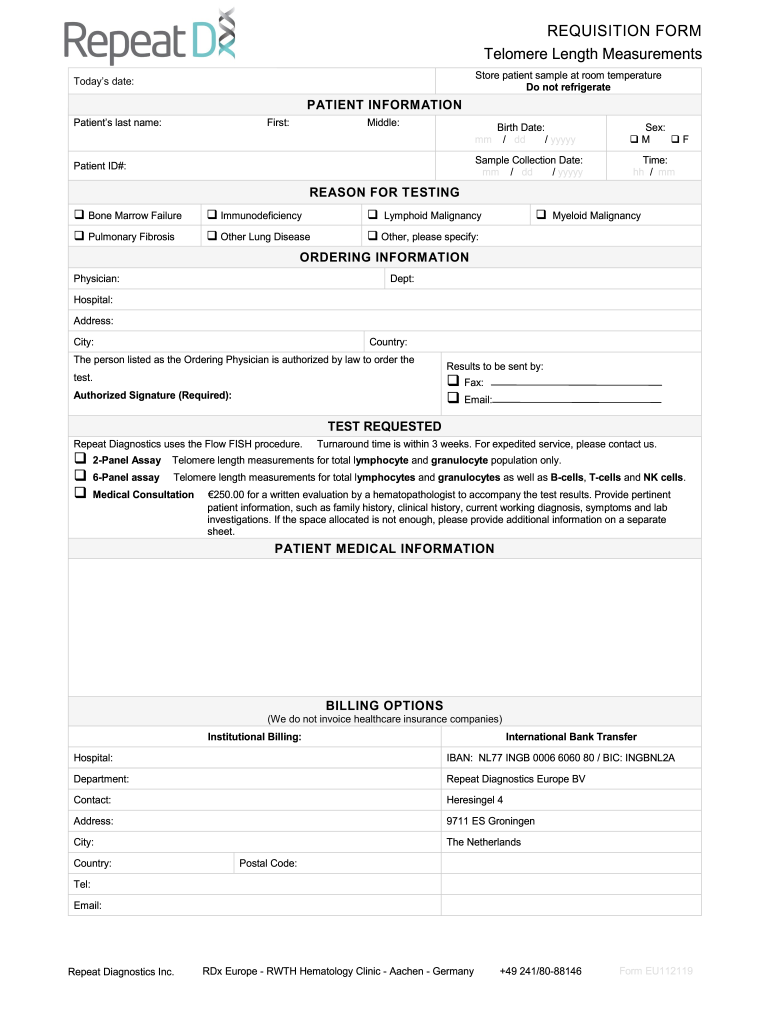







Definition and Purpose of Medical Office Registration Form for Repeat Diagnostics
The "Medical Office Registration Form" for Repeat Diagnostics serves as a critical document in medical practices. It captures and organizes essential information necessary for diagnostic processes, ensuring accuracy and efficiency in patient record management. The form typically includes patient demographics, medical history, insurance details, and specific diagnostic testing options. This registration form is designed to facilitate seamless communication between medical offices and diagnostic facilities, supporting both administrative tasks and clinical decision-making.
Steps to Complete the Medical Office Registration Form for Repeat Diagnostics
-
Gather Patient Information:
- Obtain personal details such as full name, date of birth, and contact information.
- Collect insurance details, including policy number and provider contact information.
-
Specify Diagnostic Needs:
- Indicate the type of diagnostic tests required, such as blood work or advanced imaging.
- Include relevant medical history or current symptoms that justify the need for testing.
-
Include Physician Details:
- Provide the name and contact information of the ordering physician.
- Ensure the physician's credentials are accurately recorded for verification purposes.
-
Review and Sign:
- Confirm all information for accuracy before submission.
- Patient and physician must provide signatures to validate the form.
Importance of Using the Medical Office Registration Form for Repeat Diagnostics
The form ensures structured data collection, minimizing errors in patient records and diagnostic processes. It also serves as a legal documentation of consent and information accuracy, which is crucial for compliance with healthcare regulations. Furthermore, streamlined data entry into electronic health records (EHR) systems enhances the efficiency of subsequent medical evaluations and treatments.
Who Typically Uses the Medical Office Registration Form for Repeat Diagnostics
- Healthcare Providers: Doctors, nurses, and administrative staff utilize the form to gather patient information efficiently.
- Diagnostic Centers: Laboratories and imaging facilities rely on the form for accurate test scheduling and result processing.
- Insurance Companies: Insurance processors use the form to verify patient eligibility and coverage for diagnostics.


Key Elements of the Medical Office Registration Form for Repeat Diagnostics
- Patient Demographics: Includes personal identification information and contact details.
- Insurance Information: Details of the patient's insurance plan, policy number, and payer information.
- Diagnostic Orders: Specific instructions for the tests or procedures to be performed.
- Physician Information: Contact details and credentials of the referring physician.
- Consent and Authorization: Sections requiring signatures to authorize the release and use of health information.
Legal Use and Compliance of the Medical Office Registration Form
Utilization of this form must adhere to regulations such as the Health Insurance Portability and Accountability Act (HIPAA). The form must include policies that protect patient privacy and ensure that all shared medical information is handled with the highest confidentiality. Proper compliance ensures that both the diagnostic center and medical office operate within legal boundaries, safeguarding against potential legal repercussions.
Examples of Using the Medical Office Registration Form in Practice
- Routine Check-Ups: A patient visiting their primary care physician for annual physicals may require standard blood tests, which would be noted on the form.
- Specialist Appointments: A referral to an endocrinologist for hormone assessments might necessitate additional specific diagnostic tests.
- Pre-Surgical Evaluations: Prior to procedures, patients often undergo comprehensive testing to establish baseline health status, guided by this form.
Comparison: Digital vs. Paper Version
- Digital Forms: These allow for quick data entry and easy integration with EHR systems. They offer enhanced accessibility and efficiency for medical personnel.
- Paper Forms: While traditional, they may be necessary for locations with limited digital infrastructure, but they require manual filing and are prone to errors from handwriting misinterpretations.
Software Compatibility for the Medical Office Registration Form
DocHub provides robust support for integrating forms with various healthcare systems. The platform's ability to work with diverse file formats like PDF, DOC, and XLS ensures widespread compatibility, enabling seamless form completion and tracking within different software ecosystems. Users can easily transition data from DocHub to healthcare software, ensuring continuity and accuracy in patient records management.
Through comprehensive planning and precision in completing the medical office registration form, healthcare providers can enhance operational efficiency and improve patient care outcomes.




