




01. Edit your eye exam form online
Type text, add images, blackout confidential details, add comments, highlights and more.

Type text, add images, blackout confidential details, add comments, highlights and more.

Draw your signature, type it, upload its image, or use your mobile device as a signature pad.

Send kentucky eye examination form for school entry via email, link, or fax. You can also download it, export it or print it out.
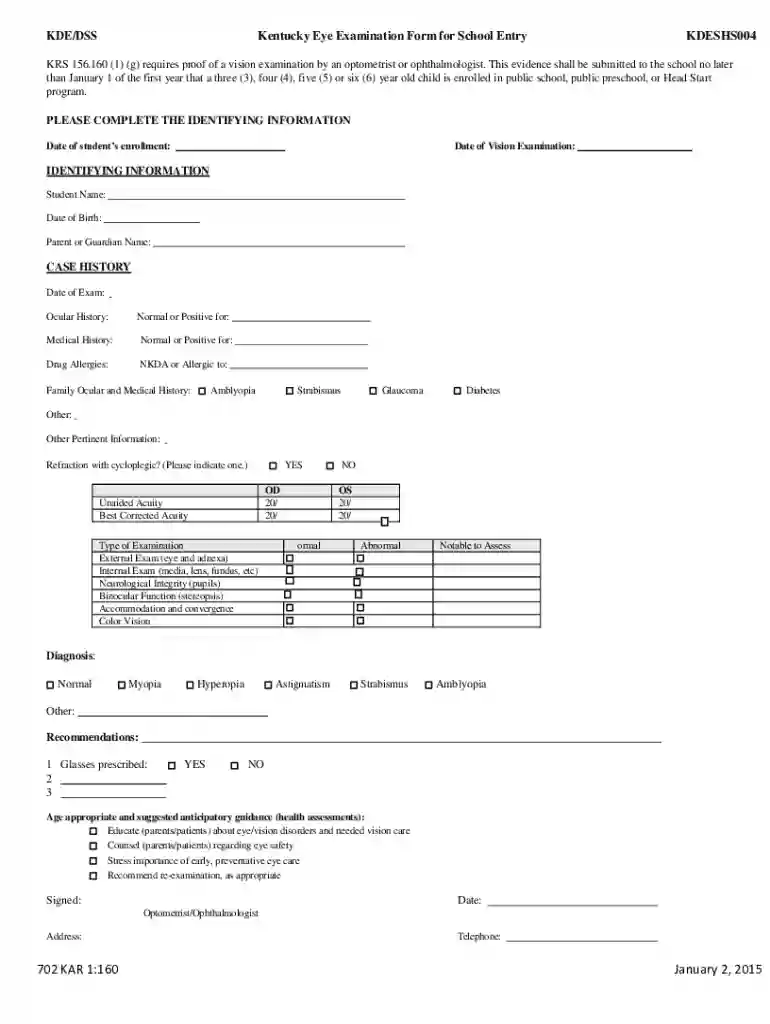
The Kentucky Eye Examination Form for school entry is a mandated document required for children aged three to six who are enrolling in school within the state of Kentucky. This form serves as proof that a child has undergone a vision examination administered by a licensed optometrist or ophthalmologist. The primary purpose of this form is to ensure early detection and treatment of potential vision issues that could affect a child's educational development. By confirming that a child’s vision is within the required parameters, schools can accommodate any necessary visual aids or treatments that could assist in a child’s learning.
The use of the form begins with scheduling an eye examination for your child with an optometrist or ophthalmologist. During the appointment, the healthcare professional will conduct a thorough eye examination covering various vision aspects to assess the child’s eyesight and overall eye health. The form includes sections for the healthcare provider to record identifying information, examination details, diagnosis, and any recommendations for vision correction if needed. It concludes with the professional's signature and possibly a parent or guardian's acknowledgment of the results and recommendations. Once completed, this form is submitted to the school as part of the enrollment requirements.
The Kentucky Eye Examination Form can be obtained from several sources. Parents can request a copy from their child's school as schools often provide forms to facilitate compliance with enrollment requirements. Alternatively, many healthcare providers, such as optometrists and ophthalmologists, have access to the form and can provide it during the examination appointment. The form may also be available for download from the Kentucky Department of Education's official website or local health department websites. It’s important to ensure that the form used is the most current version mandated by the state.
Completing and submitting the Kentucky Eye Examination Form is a crucial step in supporting a child’s educational journey. Early vision examinations can detect issues such as amblyopia (lazy eye), strabismus (crossed eyes), and refractive errors like myopia or hyperopia. Identifying these issues early allows for timely interventions that can improve a child's ability to engage in classroom activities and learning. Additionally, having a documented vision assessment helps schools accommodate special needs and provides a basis for any necessary adjustments in the child’s educational plan.
Typically, parents or guardians of children aged three to six are the primary users responsible for ensuring that the Kentucky Eye Examination Form is completed. Additionally, healthcare providers like optometrists and ophthalmologists are key participants who conduct the necessary examinations and fill out the form. School administrators also interact with the form by verifying its completion as part of the enrollment process for incoming students. These stakeholders collectively ensure compliance with state education requirements and support the child’s educational and health needs.
The form comprises several critical sections designed to capture comprehensive information about the child’s vision health:
In Kentucky, this eye examination requirement is part of the state’s educational regulations aimed at supporting student health and optimizing learning environments. The state mandates that the examination be completed by a licensed optometrist or ophthalmologist, ensuring that assessments are thorough and adhere to professional standards. Furthermore, Kentucky law specifies that this form must be on file for children entering public or private school, emphasizing its role in supporting statewide educational and health objectives. Schools must enforce compliance to accommodate students' vision-related educational needs adequately.
Consider a scenario where a child has trouble recognizing letters on a blackboard. After an eye examination documented on the form, it is discovered the child has a refractive error. Corrective lenses are prescribed, enhancing the child’s visual experience and participation in class. Another instance could involve a child with slightly crossed eyes. The form facilitates early intervention through therapy or corrective lenses, significantly improving the child’s ability to concentrate and interact socially within the school environment.
We've got more versions of the eye exam form form. Select the right eye exam form version from the list and start editing it straight away!
At DocHub, your data security is our priority. We follow HIPAA, SOC2, GDPR, and other standards, so you can work on your documents with confidence.
The state of Kentucky requires all children entering public school to have a baseline eye exam before they are enrolled in kindergarten. University ofRead more
Kentucky Eye Examination Form for School Entry. KDESHS004. KRS 156.160 (1) (g) requires proof of a vision examination by an optometrist or ophthalmologist.Read more
The information presented in this document is based on laboratory studies, pilot tests, and full-scale projects where ISCO has been used to remediateRead more


