
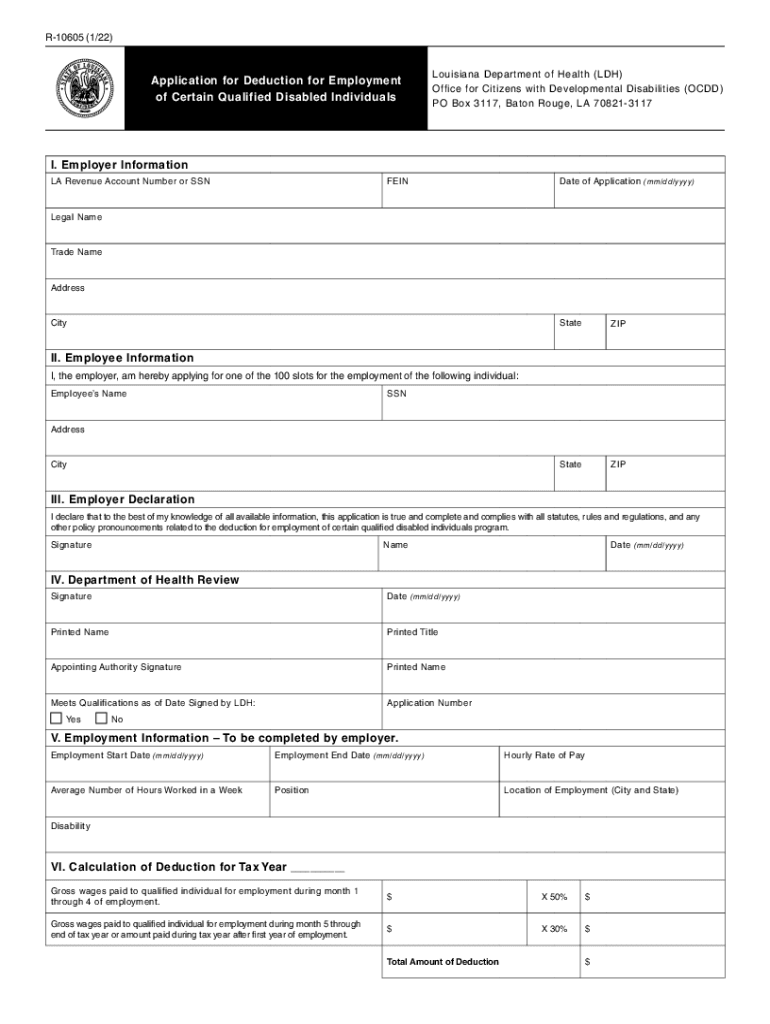







Definition and Purpose of the Form
The Application for Deduction for Employment of Certain Qualified Individuals is a tax-related form specifically designed for employers in Louisiana. This form enables these employers to claim tax deductions when they employ qualified individuals with disabilities. The primary purpose is to incentivize the hiring of individuals with disabilities by providing a financial benefit to the employers, which in turn encourages a more inclusive workforce.
- Tax Benefits: Employers can claim 50% of gross wages for the first four months and 30% thereafter.
- Eligibility: Up to 100 qualified individuals can be included in the deduction claim.
Understanding the specific objectives of this form helps employers to strategically plan their human resources in ways that not only benefit their business operations but also contribute to social welfare.
Steps to Complete the Application Form
Completing the form accurately is essential for ensuring the deduction claim is processed without hitches. Here is a comprehensive guide on how to complete the application:
- Employer Information: Fill in the name, address, and tax identification number of the business.
- Employee Details: List each qualified employee, including their names, social security numbers, and the period of employment under consideration.
- Declaration of Compliance: Affirm adherence to the eligibility criteria and any other legal requirements for employing individuals with disabilities.
- Verification by Louisiana Department of Health: Submit the form for review to ensure it meets all the necessary regulations.
Each of these steps requires attention to detail to avoid errors that can delay or negate the approval of the deduction.
Eligibility Criteria
Eligibility to claim this deduction is defined by certain conditions that both employers and employees must meet. Here are the critical eligibility criteria:
- Employee Qualification: Employees must be certified as having a disability by a recognized authority.
- Business Location: The employer must operate within the state of Louisiana.
- Wages and Duration: The employees' wages and duration of employment must align with the form's prescribed limits.
Understanding these criteria ensures that employers only claim deductions they are entitled to, thus avoiding potential legal challenges or penalties.


Legal Use of the Form
Legal compliance is vital when using this form. The Application for Deduction for Employment of Certain Qualified Individuals must be used strictly for its intended purpose, adhering to both state and federal regulations:
- Documentation: Maintain all supporting documentation that attests to the employee's qualifications and compliance with employment laws.
- State Regulations: Abide by any specific Louisiana laws that govern the employment of individuals with disabilities and tax deductions.
Legal validation of this form is critical for ensuring that the deductions are accepted and not subject to audits or challenges by tax authorities.
Key Elements of the Form
A precise understanding of the form's elements is fundamental for proper completion. Important sections to focus on include:
- Employer and Employee Details: Providing accurate personal and business information.
- Compliance Declaration: Articulate adherence to tax laws concerning the employment of eligible individuals.
- Deductions Calculation: Clearly outline how the deductions have been computed based on employee wages and allowed percentages.
Each of these elements plays a crucial role in the overall authenticity and acceptance of the form by the taxing authority.
Required Documents
Employers must gather and maintain a set of documents to accompany or validate the form:
- Employee Certification: Proof of the employees’ disabilities and their certification from recognized bodies.
- Payroll Records: Detailed payroll records demonstrating the wages paid and employment period.
- Employment Agreements: Contracts or agreements that outline the employment terms.
These documents ensure that the form is not just accurately completed but also verifiable, forming a solid basis for the deductions claimed.
Examples and Real-world Scenarios
Utilizing real-world examples sheds light on practical applications of the form in various business contexts:
- Small Businesses: A small business hiring individuals with disabilities to improve inclusivity can use the form to offset initial training costs against the deductions received.
- Corporate Initiatives: Large corporations implementing diversity initiatives can integrate this form into their financial planning to maximize tax efficiencies.
These scenarios illustrate the functional potential of the form beyond mere compliance, embodying strategic business and social advantages.
Compliance and Penalties for Non-Compliance
Accurate use of the form is not only critical for receiving deductions but also for avoiding penalties:
- Non-Compliance Risks: Incorrect or fraudulent claims can lead to audits, fines, or potential legal action.
- Documentation Requirements: Ensure all records are comprehensive and easily accessible for verification.
Being aware of these compliance requirements and potential penalties prompts businesses to approach this form with due diligence and precision.
Form Submission
Various methods are available for submitting the form, each catering to the operational preferences of different businesses:
- Online Submission: Fast and traceable, suitable for tech-savvy businesses.
- Mail: Traditional and straightforward, allowing for physical document submission.
- In-Person: Direct submission to the appropriate office for businesses preferring personal interaction.
Selection of the appropriate submission method depends on the business's infrastructure and preferred operational processes.


