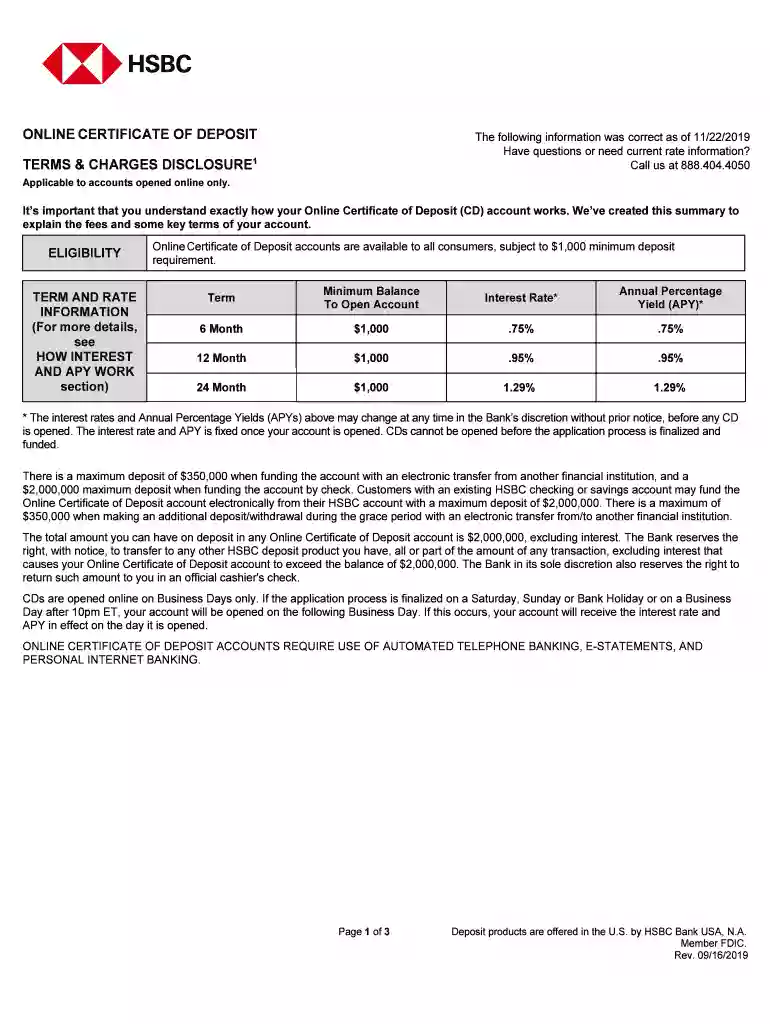
DIRECT CERTIFICATE OF DEPOSIT TERMS & CHARGES DISCLOSURE. DIRECT CERTIFICATE OF DEPOSIT TERMS & CHARGES DISCLOSURE 2026

Get Form
DIRECT CERTIFICATE OF DEPOSIT TERMS & CHARGES DISCLOSURE. DIRECT CERTIFICATE OF DEPOSIT TERMS & CHARGES DISCLOSURE Preview on Page 1

Here's how it works

01. Edit your form online
Type text, add images, blackout confidential details, add comments, highlights and more.

02. Sign it in a few clicks
Draw your signature, type it, upload its image, or use your mobile device as a signature pad.

03. Share your form with others
Send it via email, link, or fax. You can also download it, export it or print it out.

Definition and Meaning

The DIRECT CERTIFICATE OF DEPOSIT TERMS & CHARGES DISCLOSURE is a document provided by financial institutions, primarily used to outline the specific terms, applicable charges, and conditions associated with a Certificate of Deposit (CD) account. This disclosure ensures transparency, allowing potential account holders to understand all the financial implications before committing to a CD. These certificates are fixed-term financial products that typically offer higher interest rates than standard savings accounts in exchange for leaving the deposit untouched for a set duration.

Important Terms Related to DIRECT CERTIFICATE OF DEPOSIT TERMS & CHARGES DISCLOSURE

Understanding the components of the DIRECT CERTIFICATE OF DEPOSIT TERMS & CHARGES DISCLOSURE is critical. Here are key terms you might encounter:

  • Interest Rate: The annual percentage yield you earn on your deposit.
  • Maturity Date: The end of the CD's term when you can withdraw funds without penalties.
  • Early Withdrawal Penalty: Fees incurred if you withdraw funds before the maturity date.
  • Renewal Policy: Options available once the CD reaches its maturity, often including automatic renewal.

Key Elements of the DIRECT CERTIFICATE OF DEPOSIT TERMS & CHARGES DISCLOSURE

The document typically details several core elements to consider:

  • Minimum Deposit Requirements: The minimum amount required to open the CD.
  • Interest Calculation Methods: How interest is compounded and paid.
  • Terms and Tenures Available: Various periods offered, ranging from a few months to several years.
  • Withdrawal Policies: Conditions under which funds can be accessed before maturity.

How to Use the DIRECT CERTIFICATE OF DEPOSIT TERMS & CHARGES DISCLOSURE

Effectively using the disclosure requires careful review and understanding:

  1. Review Terms Thoroughly: Ensure all terms are understood, particularly interest rates and penalties.
  2. Compare Offers: Use the document to compare CDs from different institutions for the best terms.
  3. Clarify Doubts: Contact the issuing bank to clarify any unclear terms or conditions.

How to Obtain the DIRECT CERTIFICATE OF DEPOSIT TERMS & CHARGES DISCLOSURE

To acquire this form, consider these steps:

  • Bank Website: Visit the bank's website and download the document from their CD section.
  • In-Person Request: Visit a local branch and request a printed copy.
  • Customer Service: Call the bank's customer service for assistance in obtaining the disclosure.

Steps to Complete the DIRECT CERTIFICATE OF DEPOSIT TERMS & CHARGES DISCLOSURE

While the document itself does not require completion like an application, here’s how you should engage with it:

  1. Read Carefully: Go through each section to understand obligations and benefits.
  2. Check for Completeness: Ensure no sections are missing, and the document covers all aspects relevant to your decision.
  3. Highlight Concerns: Mark areas needing further clarification before opening the CD.

Legal Use of the DIRECT CERTIFICATE OF DEPOSIT TERMS & CHARGES DISCLOSURE

This disclosure is a legally required document designed to protect consumers:

  • It provides a clear, concise presentation of fees and terms, supporting informed decision-making.
  • Ensures compliance with the Truth in Savings Act, mandating transparency.

Eligibility Criteria

Eligibility to open a CD as detailed in the disclosure may include:

  • Age Requirements: Generally, you must be a legal adult (18 years or older).
  • Residency Status: U.S. residency might be necessary for domestic banks.
  • Initial Deposit Amount: Meeting the minimum deposit threshold is required.
decoration image ratings of Dochub

Application Process and Approval Time

The application process for a CD can often be straightforward, involving:

  1. Application Submission: Fill out the bank’s specific application form, either online or in-person.
  2. Identity Verification: Present required identification documents as specified.
  3. Deposit Funds: Transfer the required opening balance to complete the setup.
  4. Approval Duration: Most approvals are immediate or take a few business days.

See more DIRECT CERTIFICATE OF DEPOSIT TERMS & CHARGES DISCLOSURE. DIRECT CERTIFICATE OF DEPOSIT TERMS & CHARGES DISCLOSURE versions

We've got more versions of the DIRECT CERTIFICATE OF DEPOSIT TERMS & CHARGES DISCLOSURE. DIRECT CERTIFICATE OF DEPOSIT TERMS & CHARGES DISCLOSURE form. Select the right DIRECT CERTIFICATE OF DEPOSIT TERMS & CHARGES DISCLOSURE. DIRECT CERTIFICATE OF DEPOSIT TERMS & CHARGES DISCLOSURE version from the list and start editing it straight away!
Versions Form popularity Fillable & printable
2022 4.4 Satisfied (58 Votes)
2019 4.9 Satisfied (31 Votes)
2012 4 Satisfied (28 Votes)
be ready to get more

Complete this form in 5 minutes or less

Get form

Got questions?

We have answers to the most popular questions from our customers. If you can't find an answer to your question, please contact us.
Contact us
Certificates of Deposit (CDs) typically offer higher interest rates compared to Fixed Deposits (FDs) offered by banks. This is because CDs involve higher risk as an investment option. If you are willing to take on the associated risks, investing in CDs can potentially yield better returns.
Duration: CDs, with a maximum term of 12 months, allow you to invest your money for a brief period of time. On the other hand, FDs provide an excellent range of investment tenures, from shorter 7-day periods to 10-year periods. Minimum Sum: A minimum amount of ₹ 1 lakh must be invested in CDs.
CDs come in varying terms and may require different minimum balances. The most common terms are three months to five years, though they can be as short as a month or as long as 10 years. In general, CD interest rates are driven by the Federal Fund Rate that is set by the Federal Reserve.
Heres how much investing $25,000 in a CD right now could earn you in 1 year Type of 1-year CDTypical APYTotal value of CD with $25,000 opening deposit after 1 year CDs that pay competitive rates 4.25% $26,062 CDs that pay the national average 1.86% $25,465 CDs from big brick-and-mortar banks 0.05% $25,012.50 Mar 3, 2025
Earnings from a $10,000 CD TermTop APYInterest earnings 6 months 4.65% $229.86 1 year 4.45% $445.00 3 years 4.15% $1,297.38 5 years 4.25% $2,313.47 Feb 13, 2025

Security and compliance

At DocHub, your data security is our priority. We follow HIPAA, SOC2, GDPR, and other standards, so you can work on your documents with confidence.

Learn more
ccpa2
pci-dss
gdpr-compliance
hipaa
soc-compliance
be ready to get more

Complete this form in 5 minutes or less

Get form

People also ask

You might want to open a 6-month CD if youre looking for a way to lock in a high interest rate for half a year. ing to the FDIC, the national average CD rate on a 6-month term is 1.61% APY (Annual Percentage Yield), but the best CDs from online banks and credit unions offer much higher rates.
In a financial climate where interest rates are likely to fall, locking in a high-rate, long-term CD can be a smart move. By depositing $10,000 into a CD now, you can take advantage of currently high rates, protect yourself against future rate cuts and enjoy significant returns on a low-risk investment.

Related links