




01. Edit your 2022 schedule 1299 c online
Type text, add images, blackout confidential details, add comments, highlights and more.

Type text, add images, blackout confidential details, add comments, highlights and more.

Draw your signature, type it, upload its image, or use your mobile device as a signature pad.

Send illinois schedule 1299 c via email, link, or fax. You can also download it, export it or print it out.
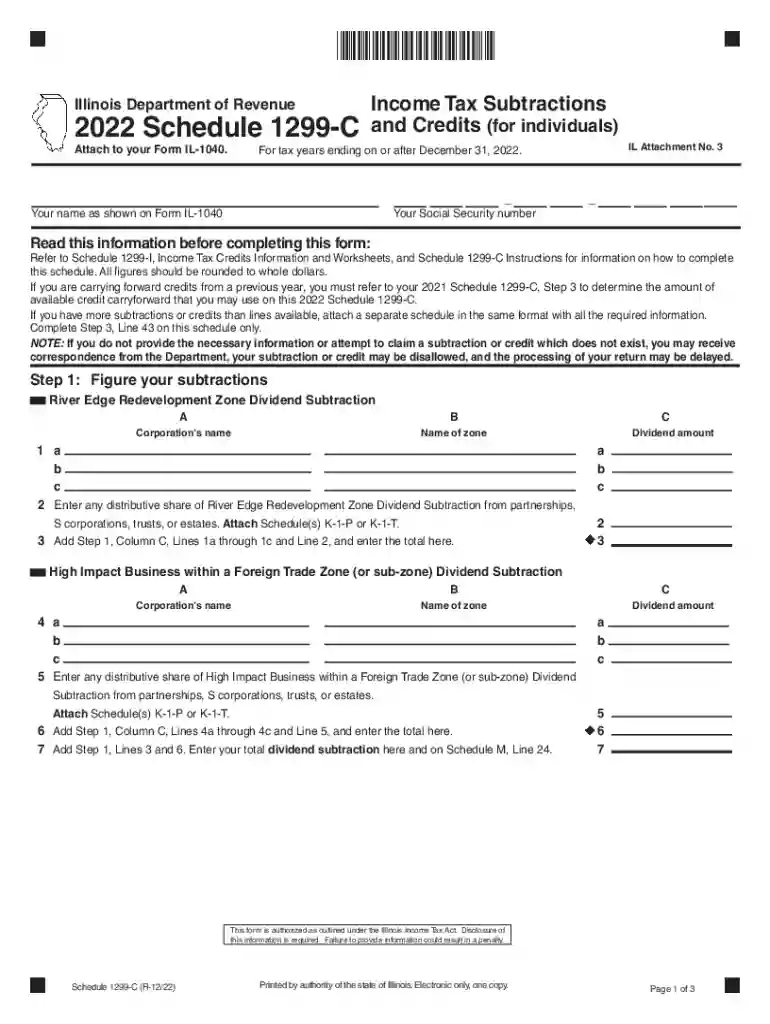
The 2021 Schedule 1299-C is a critical form issued by the Illinois Department of Revenue, designed to assist individuals in claiming allowable income tax subtractions and credits. This form serves numerous purposes, each of which is pivotal to maximizing tax benefits for individuals subject to Illinois state taxation. The form delineates the application of various subtractions such as those related to dividends from specific business zones and sets guidelines for asserting tax credits in areas of research, education, and adoption expenses.
Completing the 2021 Schedule 1299-C involves several structured steps to ensure accurate reporting and maximized tax benefits. Following these steps carefully can also help avoid potential penalties or delays in processing.
Understanding state-specific requirements is essential for the efficient completion of Schedule 1299-C. The Illinois Department of Revenue sets explicit protocols that differ from federal obligations, primarily concerning qualification criteria and documentation standards.
Eligibility for the tax credits and subtractions detailed in the 2021 Schedule 1299-C depends on specific criteria established by the Illinois Department of Revenue. Meeting these criteria is critical to ensuring successful claims.


This form is primarily utilized by individuals and business entities filing income taxes in Illinois. The need for Schedule 1299-C arises when taxpayers meet certain financial transactions or activities that qualify for state-specific subtractions and credits.

For self-employed residents operating within designated enterprise zones, utilizing the 2021 Schedule 1299-C can result in significant tax savings. It allows for income subtractions reflecting business activities that align with state growth policies.
Retired taxpayers who receive dividends from Illinois-based business funds may also qualify for advantageous treatment under income subtraction categories, effectively lowering their taxable income.
Adhering to deadlines is critical when dealing with tax forms. For the 2021 Schedule 1299-C, alignment with the general state tax filing deadline for Illinois, which usually falls on April 15, is imperative.
Failure to accurately complete and submit the Schedule 1299-C may incur penalties and financial repercussions. The Illinois Department of Revenue enforces strict compliance, and inaccuracies could lead to audits or forfeitures of claims.
By attending to the intricacies of the 2021 Schedule 1299-C, Illinois taxpayers can effectively navigate the nuances of state tax law to optimize their financial obligations and secure the benefits intended by legislative tax provisions.
We've got more versions of the 2022 schedule 1299 c form. Select the right 2022 schedule 1299 c version from the list and start editing it straight away!
At DocHub, your data security is our priority. We follow HIPAA, SOC2, GDPR, and other standards, so you can work on your documents with confidence.
If you are carrying forward credits from a previous year, you must refer to your 2021 Schedule 1299-C, Step 3 to determine the amount of available creditRead more
▷. 10c. 11. Subtract line 10c from line 9. This is your adjusted gross income . . . . . . . . . ▷. 11. 12. Standard deduction or itemized deductions (Read more


