
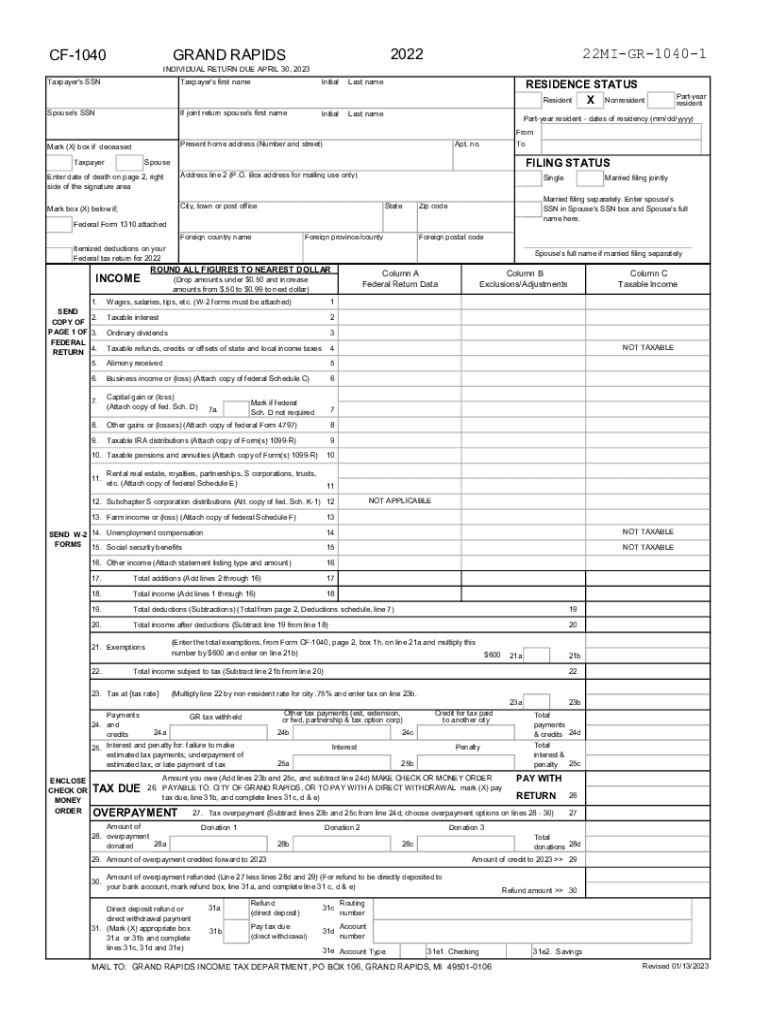







Definition & Meaning
The Grand Rapids income tax form is a crucial document used by non-residents who earned taxable income within the city of Grand Rapids during a specified tax year. This form is designed to report various types of income, including wages, salaries, and other compensation for services performed within the city, as well as business income derived from conducting activities in Grand Rapids. It ensures compliance with local tax regulations and helps the city collect necessary funds to support community services and infrastructure.
How to Use the Form Grand Rapids Income Tax
When using the Grand Rapids income tax form, individuals must accurately report their income earned within the city limits. Begin by gathering all relevant financial documents, such as W-2 forms and other records of income. Enter the reported amounts into the corresponding sections of the form, ensuring accuracy to prevent errors that could trigger an audit. Review guidelines for deductions and credits that may apply to your situation, and apply them accordingly to maximize potential tax benefits.
How to Obtain the Form Grand Rapids Income Tax
To obtain the form, you can visit the official website of the City of Grand Rapids, where downloadable PDF versions are available. Alternatively, printed forms are often distributed at local libraries, post offices, and city government offices. For those who prefer digital solutions, tax preparation software may also include electronic versions of local tax forms, allowing for seamless integration into your overall tax filing process.
Steps to Complete the Form Grand Rapids Income Tax
- Gather Required Documents: Collect W-2s, 1099s, and any other forms indicating income earned in Grand Rapids.
- Fill Out Personal Information: Enter your name, address, and Social Security number as requested on the form.
- Report Income: Accurately list all taxable income received from Grand Rapids sources, referencing W-2 and 1099 forms.
- Calculate Deductions and Credits: Determine eligibility for any deductions or credits, and complete the relevant sections to adjust your taxable income accordingly.
- Review and Sign: Ensure all details are correct, sign the form, and attach any required documentation, such as W-2 forms.
- Submit the Form: Follow instructions for submission, whether online, by mail, or in person, by the stated deadline.
Filing Deadlines / Important Dates
The Grand Rapids income tax form for the 2022 tax year must be filed by May 1, 2023. This deadline coincides with both the city's tax filing deadline and the traditional deadline for filing federal income taxes. It is essential to submit your form on time to avoid late fees and potential penalties. If you anticipate needing more time, consider applying for an extension, keeping in mind that any taxes owed must still be paid by the original deadline to prevent interest charges.
Required Documents
To complete the form, taxpayers will need documents such as:
- W-2 Forms: To verify employment income earned in Grand Rapids.
- 1099 Forms: For independent contractor earnings or other miscellaneous income from within the city.
- Business Records: If applicable, include documentation of income and expenses related to conducting business activities in Grand Rapids.
- Documentation for Deductions/Credits: Any paperwork supporting claims for deductions or credits, such as receipts and tax statements.
Form Submission Methods (Online / Mail / In-Person)
Taxpayers have several options for submitting their completed Grand Rapids income tax form:
- Online: Filing electronically through the city’s official portal provides convenience and quick confirmation of receipt.
- Mail: Postal submission to the address specified on the form instructions, using certified mail for tracking purposes is recommended.
- In-Person: Delivering the completed form to designated drop-off locations within Grand Rapids, such as the city’s tax collection office.
Penalties for Non-Compliance
Failure to comply with filing requirements for the Grand Rapids income tax form can result in several consequences:
- Late Filing Penalties: Additional charges for submissions after the deadline.
- Interest on Unpaid Taxes: Accrued interest on any unpaid tax amounts from the original due date until full payment is made.
- Legal Action: Persistent non-compliance may lead to legal action, including potential wage garnishment or liens on property.


