







Definition and Purpose of the Petition for Probate Appointment
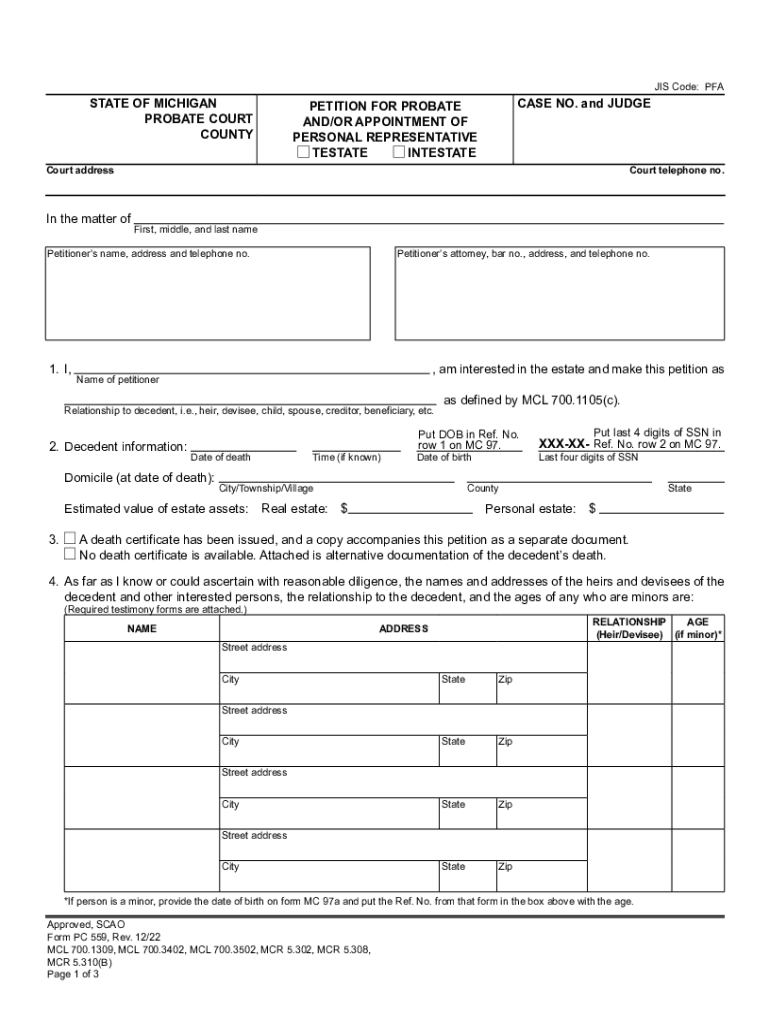
The "Petition for Probate and/or Appointment of Personal Representative" in Michigan serves a critical role within the state's probate court system. This form is used to initiate the probate process, which is necessary to legally validate a deceased individual's will or manage the distribution of their estate if no will exists. The key function of this petition is to formally appoint a personal representative who is responsible for administering the estate. The petition must outline essential details about the decedent, such as the date of death, domicile, and the estimated value of the estate. This formal request sets in motion the legal proceedings necessary for estate management.
Steps to Complete the Petition for Probate Appointment
Completing the "Petition for Probate and/or Appointment of Personal Representative" involves several important steps, beginning with gathering all necessary information regarding the decedent's estate. Here is a detailed outline of the process:
- Collect Decedent Information: Gather details such as the full name, date of death, domicile, and the approximate value of the estate.
- Identify Heirs and Beneficiaries: List all known heirs, beneficiaries, and anyone with a legal claim, including their relationship to the decedent.
- Review Legal Documentation: Confirm the presence and validity of the decedent’s will and any other legal documents affecting the estate.
- Complete the Petition Form: Carefully fill out each section of the form, ensuring all fields are accurately completed.
- Attach Required Documents: Provide supporting documentation, such as a copy of the will, death certificate, and any other relevant legal papers.
- Submit the Petition: File the form with the appropriate Michigan probate court, either in person, by mail, or online if available.
How to Obtain the Petition for Probate Appointment Form
Obtaining the "Petition for Probate and/or Appointment of Personal Representative" form is a straightforward process. Here are the most effective methods:
- Michigan Probate Court Website: Access the form by visiting the official website of the Michigan Probate Court, where downloadable versions are typically provided.
- In-Person Request: Visit your local probate court to request a physical copy of the form. Court clerks can offer guidance on obtaining and submitting the form.
- Legal Assistance: Attorneys specializing in estate law can provide the form and assist in its completion, ensuring compliance with all legal requirements.
Important Terms Related to the Petition for Probate Appointment
Navigating the probate process involves understanding several key terms:
- Decedent: The person who has passed away, whose estate is subject to administration.
- Estate: The totality of a person's assets, properties, and debts at the time of their death.
- Personal Representative: An individual appointed to manage the estate, either named in the will or appointed by the court if no will exists.
- Probate Court: A judicial body that oversees the validation of wills, distribution of estates, and related legal processes.
- Heir: An individual legally entitled to inherit assets from the decedent's estate, typically based on familial relationships.
Legal Use of the Petition for Probate Appointment
Legal utilization of the "Petition for Probate and/or Appointment of Personal Representative" involves adhering to specific legal standards and processes:
- Court Jurisdiction: The petition is filed under the jurisdiction of Michigan's probate court. Each county has its own court managing local cases.
- Adherence to Deadlines: Timely filing of the petition is crucial to avoid delays in estate proceedings. The process should commence shortly after the decedent’s death.
- Compliance with State Laws: The petition and subsequent estate management must comply with Michigan probate laws, including rules on estate taxation, creditor claims, and distribution of assets.
Who Typically Uses the Petition for Probate Appointment
The primary users of this petition include:
- Surviving Family Members: Often the next of kin, such as a spouse or adult children, who seek to manage the decedent’s estate.
- Designated Executors: Individuals specifically named in the will to act as the estate's personal representative.
- Legal Professionals: Attorneys acting on behalf of the estate or family, especially in cases involving complex or contested estates.


Key Elements of the Petition for Probate Appointment
This petition includes several fundamental components that must be accurately completed for processing:
- Petitioner Information: Contact details and role of the individual submitting the petition.
- Decedent Details: Comprehensive information about the deceased, including date and place of death.
- Estate Valuation: An estimate of the total value of the decedent’s assets and liabilities.
- Heirs and Beneficiaries: A list of potential heirs and any known beneficiaries mentioned in existing wills or trusts.
- Will Verification: Documentation confirming the existence and legitimacy of the decedent's will, if applicable.
State-Specific Rules for the Petition for Probate Appointment
The Michigan probate process encompasses specific legal guidelines and requirements distinct to the state:
- Residency Requirements: The decedent must have been a resident of Michigan or owned property in the state for the petition to apply.
- Supervised vs. Unsupervised Administration: Michigan may allow for supervised or unsupervised administration of estates, impacting the degree of court involvement.
- Document Filing Fees: The submission of the petition often incurs a filing fee, which varies by county and is necessary to initiate the court process.
Examples of Using the Petition for Probate Appointment
Practical scenarios illustrate the use of this petition:
- Scenario 1: After a parent’s passing, the eldest child uses the petition to probate the will and distribute assets according to the decedent's wishes.
- Scenario 2: In the absence of a will, siblings file the petition to appoint a neutral attorney as the estate's personal representative, ensuring fair asset distribution.
By understanding these aspects of the "Petition for Probate and/or Appointment of Personal Representative," individuals can navigate the probate process with greater clarity and confidence, ensuring that the decedent's estate is administered in accordance with Michigan law.




