




01. Edit your form 8288 online
Type text, add images, blackout confidential details, add comments, highlights and more.

Type text, add images, blackout confidential details, add comments, highlights and more.

Draw your signature, type it, upload its image, or use your mobile device as a signature pad.

Send 8288 form via email, link, or fax. You can also download it, export it or print it out.
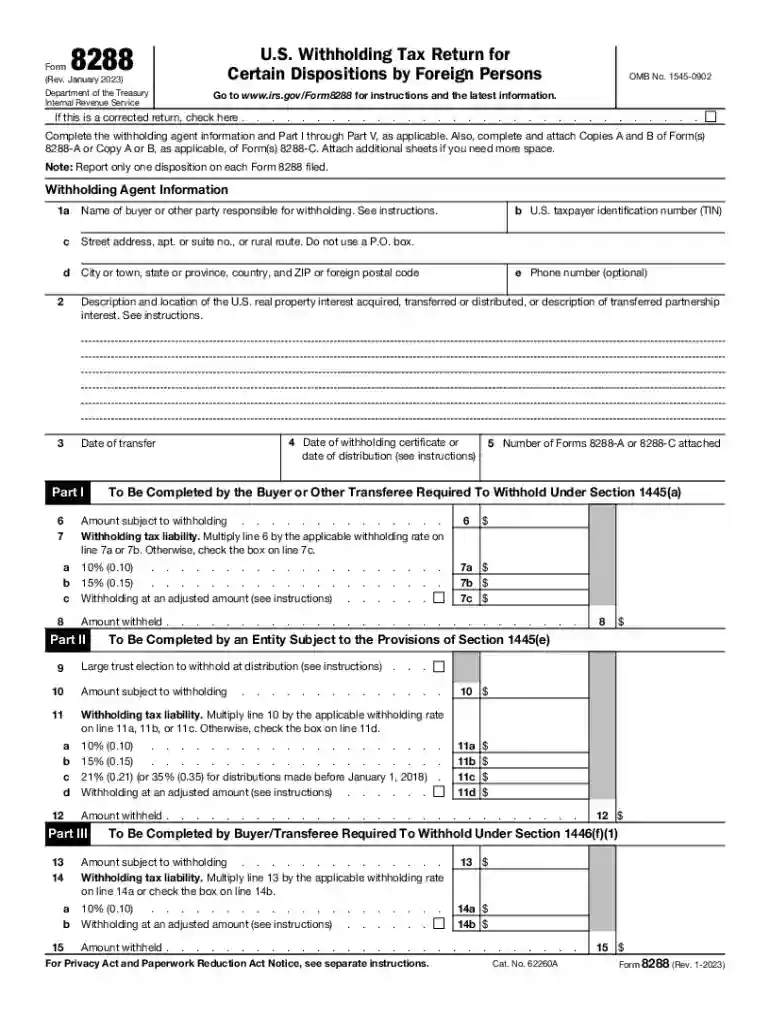
IRS Form 8288, known as the U.S. Withholding Tax Return for Dispositions by Foreign Persons, is used to report the withholding tax obligation for the disposal of U.S. real property interests by foreign persons or entities. This form is crucial in ensuring compliance with the requirements under the Foreign Investment in Real Property Tax Act (FIRPTA). The form primarily documents the details of the property disposition and the associated withholding taxes that the transferee is obligated to withhold and remit to the IRS.
FIRPTA mandates that the buyer of a U.S. real estate interest from a foreign person must withhold tax to ensure that the IRS receives tax dues related to the transaction. IRS Form 8288 facilitates this by providing a structured means to report and remit those amounts. Compliance is vital as non-compliance can lead to significant penal actions.
The form is typically used by buyers, transferees, or agents involved in the acquisition of U.S. real estate interests from foreign sellers. It is not filed by the foreign transferor but rather by the person responsible for withholding the tax, often the buyer or their agent, who ensures the IRS receives the applicable tax. This responsibility underscores the importance of understanding one's role in the transaction to avoid compliance issues.
The withholding agent must calculate the appropriate withholding amount—typically fifteen percent of the sales price—and ensure timely submission to the IRS. They must accurately complete Form 8288, covering details like the transferee’s information, property details, and calculations of the withholding tax.
Form 8288 must be submitted to the IRS within twenty days of the date of the transfer of property. This tight timeline requires prompt action following the transaction. Filing deadlines are critical, as missing them could result in penalties and interests charges accruing on the taxes that should originally have been withheld.
To adhere to these timelines, it is advisable that withholding agents prepare documents in advance, where foreseeable, and maintain an organized checklist to gather the required information promptly.
Form 8288 consists of several sections that must be completed with accuracy. These include:
Certain exceptions allow for reduced withholding, such as obtaining a withholding certificate or small amount transactions—care should be taken to explore these possibilities when applicable.
While IRS Form 8288 is specific to certain transactions under FIRPTA, alternative forms or certificates may apply if exemptions or reductions from withholding tax are requested or approved. Understanding these alternatives ensures compliance with IRS requirements while potentially benefiting from reduced tax withholding.
To qualify for reduced withholding, apply for a withholding certificate through IRS Form 8288-B. This process involves proving that a reduced tax obligation is appropriate for the transaction.
Failure to file IRS Form 8288 or to remit the proper withholding amount can result in severe penalties, including fines and interest charges on the unremitted taxes. The IRS holds the withholding agent accountable, thus highlighting the importance of compliance with all FIRPTA requirements to avoid financial and legal repercussions.
For any potential compliance issues, seeking advice from a tax professional or legal advisor can mitigate risks and ensure accurate and timely fulfillment of obligations when using IRS Form 8288.
We've got more versions of the form 8288 form. Select the right form 8288 version from the list and start editing it straight away!
At DocHub, your data security is our priority. We follow HIPAA, SOC2, GDPR, and other standards, so you can work on your documents with confidence.


