
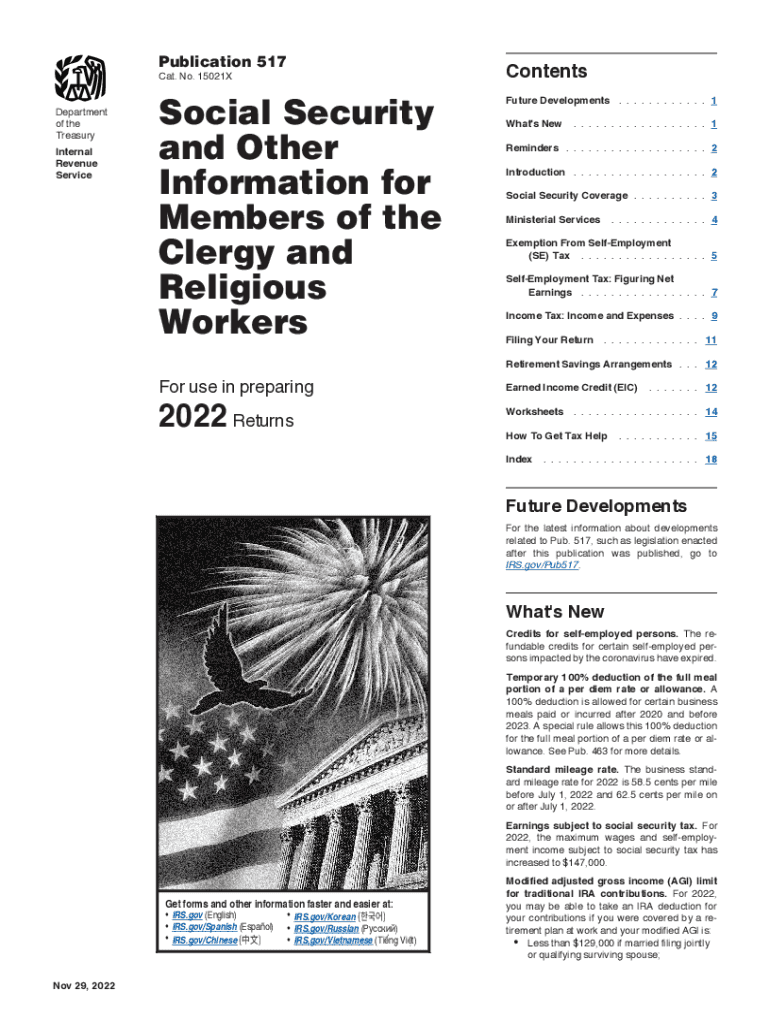







Definition and Importance of Publication 517
Publication 517, Social Security and Other Information for Members of the Clergy and Religious Workers, is a crucial document that provides comprehensive guidance on Social Security and tax responsibilities relevant to religious figures. This publication offers detailed explanations on how clergy members should handle income reports, taxes, and related exemptions. Key topics include FICA (Federal Insurance Contributions Act) and SECA (Self-Employment Contributions Act) coverage, retirement plan contributions, and more. Understanding these domains ensures compliance and optimal tax management for religious professionals.
Specific Provisions Covered
- Self-Employment Tax Exemption: Details about the conditions under which clergy can opt out of self-employment tax, focusing on conscientious objections grounded in religious beliefs.
- Housing Allowance: Instructions on reporting the parsonage or housing allowance. It also addresses its qualifications for a tax-free status, touching upon fair rental value considerations.
Steps to Access Publication 517
Accessibility to Publication 517 can be straightforward. It is readily accessible via the IRS website and many official online tax preparation interfaces such as TurboTax and QuickBooks.
Obtaining the Document
- Visit the IRS Website: It can be downloaded in PDF format directly from the official IRS site.
- Third-Party Tax Software: Use platforms like QuickBooks or TurboTax, which offer integrated access to IRS documents.
- Tax Professional Consultation: Obtain through professionals who often possess specialized versions and additional resources.
Key Elements Addressed by Publication 517
Publication 517 elaborates on several essential tax-related elements specific to the clergy and religious workers:
- Income Reporting: Guidance on reporting various forms of income, including wages, offerings, and fees received for services such as marriages, christenings, and funerals.
- FICA and SECA Coverage: Detailed information on contributions towards FICA and SECA, including any qualifying exemptions.
- Retirement Planning: Provisions for retirement savings plans tailored for clergy, highlighting tax advantages.
- Filing Obligations: Explanation of filing requirements depending on income and occupational designation.
Legal Use and Compliance with Publication 517
Ensuring the proper legal use of Publication 517 is vital for compliance in matters concerning Social Security and taxation. Missteps could result in significant penalties, so it is imperative to follow IRS guidelines meticulously.
IRS Guidelines
- Accurate Income Reporting: Ensures all substantial income is reported correctly to avoid underreporting.
- Exemption Verification: Double-check exemption qualifications to maintain compliance with IRS standards.
Clergy and Religious Workers: Eligibility and Users of Publication 517
Publication 517 targets clerically ordained members, elders, ministers, rabbis, priests, and other religious functionaries who earn income through religious services.
Common User Scenarios
- Self-Employed Clergy: Understanding self-employment tax responsibilities and exploration of potential exemptions.
- Employed by a Congregation: Guidance on handling W-2 forms and determining taxable income related to congregation compensation.
Digital vs. Paper Version of Publication 517
Choosing between the digital and physical copy of Publication 517 depends on individual preferences and needs.
Advantages of Digital Version
- Immediate Access: Quickly accessible from the IRS or related websites.
- Search Functionality: Easier navigation through interactive Table of Contents and keyword search options.
Paper Version Usage
- Traditional Preference: Some users prefer tangible copies for annotations or easy offline reference.
- Reduced Eye Strain: For extended reading and reviewing, a paper format can be more comfortable.
Filing and Submission Methods
Different methods cater to the filing and submission of relevant information as guided by Publication 517.
Submission Options
- Online: The IRS website, supported by tools like DocHub, provides options for electronic submissions.
- Mail-In: Traditional mail submission for those who prefer or require paper filing.
- In-Person: Certain cases might necessitate or allow for direct IRS center submissions, although less common with modern digital solutions.
Common Tax Scenarios Addressed in Publication 517
Publication 517 outlines several specific scenarios clergy may face, enhancing its practical application.
Examples and Nuances
- Part-Time Clergy: Includes those working another job and highlights dual tax obligations.
- Retired Clergy: Offers insights on Social Security benefit processing while maintaining transparency on any earned ministry income.
Variability by Religious Denomination
Special considerations and varying practices based on denominational differences are subtly handled to accommodate a broad array of religious entities.
By providing insights into Publication 517, members of the clergy and religious workers can exercise informed judgment in managing their tax and Social Security obligations. This ensures compliance, maximizes lawful exemptions, and facilitates better personal financial management for those in religious vocations.




