




01. Edit your 1099a to pay bills online
Type text, add images, blackout confidential details, add comments, highlights and more.

Type text, add images, blackout confidential details, add comments, highlights and more.

Draw your signature, type it, upload its image, or use your mobile device as a signature pad.

Send 1099a via email, link, or fax. You can also download it, export it or print it out.
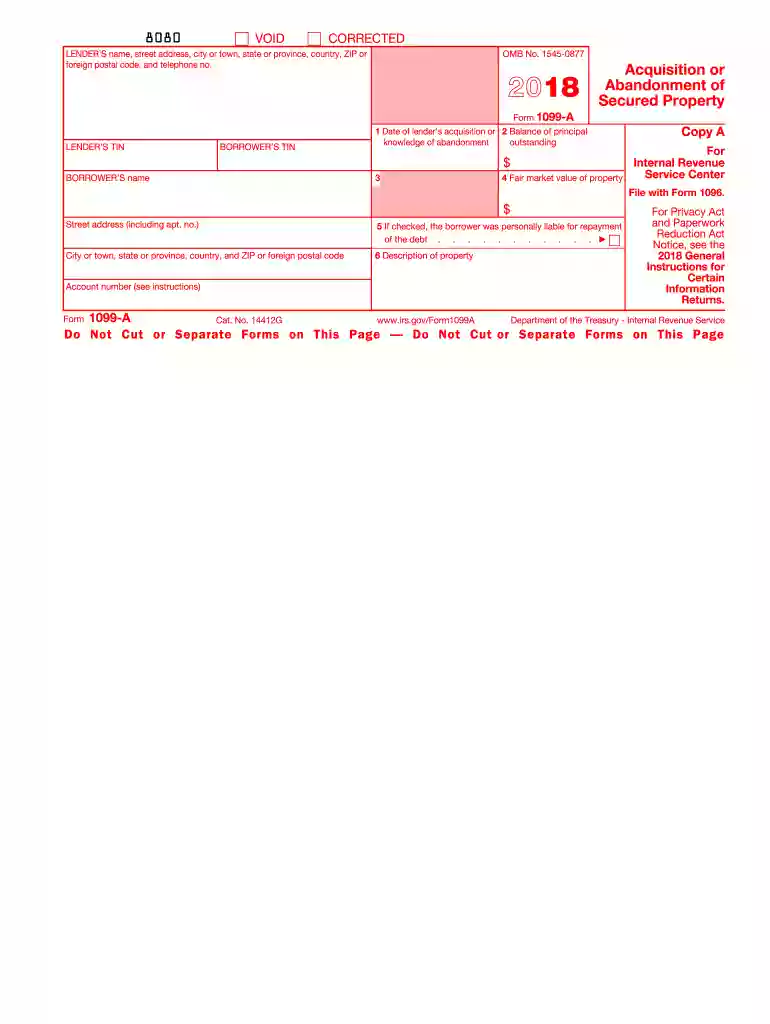
Form 1099-A, specifically the 2018 version, is utilized to report the acquisition or abandonment of secured property. It is primarily issued by lenders when property ownership is transferred due to foreclosure or foreclosure processes are completed. The "A" in the form title refers to "Acquisition or Abandonment," indicating the nature of the transactions it reports. This form is vital for documenting property transactions where ownership changes hands, typically involving significant financial implications for both borrower and lender.
When using Form 1099-A, it is crucial for both lenders and borrowers to understand their respective responsibilities. Lenders must accurately report information such as the outstanding balance on the loan at the time of acquisition or abandonment, as well as the fair market value of the property involved. Borrowers use the information on this form to calculate any gain or loss from the transfer of the property, which must then be reported on their tax returns. This helps prevent discrepancies that could lead to audits or penalties.
Identify Information: Gather relevant details about the loan and property. This includes the borrower's identification and the property's address.
Section Completion: Fill in each required section accurately. For the lender, this involves specifying the date of the lender's acquisition, the balance of principal outstanding, and the property's fair market value.
Verification: Double-check all entered information for accuracy, ensuring it matches internal records and loan agreements.
Distribution: Provide copies of the completed form to the IRS, the borrower, and retain a copy for the lender's records.
Record Submission: File the form according to IRS guidelines, ensuring it meets all deadline requirements for timely submission.
The primary need for Form 1099-A arises from its legal requirement in documenting property transactions involving foreclosure or abandonment. This form ensures transparency and compliance with tax regulations by providing a clear record of the change in ownership. For lenders, it serves as a critical document for tax fulfillment, while for borrowers, it helps calculate potential taxable gains or losses related to their property, which is essential for correct tax reporting.
Typically, lenders such as banks or financial institutions, as well as borrowers involved in foreclosure or property abandonment, use Form 1099-A. Lenders use it to notify the IRS and the borrower about the transaction details, while borrowers use the information from the form to complete their tax returns. Both parties must understand and fulfill their obligations to ensure compliance and avoid any legal repercussions.


The IRS provides specific guidelines regarding the completion and filing of Form 1099-A. It mandates the accurate reflection of transaction details like outstanding loan balances and property values. These guidelines also detail the deadlines for submission and the importance of timely delivery to all parties involved. Adhering to these rules is crucial to avoid penalties, which can have significant financial implications for lenders.
The IRS requires that Form 1099-A be filed with them and sent to the borrower by January 31 of the year following the calendar year of the reportable transaction. Timely filing avoids potential penalties for non-compliance, and being aware of these deadlines helps both lenders and borrowers to prepare adequately for their tax filing responsibilities.
Failing to comply with the requirements for Form 1099-A can result in penalties. For lenders, failing to file the form, filing inaccurately, or missing filing deadlines can incur fines. These penalties increase if the failure is due to intentional disregard of the filing requirements. Therefore, accurate and timely submission of Form 1099-A is critical to avoid such financial repercussions.
We've got more versions of the 1099a to pay bills form. Select the right 1099a to pay bills version from the list and start editing it straight away!
| Versions | Form popularity | Fillable & printable |
|---|---|---|
| 2022 | 4.5 Satisfied (31 Votes) | |
| 2021 | 4.7 Satisfied (87 Votes) | |
| 2020 | 4.1 Satisfied (64 Votes) | |
| 2019 | 4.4 Satisfied (101 Votes) | |
| 2018 | 4.2 Satisfied (98 Votes) | |
| 2017 | 4.4 Satisfied (745 Votes) | |
| 2016 | 4.4 Satisfied (574 Votes) | |
| 2015 | 4.4 Satisfied (46 Votes) | |
| 2014 | 4 Satisfied (33 Votes) | |
| 2013 | 4.2 Satisfied (36 Votes) | |
| 2012 | 4.2 Satisfied (69 Votes) | |
| 2011 | 4 Satisfied (50 Votes) | |
| 2010 | 4 Satisfied (54 Votes) | |
| 2008 | 4 Satisfied (35 Votes) | |
| 2007 | 3.9 Satisfied (52 Votes) |
At DocHub, your data security is our priority. We follow HIPAA, SOC2, GDPR, and other standards, so you can work on your documents with confidence.
Such system shall (1) allow covered beneficiaries to elect to enroll in a health care plan, or modify a previous election, from eligible health care plansRead more
Form 1099-DIV (dividends, including those from stocks or mutual funds). Form 1099-MISC (various types of income, prizes, awards, or gross 10-2018).
To complete Form 1099-A, use: the 2018 General Instructions for Certain Information. Returns, and. the 2018 Instructions for Forms 1099-A and 1099-C.Read more


